If your payroll still runs on the old formula, three things are probably wrong: it deducts a Consolidated Relief Allowance that no longer exists, it uses the pre-2026 tax bands, and it deducts the National Housing Fund from everyone. The Nigeria Tax Act 2025 and the Nigeria Tax Administration Act 2025 took effect on 1 January 2026, and this checklist walks through what to change and how to prove the change worked.
It is written for an employer or payroll officer who has about an hour. Work down it in order, tick each line, and keep a copy for your audit file. For the monthly routine itself, see how to run payroll step by step.
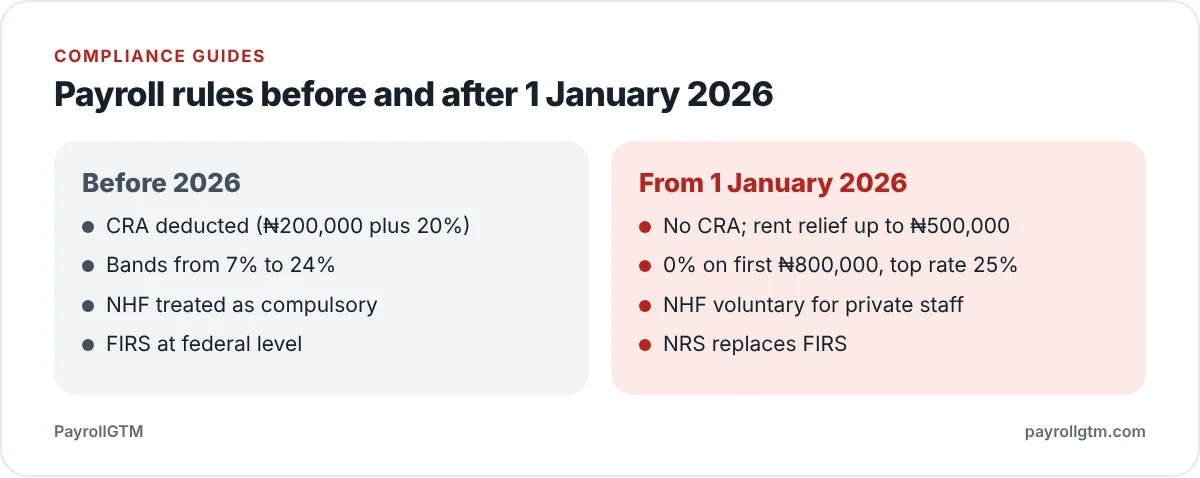
What changed, in one table
| Item | Before 2026 | From 1 January 2026 |
|---|---|---|
| PAYE bands | 7% to 24% | 0% on the first ₦800,000, then 15%, 18%, 21%, 23% and 25% |
| Relief | CRA (₦200,000 plus 20%) | No CRA. Rent relief of 20% of rent paid, capped at ₦500,000, with evidence |
| Tax authority at federal level | FIRS | Nigeria Revenue Service (NRS, formerly FIRS) |
| Who collects employee PAYE | State IRS | State IRS of the employee's state of residence (check your own state) |
| NHF for private staff | Treated as compulsory | Voluntary, deduct only if the employee opts in |
| Annual return of emoluments | Annual returns under the previous law | Due 31 January for the previous year (NTAA s.14) |
Checklist 1: the tax engine
- Remove CRA from your sheet or software. Search for any cell, rule or setting called "CRA", "relief" or "200,000". If it is still being subtracted, every PAYE figure is too low, which is the more dangerous direction. Our note on how rent relief replaced the CRA explains the change.
- Load the new bands. Annual chargeable income is taxed at 0% on the first ₦800,000, 15% on the next ₦2,200,000, 18% on the next ₦9,000,000, 21% on the next ₦13,000,000, 23% on the next ₦25,000,000 and 25% above ₦50,000,000.
- Calculate chargeable income correctly. Gross pay for the year, minus employee pension (8% of basic, housing and transport), minus NHF if the employee has opted in, minus any evidenced rent relief or other deduction.
- Divide annual tax by 12 for the monthly deduction.
- Apply rent relief only with evidence. A tenancy agreement and rent receipts, kept on the employee's file. See how employees claim rent relief.
Checklist 2: re-test three salaries
Do not trust a changed setting until the output matches a known-good figure. Pick one low, one middle and one high salary from your payroll, run them through your system, and compare with the figures below. We produced these with our own PAYE calculation module using the 2026 bands.
| Test case | Pension 8% | Monthly PAYE | Net pay |
|---|---|---|---|
| ₦90,000 gross, all pensionable | ₦7,200 | ₦2,420 | ₦80,380 |
| ₦350,000 gross (basic ₦200,000, housing ₦80,000, transport ₦40,000) | ₦25,600 | ₦40,892 | ₦283,508 |
| ₦350,000 as above, with ₦1,200,000 annual rent paid and evidenced | ₦25,600 | ₦37,292 | ₦287,108 |
| ₦1,200,000 gross, all pensionable | ₦96,000 | ₦184,340 | ₦919,660 |
If a figure differs by even ₦100, find out why. The usual causes are the pension base (whole gross against basic, housing and transport only), rounding done per month instead of per year, or a leftover relief. The net to gross guide matters here if you quote salaries to candidates as take-home figures, because every one of those quotes changed.
Checklist 3: pension, NHF and levies
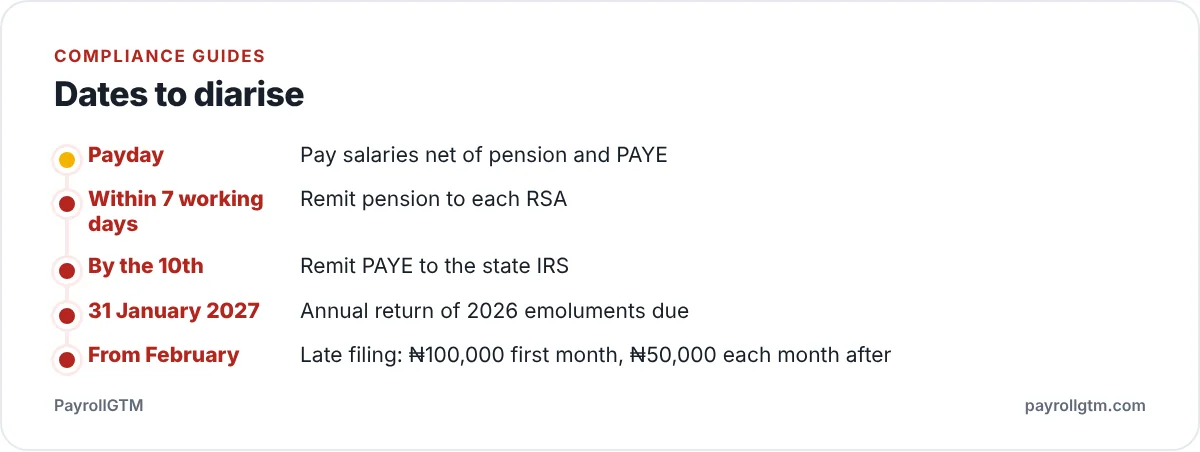
- Pension is unchanged: 8% employee, 10% employer, on at least basic, housing and transport, remitted within 7 working days of paying salaries. It still applies to employers with 3 or more employees.
- NHF: stop deducting 2.5% of basic from private-sector staff who have not opted in. Keep the opt-in on file if they have. The position on refunds for earlier opt-outs is unclear, so say so to staff who ask, as explained in the guide to voluntary NHF.
- NSITF and ITF: the 1% levies did not change. NSITF is 1% of total monthly payroll paid by the employer. ITF is 1% of annual payroll for employers with 5 or more employees, or turnover of ₦50 million or more. Details are in the NSITF guide and the ITF guide.
Checklist 4: registration, IDs and returns
- Tax ID. Every taxable person needs one. The NRS has reported a single unified Tax ID system with the Joint Revenue Board, with NIN reported as the individual's Tax ID and the CAC RC number for businesses. Check the current NRS notice for the steps before you collect staff details. See Tax ID and NIN for employees.
- Monthly PAYE remittance by the 10th of the following month, to the state IRS where the employee resides. Confirm the date with your state IRS.
- Annual return. Under NTAA s.14, the return of employees' emoluments is due on 31 January for the preceding year. The first return under the new regime covers 2026 and falls due on 31 January 2027, so start collecting data now. Employees must also file their own returns. Late filing carries a penalty of ₦100,000 for the first month and ₦50,000 for each month after (NTAA s.96).
- Administrative assessment. If you do not file, NTAA s.34 lets the authority assess you from the records it has.
Where old templates quietly break
- Hard-coded bands. A spreadsheet with the 7% to 24% bands typed into a formula will not warn you. Search every sheet in the workbook, not only the one you use each month.
- Software that was never updated. If you use an installed tool, check its version date and ask the vendor in writing whether it carries the 2026 bands and removes CRA. Do not assume an automatic update happened.
- Offer letters and contracts. A letter that promises "₦300,000 net" was priced under the old formula. Under the new rules the gross needed for that net figure is different, so recalculate before the next hire.
- Staff earning at or below the minimum wage. Employees on ₦70,000 a month or less are exempt from PAYE. Check that nobody in that group is still being taxed.
- The H1 data file. If you only record monthly totals, you will struggle at 31 January. Keep per-employee gross, pension, NHF and PAYE for every month.
An hour spent on these five points is cheaper than a state IRS letter. If your records already show a wrong method for earlier months, the penalty exposure depends on how the authority treats voluntary correction, which we cannot confirm here. Ask your state IRS before filing amended figures.
What to tell your staff
Send one short note before the next payslip, not after. Say that PAYE is now calculated on the 2026 bands, that CRA has gone, that rent relief is available if they send tenancy documents, and that NHF is now voluntary for them. Add a date for the rent-evidence deadline. A message like this prevents a rash of "why did my tax go up" queries, because for some staff it did go up and for many it went down.
Corrections for months already run under the old method are a separate job, described in back pay and payroll corrections. To see how the changes look for a typical payroll team, read common payroll mistakes of Nigerian SMEs, and keep your three test results with the policy note in case of a visit from the state IRS.