A monthly payroll in Nigeria has ten steps: collect the month's changes, work out gross pay, deduct pension and PAYE, deduct anything else lawful, confirm net pay, get approval, pay salaries, remit PAYE by the 10th of the following month, remit pension within 7 working days of paying salaries, and file the evidence. Skip any one of them and you will notice it later, usually in a letter.
This guide follows the order we would run it in, with a three-person payroll worked through from start to finish so you can see the figures that come out of each step. Dates for the deadlines are the ones used in the sources we rely on, and your state IRS can confirm any local difference.
Steps 1 and 2: Collect the changes and work out gross pay
Step 1, collect the month's changes. Payroll errors start with missing information, not bad arithmetic. Pick a cut-off date (the 20th is common) and collect, in writing, everything that changes pay for the month: new starters with their bank details and start dates, leavers with last working days, unpaid leave, approved overtime, new loans or advances, allowance changes and any promotion letters. Anything that arrives after the cut-off goes into next month unless it is urgent and approved. The detail is in payroll cut-off dates and pay schedules. Common misses are a leaver whose last day was never communicated, a promotion approved verbally and a bank account change sent by text message. Insist on written notice for each, and verify bank detail changes by calling the employee on a number you already hold.
Keep the change list as a single sheet. Next month you can compare the two sheets and see which employees' pay moved and why.
Step 2, gross pay for each person. Start with the contracted monthly gross split into basic, housing, transport and other allowances. Then add overtime, commission or bonuses approved for the month and subtract unpaid absence. For a part month, prorate as set out in the contract; the split matters because it sets the pension base.
In our worked payroll the employer has three staff: Kemi (₦180,000 gross), Obinna (₦450,000) and Zainab (₦900,000). The splits are below.
| Employee | Basic | Housing | Transport | Other | Gross | Pensionable (basic + housing + transport) |
|---|---|---|---|---|---|---|
| Kemi | ₦100,000 | ₦40,000 | ₦20,000 | ₦20,000 | ₦180,000 | ₦160,000 |
| Obinna | ₦250,000 | ₦100,000 | ₦50,000 | ₦50,000 | ₦450,000 | ₦400,000 |
| Zainab | ₦500,000 | ₦200,000 | ₦100,000 | ₦100,000 | ₦900,000 | ₦800,000 |
Step 3: Apply the statutory deductions
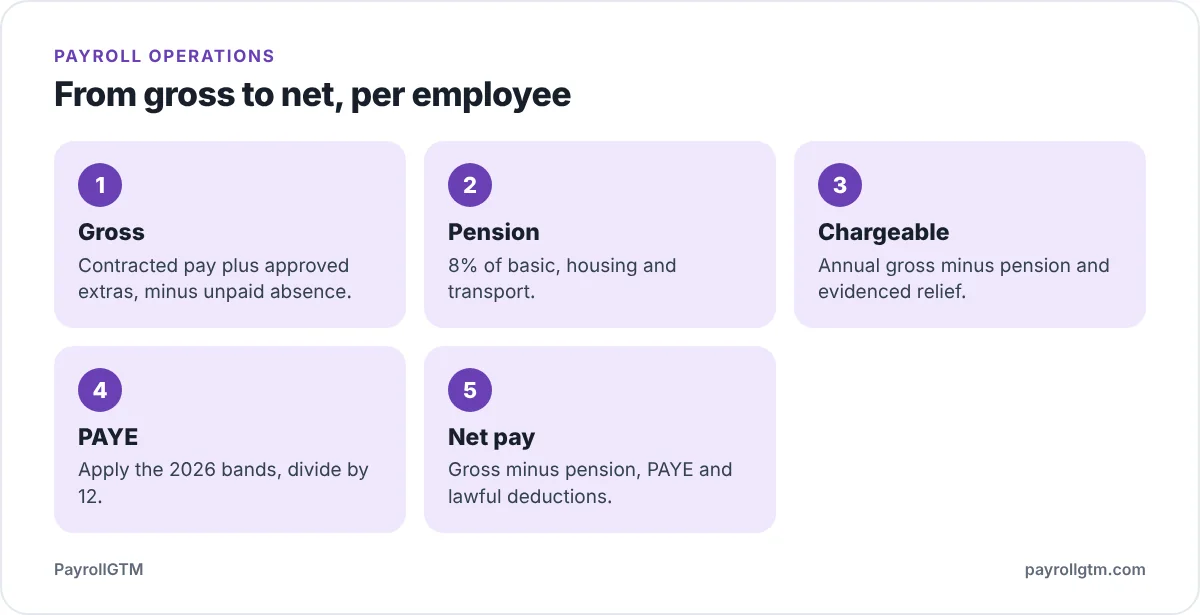
Two deductions are mandatory for most employees. The first is the employee's pension contribution, which is 8% of basic, housing and transport. The second is PAYE, worked out after pension and any evidenced relief.
For PAYE, take annual gross, subtract the employee's pension for the year, subtract rent relief if the employee has provided evidence (20% of rent paid, capped at ₦500,000) and NHF only if the employee has opted in. Then apply the 2026 bands and divide by 12. The method is explained in full in the PAYE calculation guide.
- Kemi: pension 8% of ₦160,000 = ₦12,800. Chargeable income: (₦180,000 minus ₦12,800) x 12 = ₦2,006,400. PAYE: 15% of (₦2,006,400 minus ₦800,000) = ₦180,960 a year, or ₦15,080 a month.
- Obinna: pension 8% of ₦400,000 = ₦32,000. He pays ₦1,500,000 a year in rent with receipts, so rent relief is 20% = ₦300,000. Chargeable income: (₦450,000 minus ₦32,000) x 12 minus ₦300,000 = ₦4,716,000. PAYE ₦638,880 a year, or ₦53,240 a month.
- Zainab: pension 8% of ₦800,000 = ₦64,000. Chargeable income: (₦900,000 minus ₦64,000) x 12 = ₦10,032,000. PAYE ₦1,595,760 a year, or ₦132,980 a month.
Do not do this arithmetic by hand every month. Build the formula once, test it against known results, and use the payroll calculator as a check. If you changed templates this year, re-test them against known figures first.
Steps 4 and 5: Other deductions, net pay and the checks
Step 4, other deductions, but only lawful ones. Salary advances the employee asked for, loan repayments they agreed to in writing, union dues where the employee has authorised them and any court-ordered deductions can come off. Disciplinary fines, deductions for cash shortages and charges for uniforms are legally risky, because the Labour Act restricts what an employer may deduct from wages. Read wage payment and lawful deductions before you add a deduction that is not statutory. Keep a signed authority for each one.
Step 5, net pay. Net pay is gross minus pension minus PAYE minus other lawful deductions. For our three employees:
| Employee | Gross | Pension 8% | PAYE | Net pay | Employer pension 10% |
|---|---|---|---|---|---|
| Kemi | ₦180,000 | ₦12,800 | ₦15,080 | ₦152,120 | ₦16,000 |
| Obinna | ₦450,000 | ₦32,000 | ₦53,240 | ₦364,760 | ₦40,000 |
| Zainab | ₦900,000 | ₦64,000 | ₦132,980 | ₦703,020 | ₦80,000 |
| Total | ₦1,530,000 | ₦108,800 | ₦201,300 | ₦1,219,900 | ₦136,000 |
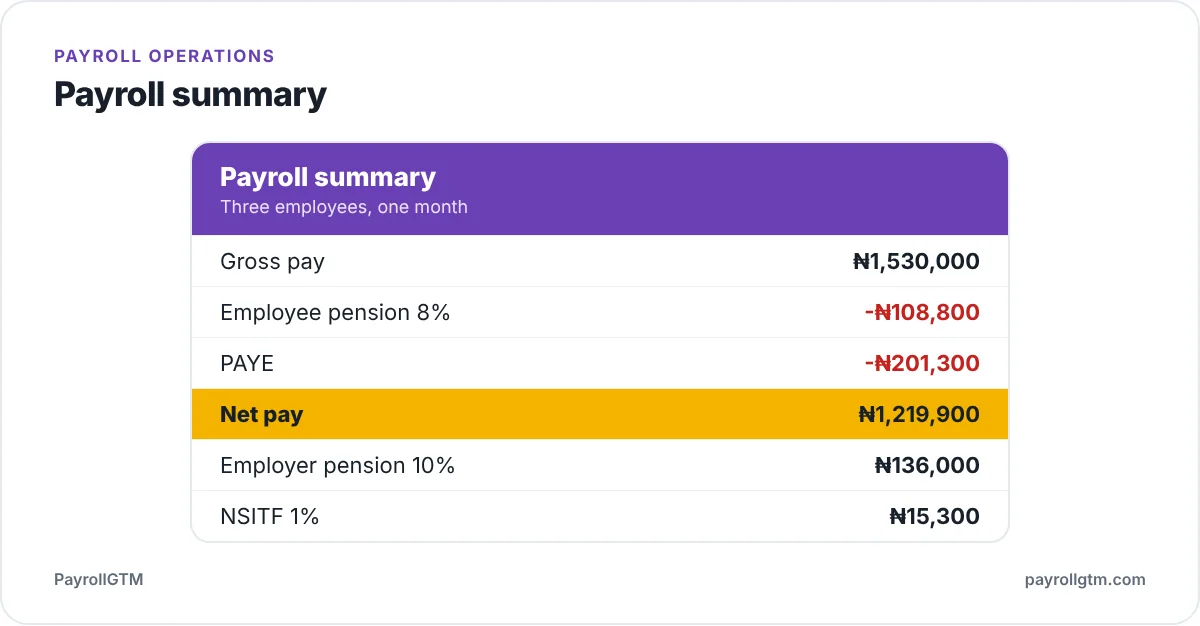
Run three checks before moving on. Does total net pay move in line with the change list? Is any net figure more than 10% different from last month with no explanation? Is anyone's net pay negative or zero? A short exception report like this catches most errors. The same report is also your first defence against fraud.
Steps 6 and 7: Approve, pay and issue payslips
Step 6, approval from someone who did not prepare it. The person who computes payroll should not be the only person who releases it. At minimum, have the owner, finance manager or another named approver sign the payroll summary and the bank payment list. In a very small business this may just be the owner, who should still read the exception report rather than sign a stack of papers blind.
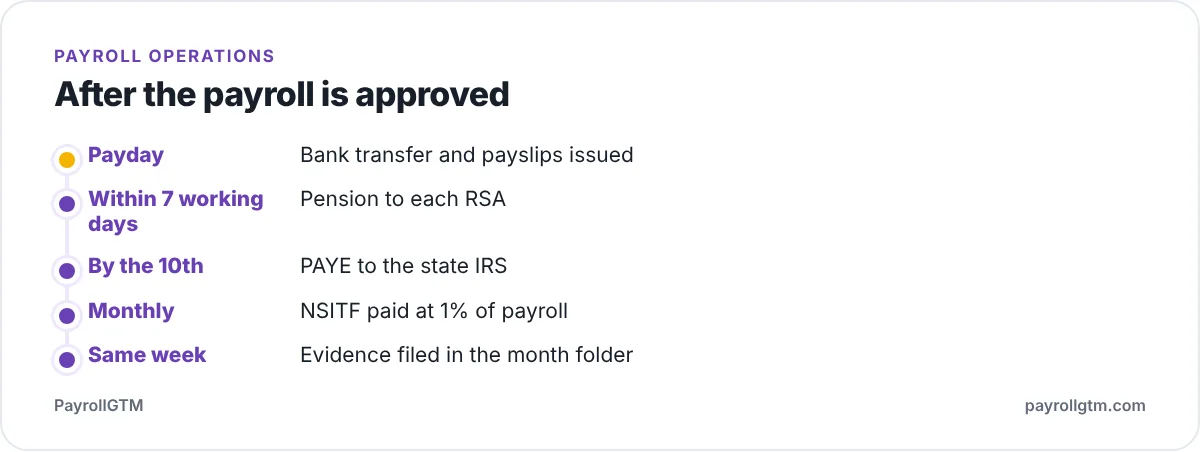
Step 7, pay and issue payslips. Pay by bank transfer from the company account to each employee's account, using a bulk payment file where your bank supports it. Match the payment file total (₦1,219,900 in our example) to the approved net pay total before you authorise it. See paying salaries by bank transfer for file formats and checks. Send each person a payslip on or just after payday. What a good one shows is in how to read a Nigerian payslip.
Steps 8 and 9: Remit PAYE, pension and the employer levies
Step 8, PAYE. PAYE goes to the State Internal Revenue Service of each employee's state of residence, by the 10th of the following month under state practice. In the example, ₦201,300 is the amount for the month. Use the schedule your state IRS requires and keep the payment proof. Practical steps, forms and payment channels are in PAYE remittance deadlines and how to pay. Confirm the date and portal with your state IRS, because local practice varies.
Step 9, pension and levies. Pension contributions go to each employee's RSA with the PFA they chose, within 7 working days of paying salaries. In the example that is ₦108,800 employee plus ₦136,000 employer, which makes ₦244,800. A delay costs 2% of the unremitted amount for each month. The remittance deadline and penalty guide shows how to count the working days.
The employer also owes NSITF at 1% of total monthly payroll. For ₦1,530,000 that is ₦15,300. ITF is 1% of annual payroll if you have 5 or more employees or turnover of ₦50 million or more, so it may not apply to a three-person business with a small turnover. Check your own position before you assume either levy does not apply.
The cash cost of this payroll to the employer is therefore ₦1,530,000 gross, plus ₦136,000 employer pension, plus ₦15,300 NSITF, which is ₦1,681,300. That equals what leaves the bank in total: net pay ₦1,219,900, PAYE ₦201,300, pension ₦244,800 and NSITF ₦15,300. Group life premiums are an additional employer cost.
A sample month on the calendar
Suppose payday is 28 October. Salaries go out that day with payslips. The pension remittance follows within 7 working days of payday, counted on working days only, so check the calendar for weekends and public holidays. PAYE for October is due by 10 November, and the NSITF payment for the month follows your usual schedule. Next month's change list closes on about 20 November, so the cycle is a rolling one, with step 1 of November starting before step 9 of October has finished. Put the dates in a shared calendar with a named owner for each, as suggested in the payroll compliance calendar.
A small business often has one person doing all ten steps. The control that matters then is time: do not compute and approve on the same day, and have someone else look at the total and at three random payslips before money moves.
Step 10: Archive the evidence
Save, in one folder per month: the change list, the payroll summary with approvals, the bank payment file and bank confirmation, the PAYE and pension remittance proofs, and the payslips. You will need them for the annual return due on 31 January, for the audit file, and for any dispute. How long to keep them and in what form is covered in payroll record keeping.
Who should do what
Even a two-person office can split the work so no single person controls the money from start to finish. One person keeps the employee master data (names, bank accounts, pay components). A second person enters the month's changes and prepares the run. The owner or an independent approver releases the payment. If that is impossible, the owner at least reviews the master data change report every month, because new names and bank detail changes are where payroll theft starts.
Whether the tool is a spreadsheet or software matters less than whether it has been tested. Whichever you use, test it every January and every time a rate changes: three salaries, known answers, written down. Keep a version history so you can show how the June figures were produced in December.
Finally, give every employee a way to query their payslip within a stated number of days, and record each query and its outcome. Most errors reach you that way first, and a visible, dated record shows the state IRS or the National Industrial Court that you handled it properly.
When the month goes wrong
An error that reaches payday is normal, and fixing it properly is part of the process. If you underpaid someone, pay the difference in the next run and label it clearly. If you overpaid, agree the recovery in writing and do not take it all in one go. Corrections to tax and pension need the same care as the first run, and back pay and payroll corrections sets out the steps.
Print the ten steps, put a name and a date against each one for the next three months, and the process will become routine. By the fourth month you will find that most of the time goes into step 1, because that is where the facts come from.