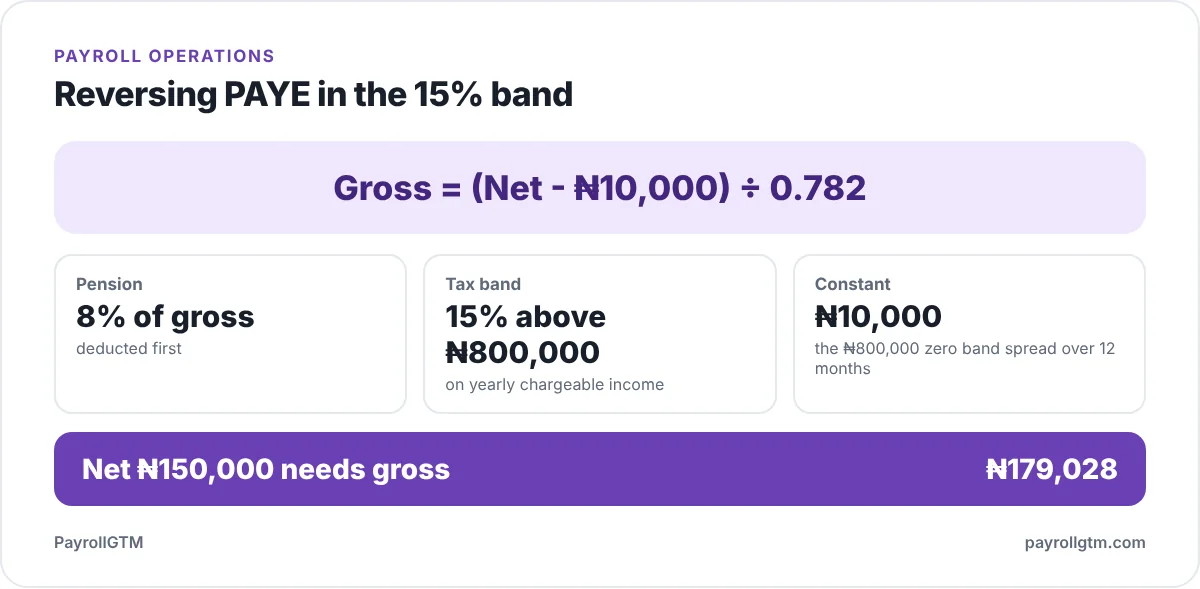
To get a take-home of ₦150,000 in Nigeria in 2026 you need to pay a gross salary of about ₦179,028 a month, assuming the whole gross is pensionable and no rent relief or other deduction is claimed. The reverse calculation is not a flat markup, because PAYE rises in steps as pay rises, so the gap between net and gross widens the more you promise. This guide gives the working, a lookup table for common targets, and what the promise costs the employer.
Why employers end up promising net pay
A candidate says "I need ₦200,000 in my account" and the hiring manager agrees on the spot. Payroll then has to find the gross figure that leaves exactly that after 8% pension and PAYE. Many offer letters state the net, and then someone has to build the salary structure behind it. It is a legitimate way to hire. The risk is that the promise is made without checking the arithmetic, and the first payslip comes out ₦10,000 short.
It also matters because the net target is only stable while the rules stay the same. A "net" promise written before 2026 (under the old bands and the old relief allowance) produces a different gross today. If you inherited such letters, see the January 2026 payroll changes checklist before you assume the old gross still delivers the old net.
The forward formula you are reversing
For each month, using the method in how to calculate PAYE in 2026:
- Pension = 8% of the pensionable pay (here, the whole gross G).
- Chargeable income for the year = 12 × (G − pension) − any rent relief or other deductions.
- Annual tax = the band calculation on that chargeable income. The first ₦800,000 is at 0%, the next ₦2,200,000 at 15%, the next ₦9,000,000 at 18%.
- Net = G − pension − (annual tax ÷ 12).
To reverse it you first need to know which band the answer lands in, because the formula changes slightly in each band.
The algebra in the 15% band
Suppose the final chargeable income is above ₦800,000 and below ₦3,000,000. Then the annual tax is 15% of the part above ₦800,000, and:
Net = G − 0.08G − ((12 × 0.92G − 800,000) × 0.15) ÷ 12
Expand it. 12 × 0.92G is 11.04G. Multiplying by 0.15 and dividing by 12 gives 0.138G, and the ₦800,000 term becomes ₦10,000 a month. So the net is 0.92G − 0.138G + 10,000, which is Net = 0.782G + ₦10,000. Rearranged, G = (Net − ₦10,000) ÷ 0.782.
The 15% band formula works for gross up to about ₦271,739 a month, which is where chargeable income reaches ₦3,000,000 (₦3,000,000 ÷ 11.04). Above that it changes.
The algebra in the 18% band
When chargeable income is between ₦3,000,000 and ₦12,000,000, the tax for the year is ₦330,000 (the full 15% on ₦2,200,000) plus 18% of the amount above ₦3,000,000. Monthly, that is ₦27,500 plus 0.18 × (11.04G − 3,000,000) ÷ 12. Working it through gives:
Net = 0.7544G + ₦17,500, so G = (Net − ₦17,500) ÷ 0.7544.
Lookup table for common net targets
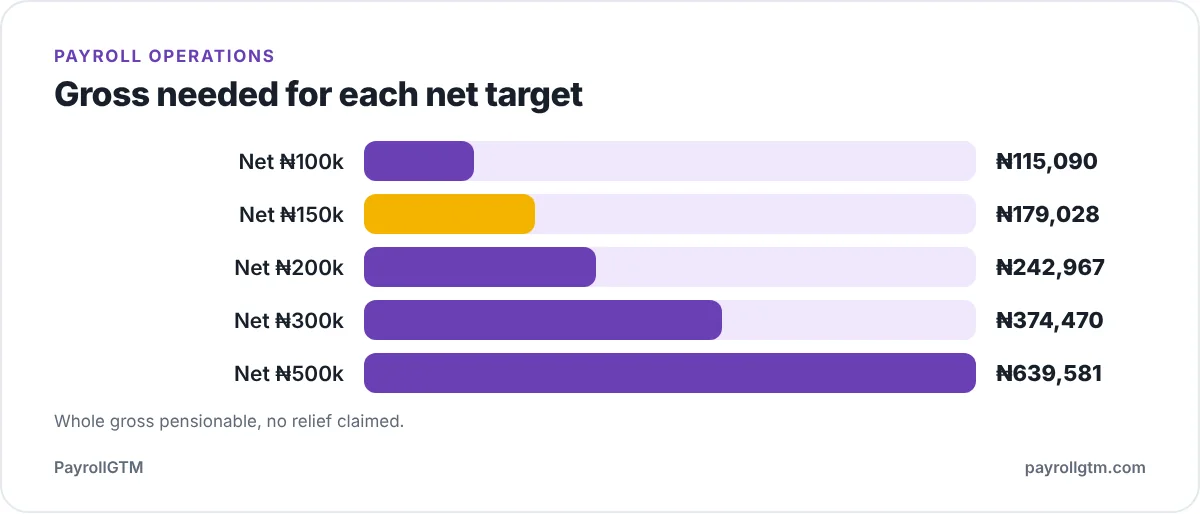
These figures assume the whole gross is pensionable, no rent relief, no NHF and no other deduction. They come from solving the calculation numerically (a bisection search that adjusts the gross until the net matches the target), and the rounded gross is within a few kobo of the exact answer.
| Target net | Gross needed | Employee pension (8%) | Monthly PAYE | Employer pension (10%) |
|---|---|---|---|---|
| ₦100,000 | ₦115,090 | ₦9,207 | ₦5,882 | ₦11,509 |
| ₦150,000 | ₦179,028 | ₦14,322 | ₦14,706 | ₦17,903 |
| ₦200,000 | ₦242,967 | ₦19,437 | ₦23,529 | ₦24,297 |
| ₦300,000 | ₦374,470 | ₦29,958 | ₦44,512 | ₦37,447 |
| ₦500,000 | ₦639,581 | ₦51,166 | ₦88,415 | ₦63,958 |
Notice how the markup grows. For ₦100,000 net the gross is about 15% higher. For ₦500,000 net it is about 28% higher. A promise that sounds like "just add the tax" costs more as the number rises.
What the promise costs the employer
The employer's real cost is the gross plus the employer's own 10% pension contribution on top of it, before group life insurance, the NSITF 1% on total payroll and any other benefit. For Aisha's ₦150,000 net, the gross is ₦179,028 and the employer pension is ₦17,903, so the salary line plus pension is about ₦196,931 a month. Her take-home is ₦150,000, so the company spends roughly ₦46,931 more than she receives. Part of that is her own pension (₦14,322 from her side and ₦17,903 from the employer, all of it hers) and the rest is PAYE paid to the state IRS.
You can check any scenario with the employer cost calculator, and the pension contribution guide explains why the pensionable base matters. If the salary has a basic, housing and transport split, only those components are pensionable, so the pension is lower and the net is higher for the same gross. The lookup table above does not apply to that case.
A mistake that costs the employee money
The usual shortcut is to divide the net by 0.92, as if pension were the only deduction. For a ₦200,000 target that gives ₦217,391. Run that through the real calculation and PAYE is about ₦20,000, so the employee takes home roughly ₦180,000, about ₦20,000 short of the promise. Every month. By year end that is a ₦240,000 shortfall and a conversation nobody wants. The other shortcut, multiplying the net by 1.1 or 1.2 "to cover tax", fails the same way, because the right markup depends on the band. Use the band formulas, or solve it properly, then confirm by running the gross through the payroll calculator.
Round the gross up to a whole naira, never down. A gross rounded down by ₦1 leaves the net a few kobo under the target, which looks careless on a payslip.
Before you promise a net figure
- Write it as a gross in the contract. Say "gross ₦179,028 a month, which the company expects to produce a net of about ₦150,000 on current tax rules". A net-only promise leaves the employer holding the risk of every future change in the bands.
- Remember allowances and relief change the answer. If the employee later claims rent relief, their PAYE falls and their net rises. That is a gain for the employee, not an overpayment, so do not reduce the gross to compensate.
- Bonuses and other pay join the same base. PAYE on a bonus is worked out on the whole year, as described in PAYE on bonuses and 13th-month pay, so the net in a bonus month will not match the target.
- Keep a note of the method. If the figure is ever queried, the calculation sheet is your evidence. See the payroll spreadsheet template for a layout.
If a correction is needed later, because the first payslips used the wrong gross, the process in back pay, arrears and salary corrections applies. For the opposite direction, from a known gross to take-home, use salary after tax in Nigeria.