PAYE in Nigeria for 2026 is worked out in one pass: take the year's pay, remove the 8% employee pension (and any NHF or rent relief you can evidence), push what is left through the 0% to 25% bands, then divide the tax by 12. On ₦350,000 a month with ₦1,500,000 of rent paid, that comes to ₦36,464 a month.
The rules come from the Nigeria Tax Act 2025, in force since 1 January 2026. Below are the steps, then three full examples at different pay levels, then a section on why spreadsheets still built on the old Consolidated Relief Allowance (CRA) give wrong answers. Every figure was produced with the same calculation, so you can check your own payslip against them.
The six steps, in order
Do them in this order. Swapping steps 2 and 3 is the commonest reason two payroll officers get different answers for the same person.
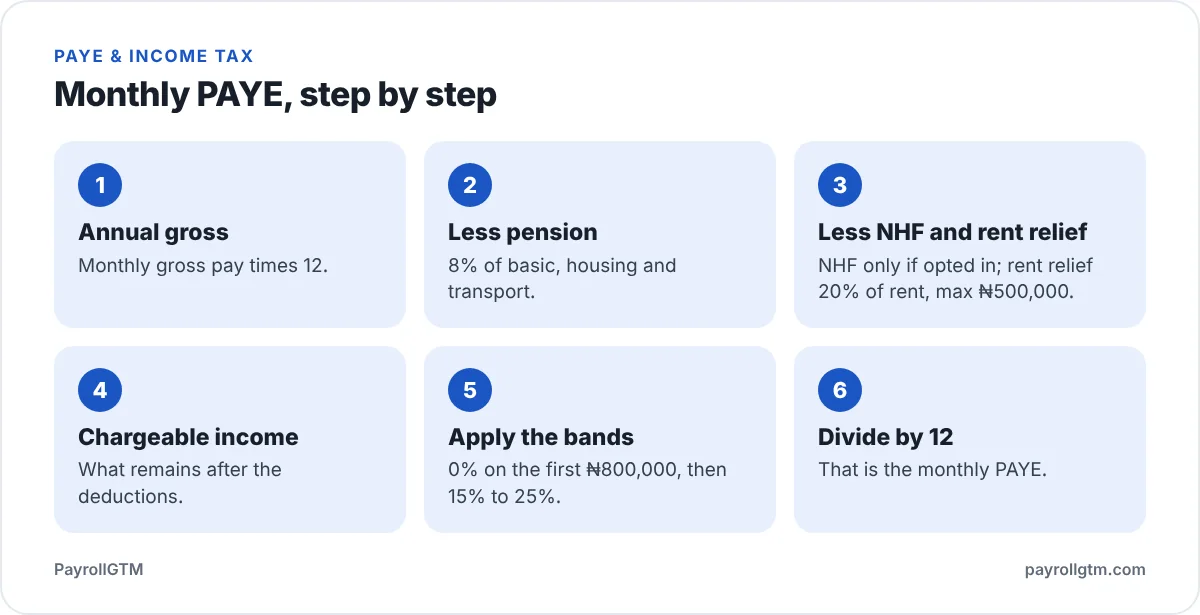
- Annual gross. Monthly gross pay (basic plus every allowance) times 12.
- Employee pension. 8% of basic + housing + transport, the statutory base. If your payslip has other allowances (meal, utility, "other"), they are not in that base unless your contract or employer policy includes them.
- NHF, only if the employee has opted in. 2.5% of basic salary. For private-sector staff this is voluntary since the Business Facilitation Act 2022.
- Rent relief, only if claimed with evidence. 20% of annual rent actually paid by the employee, capped at ₦500,000 a year.
- Chargeable income. Annual gross, less annual pension, less NHF, less rent relief.
- Bands, then divide by 12. The first ₦800,000 is taxed at 0%, the next ₦2,200,000 at 15%, the next ₦9,000,000 at 18%, the next ₦13,000,000 at 21%, the next ₦25,000,000 at 23%, and anything above ₦50,000,000 at 25%. Divide the annual tax by 12 for the monthly PAYE.
Other deductions (voluntary pension, health insurance contributions, interest on an owner-occupied home loan, life insurance premiums) also reduce chargeable income when properly claimed. We leave them out of the examples because the law as we have it sets no amounts to illustrate, and the guide to deductions that reduce PAYE covers what to document for each.
Example 1: ₦120,000 a month, no rent claim
Take Hauwa, an office assistant in Kano. Her pay is basic ₦60,000, housing ₦30,000, transport ₦20,000 and ₦10,000 of other allowances.
- Pensionable pay: ₦60,000 + ₦30,000 + ₦20,000 = ₦110,000. The ₦10,000 is outside the base.
- Pension at 8%: ₦8,800 a month, ₦105,600 a year.
- Chargeable income: (₦120,000 - ₦8,800) x 12 = ₦1,334,400.
- First ₦800,000 at 0% = ₦0. Remaining ₦534,400 at 15% = ₦80,160.
- Monthly PAYE: ₦80,160 / 12 = ₦6,680.
- Take-home: ₦120,000 - ₦8,800 - ₦6,680 = ₦104,520.
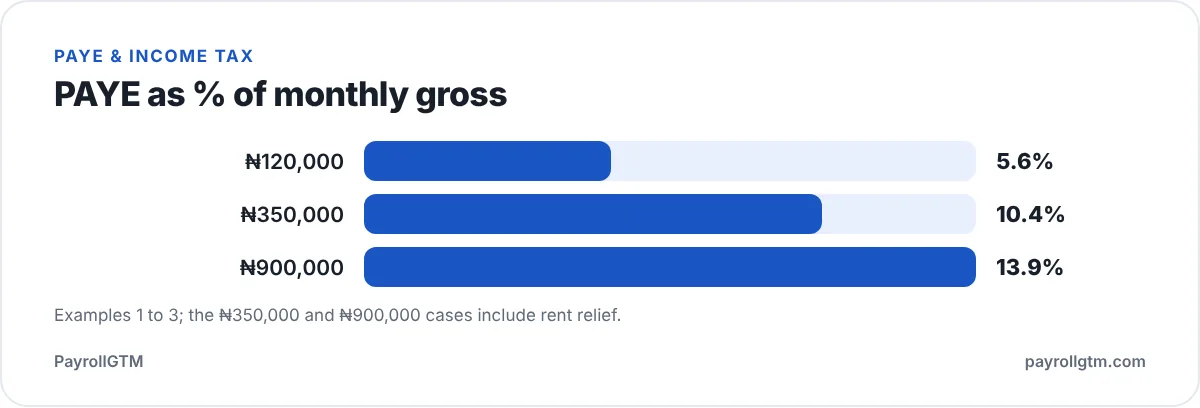
PAYE is about 5.6% of her gross. Her employer separately pays ₦11,000 a month (10% of ₦110,000) into her RSA.
Example 2: ₦350,000 a month with rent relief
Segun is an accountant in Ibadan on basic ₦175,000, housing ₦87,500, transport ₦52,500 and ₦35,000 other. He pays ₦1,500,000 a year in rent and has given HR his tenancy agreement and receipts.
- Pensionable pay: ₦175,000 + ₦87,500 + ₦52,500 = ₦315,000. Pension at 8% = ₦25,200 a month, ₦302,400 a year.
- Rent relief: 20% of ₦1,500,000 = ₦300,000, which is under the ₦500,000 cap.
- Chargeable income: ₦4,200,000 - ₦302,400 - ₦300,000 = ₦3,597,600.
- 0% on ₦800,000 = ₦0. 15% on ₦2,200,000 = ₦330,000. 18% on the remaining ₦597,600 = ₦107,568.
- Annual tax: ₦437,568. Monthly PAYE: ₦36,464.
- Take-home: ₦350,000 - ₦25,200 - ₦36,464 = ₦288,336.
Without the rent claim his chargeable income would be ₦3,897,600 and his PAYE ₦40,964 a month. The claim is worth ₦4,500 a month to him. The rent relief claim guide lists what the paperwork must show.
Example 3: ₦900,000 a month, rent above the cap
Yetunde is a senior manager in Lagos with basic ₦450,000, housing ₦225,000, transport ₦135,000 and ₦90,000 other. She pays ₦3,000,000 a year in rent.
- Pensionable pay: ₦810,000. Pension at 8% = ₦64,800 a month, ₦777,600 a year.
- Rent relief: 20% of ₦3,000,000 is ₦600,000, but the cap holds it at ₦500,000.
- Chargeable income: ₦10,800,000 - ₦777,600 - ₦500,000 = ₦9,522,400.
- 0% on ₦800,000 = ₦0. 15% on ₦2,200,000 = ₦330,000. 18% on ₦6,522,400 = ₦1,174,032.
- Annual tax: ₦1,504,032. Monthly PAYE: ₦125,336.
- Take-home: ₦900,000 - ₦64,800 - ₦125,336 = ₦709,864.
The ₦100,000 of relief above the cap earns her nothing. Her marginal rate is 18%, so each extra ₦100,000 of annual income costs her ₦18,000 in tax, not 25%.
What changes if the employee opts in to NHF
Back to Segun, with no rent claim for a clean comparison. If he opts in to the National Housing Fund, 2.5% of his basic ₦175,000 is ₦4,375 a month. His chargeable income falls to ₦3,845,100, PAYE drops from ₦40,964 to ₦40,176, and take-home goes from ₦283,836 to ₦280,248.
So the deduction saves ₦788 of tax but costs ₦4,375 of cash. That is a saving plan, not a tax strategy. And never deduct it for private-sector staff who have not agreed in writing. If the employee later wants out or a refund, the rules are not clear enough to promise anything; see the NHF voluntary contribution guide.
Why the old CRA method now gives wrong answers
Until the end of 2025 the Personal Income Tax Act gave every employee a CRA of ₦200,000 (or 1% of gross if higher) plus 20% of gross, and taxed the rest at 7% to 24%. That relief no longer exists. A payroll template that still has a CRA column is applying a repealed rule to a different band table.
The error is not always in the same direction, and it is biggest for the lowest earners. Take an employee on ₦80,000 (basic ₦40,000, housing ₦20,000, transport ₦12,000). The old method shows PAYE of about ₦3,573 a month. Under the 2026 bands it is ₦1,136, so the old sheet takes roughly ₦2,400 a month too much from someone who can least spare it. At ₦900,000 with no rent claimed the gap is small: about ₦135,915 under the old method against ₦132,836 now, because the old bands were steeper but the CRA was generous.
For a side-by-side with the full old working, read how rent relief replaced the CRA. The short version is that the new system moved the relief into a high zero band and a rent deduction, and a spreadsheet cannot mix the two.
Check any template you inherited: if a cell multiplies gross by 20%, or if the lowest band is 7%, replace the sheet.
Mistakes that change the answer
- Taking pension on gross when the contract defines the base. The statutory minimum is basic + housing + transport. Using whole gross overstates the deduction for staff with large "other" allowances, which understates PAYE and invites an audit query.
- Applying rent relief with no document. The state IRS can disallow it. Keep the tenancy agreement and receipts on the employee file.
- Treating a bonus month as an ordinary month. Bonuses join the year's income; see PAYE on bonuses and 13th-month pay.
- Running two jobs through the zero band twice. The ₦800,000 band is used once per person per year; the second jobs guide explains how to avoid under-deducting.
- Taxing someone on ₦70,000 or less. Minimum wage earners are exempt; see is the minimum wage taxable.
To test a figure quickly, put the same inputs into the payroll calculator. To go the other way, from a take-home target back to a gross, use the net-to-gross method, and for a table of common salaries see salary after tax in 2026. Remit what you deduct to your state IRS; the monthly mechanics are in the payroll guides, and your state IRS can confirm how it wants returns shown.