Stay on a spreadsheet while you have fewer than about ten employees, stable pay and a second person who checks the numbers every month. Move to payroll software when payroll takes more than a day, errors keep turning up, or only one person understands the workbook. Neither choice makes you compliant by itself: PAYE, pension and NSITF are still your responsibility.
We publish a free PAYE calculator and a spreadsheet template on this site, so we are not neutral about spreadsheets. We have tried to apply the same tests to every option, and below we say plainly when a spreadsheet is the better choice.
When a spreadsheet is enough
A small team on fixed salaries, with no overtime, commissions or loan repayments, can run payroll on a well-built workbook for years. It costs nothing beyond software you already own, every formula is visible, and your accountant can audit it in an hour. The conditions are strict, though: locked formulas, one master copy, and a second person who reviews the result before anyone is paid.
If you go this way, start from a payroll spreadsheet template with working formulas rather than a blank sheet, and test it before you trust it.
Where spreadsheets fail
- Stale rules. The 2026 bands replaced the old ones on 1 January, and the old Consolidated Relief Allowance no longer exists. A workbook nobody updated still calculates last year's tax. Our January 2026 payroll checklist lists what had to change.
- Wrong pension base. Pension must be calculated on at least basic, housing and transport. Sheets built on basic alone, or on gross, are common.
- Version drift. Three copies of "Payroll_March_final2" circulate by email and nobody knows which one was paid.
- No audit trail. You cannot show who changed a salary or when.
- Open access. One file holds every salary and bank account number. See how the data protection law applies to payroll records.
- Key person risk. The one person who built it goes on leave.
What one wrong cell costs
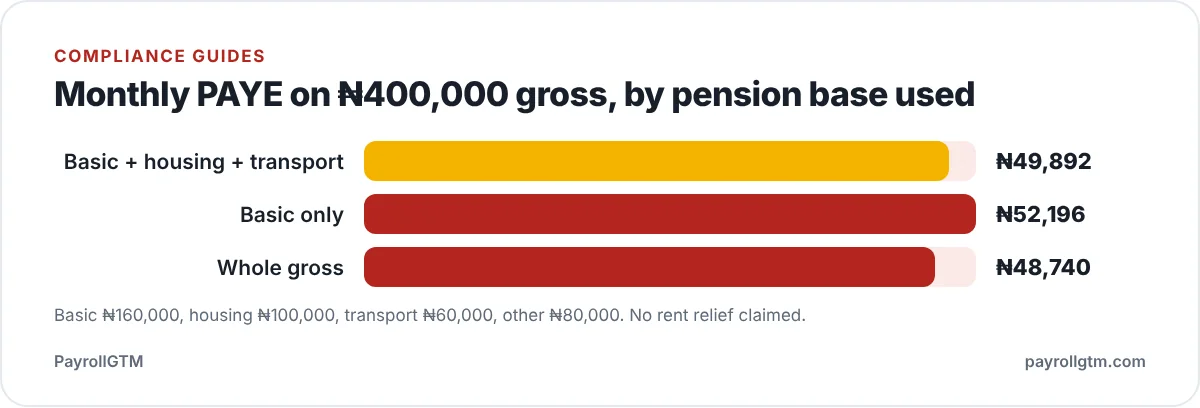
Take an employee paid ₦400,000 a month: ₦160,000 basic, ₦100,000 housing, ₦60,000 transport and ₦80,000 other allowances. Pension is 8% of basic plus housing plus transport, which is ₦320,000, so the employee contributes ₦25,600. We ran the three versions through the calculator on this site.
| Pension base used | Employee pension | Monthly PAYE |
|---|---|---|
| Basic + housing + transport (correct) | ₦25,600 | ₦49,892 |
| Basic only (wrong) | ₦12,800 | ₦52,196 |
| Whole gross (wrong) | ₦32,000 | ₦48,740 |
The sheet that uses basic only under-collects ₦12,800 a month in pension, so the employer's 10% share is also short by ₦16,000 against the correct ₦32,000, and PAYE is over-deducted by ₦2,304. Multiply by twenty staff and twelve months and the shortfall in the RSAs is large. Under the Pension Reform Act the late-remittance penalty is 2% of the unremitted amount for each month, and an under-calculated contribution is unremitted money.
What payroll software does and does not do
Good software applies one set of rules to everyone, updates the tax tables when the law changes, produces payslips and remittance schedules, logs who changed what, and lets employees see their own payslips. Adding the fortieth employee takes minutes.
It does not fix bad inputs. If the contract says ₦400,000 and the system holds ₦380,000, you will pay the wrong amount very accurately. It does not decide whether a worker is an employee, it does not make your pension compliance automatic, and unless it connects to your state IRS or PFA portals it does not file or pay anything. A badly configured system is more dangerous than a spreadsheet because everyone trusts it.
Seven signs you have outgrown spreadsheets
- You have more than 10 to 15 employees, or will within a year.
- Payroll takes more than a day each month.
- You found at least one calculation error in the last 12 months.
- Staff query payslips and nobody can explain them quickly.
- You pay people in more than one state or on several pay arrangements.
- Only one person understands the workbook.
- A statutory payment was late because of a data problem.
Two or three of these mean you should start comparing options. Five or more means you should move this quarter. The most common payroll mistakes in Nigerian SMEs read like a list of the things software prevents.
What it costs you
Do not compare the subscription with zero. Count the staff time, the cost of one error and the cost of a late payment. Suppose a finance officer spends two days a month on payroll for 20 employees, and a day of that officer's time is worth ₦15,000. That is ₦30,000 a month. If software cuts it to half a day, the time saving is ₦22,500 a month before any avoided errors. Those figures are an illustration, so replace them with your own and compare the result with the vendor's price per employee.
Tests to run before you buy
- Run your own test pack. Enter three or four real employees and compare the output with a hand calculation or our calculator. Include someone on ₦70,000 (PAYE should be zero) and someone with allowances beyond basic, housing and transport.
- Ask about updates. How fast does the vendor change the tax tables after a law change, and how will you be told?
- Check the reports. Can it produce a PAYE schedule, a pension schedule by PFA and the data for the annual Form H1 return?
- Check payments. Can it create the file your bank accepts for bulk salary transfers?
- Check data handling. Where is the data stored, who can see it, and how do you export everything if you leave?
- Check support hours. Is someone reachable on the 25th of the month, Nigerian time?
- Read the price list. Per employee, per pay run, per payslip? What costs extra?
If you stay on spreadsheets, or outsource
Lock every formula cell and leave only input cells open. Keep one master file in a shared drive with version history on, and stop emailing editable copies. Separate inputs, calculations and outputs into different tabs. Add a check that gross minus deductions equals net, and that the payslip total equals the bank file. Have a second person compare each month with the last and explain every difference. Our monthly payroll reconciliation checklist gives the full routine.
Outsourcing as a third option
Some owners hand payroll to an accountant or a bureau. That removes the preparation work, but you stay responsible for the inputs and for the deadlines. If you outsource, get a monthly summary you can read, confirm in writing who makes each remittance, and keep the evidence. We compare the trade-offs in when payroll outsourcing makes sense.
Switching without chaos
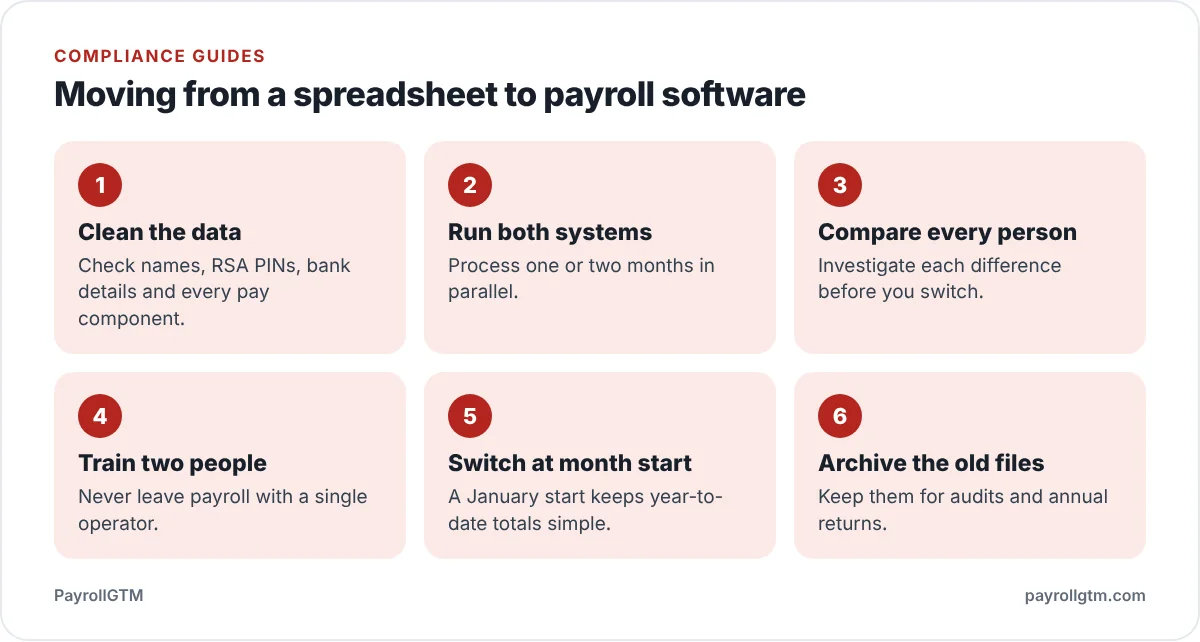
Do the move at the start of a month, and ideally the start of a calendar year so that year-to-date totals stay simple. Archive the old spreadsheets afterwards: you will need them for an audit and for the employer's annual return.
Common questions
Is Excel good enough for five employees?
Often yes, if the workbook is protected and someone else reviews it each month.
Does software guarantee compliance?
No. It reduces calculation errors. You remain responsible for classification, inputs and paying on time. If the vendor's tax tables are wrong, that is still your payroll.
Can free tools replace payroll software?
They are good for cross-checking one employee's figures, but check how they treat your data and whether they follow the 2026 rules.