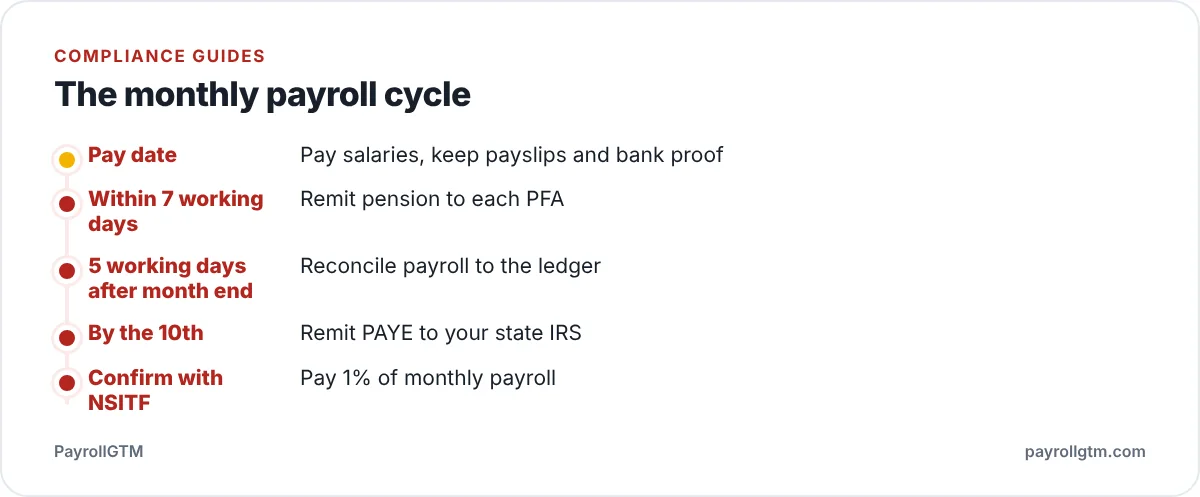
Three dates matter most each month: pay salaries on the contract date, remit pension within 7 working days after that, and remit PAYE to your state IRS by the 10th of the following month. Once a year, file the employer annual return (Form H1) by 31 January. Everything else on this calendar, from NSITF to ITF to CAC, has a date you should confirm with the authority and write down with its source.
Monthly tasks
Use this table as the base of your calendar. Where we give no date, it is because the date varies or we cannot confirm it for every employer.
| Task | Timing | Notes |
|---|---|---|
| Run payroll and pay salaries | Contract pay date | Keep payslips and the bank confirmation |
| Remit pension | Within 7 working days of paying salaries | 8% employee plus 10% employer, to each employee's PFA |
| Remit PAYE | By the 10th of the following month | To the state IRS of each employee's state of residence. See PAYE remittance deadlines |
| Pay NSITF | Confirm the date with NSITF | 1% of total monthly payroll, paid by the employer. See NSITF contributions |
| Withholding tax and VAT | Confirm with your tax authority | Only if you pay contractors or are VAT-registered (VAT is 7.5%) |
| NHF | Only for staff who opted in | Voluntary for private-sector staff |
| Reconcile payroll to the ledger | Within 5 working days of month end | Compare totals to your accounts |
Dates and portals can change. Each January, check every date with the authority and record the source next to it. For PAYE, the 10th is state practice, so confirm it with your own state IRS.
Quarterly tasks
- Pension reconciliation. Compare payroll with the schedules sent, and ask a few staff to check their RSA statements for a credit every month.
- Headcount check. Make sure every person on payroll is real and correctly classified.
- Leave balances. Review accrued leave and agree plans for large unused balances.
- Insurance. Check that group life cover (at least 3 times annual total emolument) still matches headcount and pay.
- Rule changes. Note any change in rates or procedure and update your steps.
Annual tasks
These are the yearly items. Dates marked "confirm" differ by authority or sector.
| Task | Timing | Notes |
|---|---|---|
| Employer annual return (Form H1) | 31 January for the previous year | See Form H1 and annual returns |
| ITF contribution | Confirm date with ITF | 1% of annual payroll for employers with 5 or more employees, or turnover of ₦50 million or more. See ITF compliance |
| Group life renewal | Before the policy expires | Premium paid by the employer |
| CAC annual returns | Confirm with CAC | See CAC annual returns |
| Payroll audit | After year end | Use the annual payroll audit checklist |
| Pay review and handbook update | Before the new budget year | Check against the ₦70,000 minimum wage if you have 25 or more employees |
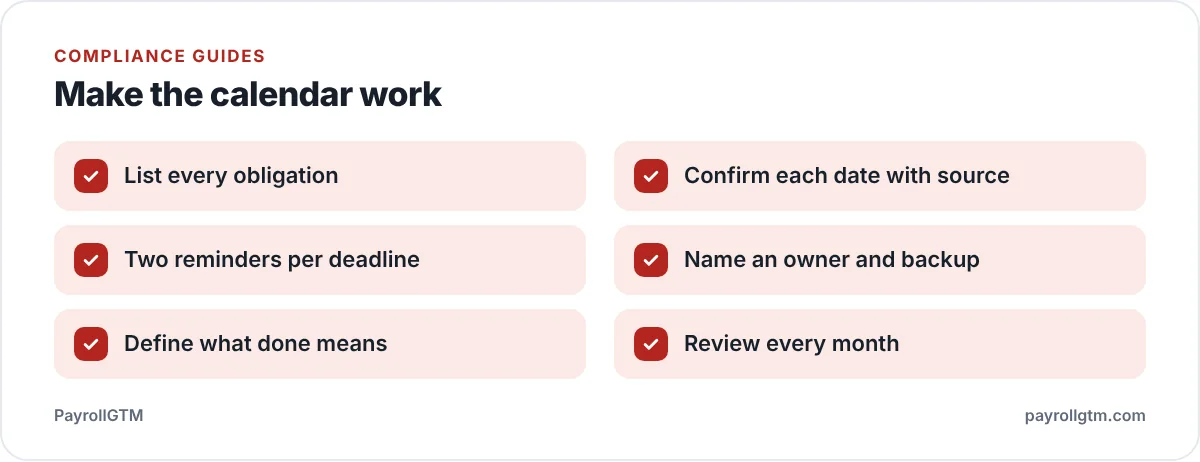
Build your own calendar in six steps
- List every obligation. Start from the tables and add sector items such as licence renewals.
- Confirm each date with the authority or your adviser and write the source beside it.
- Set two reminders. One 5 working days before for preparation, one 2 days before for payment. Use a shared calendar, not one person's phone.
- Name an owner and a backup for every task.
- Define "done". PAYE is done when the payment is made and the receipt is filed, not when the transfer is approved.
- Review monthly. Tick off tasks and note any slip and its cause.
Cash planning: how much to set aside each payday
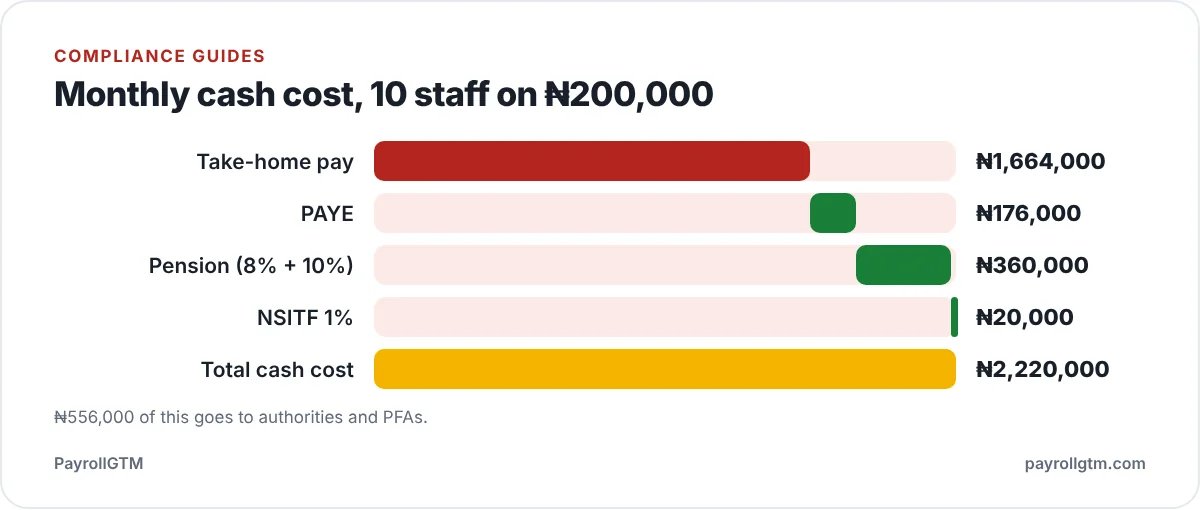
A calendar says when to pay. You also need the cash. Move statutory amounts into a separate account on payday, so they are not spent as working capital.
A business has 10 staff, each on ₦200,000 a month, all pensionable. For each person, the 8% pension is ₦16,000, PAYE is ₦17,600 and take-home is ₦166,400. Across 10 staff, take-home is ₦1,664,000, PAYE is ₦176,000, and pension is ₦360,000 (₦160,000 deducted plus ₦200,000 employer's 10%). NSITF at 1% of the ₦2,000,000 payroll is ₦20,000. The true monthly cash cost is ₦2,220,000, of which ₦556,000 (PAYE, pension and NSITF) must go to authorities and PFAs rather than staff.
Annual items such as ITF and insurance renewals are easier if you divide the yearly amount by 12 and set that aside monthly. Our January 2026 employer checklist covers what changed in the rules this year.
A sample month for a ten-person business
Salaries are paid on the last working day. On the 25th the payroll officer freezes changes. On the 27th the owner approves the draft and transfers are scheduled. On payday, salaries go out and payslips are emailed. In the next few days the pension schedule is prepared and paid, well inside 7 working days. By the 8th, the PAYE figure is final and scheduled so it clears before the 10th. Setting internal deadlines two or three days before official ones gives you room for portal outages and bank delays.
In a small team one person often does everything. Write a one-page procedure for each task, listing steps, portal, who holds the login and where evidence is saved, and have a second person do each task once a year.
What happens if you miss a date
If you miss one, pay as soon as you can, keep evidence of the date and reason, and contact the authority. Prompt correction is usually received better than silence. See penalties for late PAYE and payroll defaults and common payroll mistakes.
Common questions
Are these dates the same in every state?
Federal rules are uniform, but state IRS offices set their own procedures and portals. Confirm with yours.
What if a deadline falls on a weekend or public holiday?
Do not count on an extension. Pay on the last working day before.
Do I need software?
No. A shared calendar and a spreadsheet are enough for a small team.