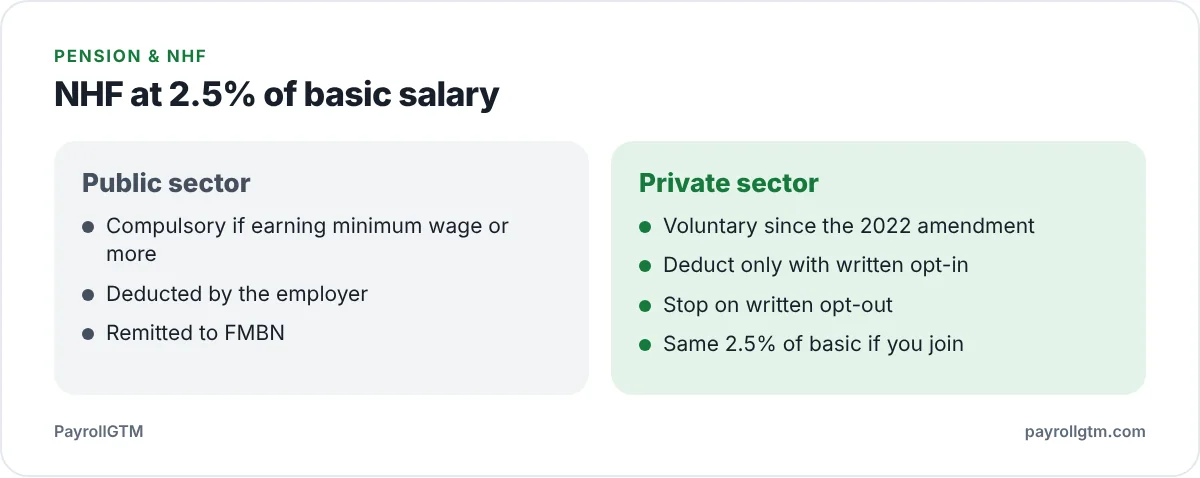
For private-sector employees, no. Since the Business Facilitation Act 2022 amended the National Housing Fund Act, NHF contributions of 2.5% of monthly basic salary are voluntary for private-sector staff. They stay compulsory for public-sector employees earning the minimum wage or more. If your payroll still takes 2.5% from every private employee by default, you need the employee's written opt-in or you should stop.
This is one of the most repeated wrong rules in Nigerian payroll, because for years it was true. We take the common beliefs in turn.
Myth: every Nigerian worker must pay 2.5% to NHF
Fact. The old position under the National Housing Fund Act 1992 was that 2.5% came off every covered employee's basic salary. The 2022 amendment changed that for the private sector: an employee there may contribute, but is not forced to. The Act still treats public-sector employees (earning at least the minimum wage) as compulsory contributors, and self-employed persons are mentioned in the Act as well.
So the first thing to ask about any payslip line is: is this person a public-sector or a private-sector employee? A federal ministry officer on Grade Level 8 has no choice. A sales executive at a Lagos distributor does.
Myth: it is 2.5% of gross pay
Fact. It is 2.5% of monthly basic salary. Housing, transport and other allowances are outside the base. Take Segun, whose gross is ₦250,000 with basic of ₦120,000, housing of ₦60,000 and transport of ₦30,000. His NHF is 2.5% of ₦120,000, which is ₦3,000 a month, not ₦6,250. Overdeducting is a common slip, especially when the payroll sheet points to the gross column. How your pay is split matters here; see how basic, housing and transport are structured.
Myth: the employer can just keep deducting, staff signed a contract
Fact. A deduction from wages needs a lawful basis. For a private-sector employee, NHF is now a choice, so the safe basis is the employee's own written agreement, separate from the general contract. A blanket line in an old offer letter that says "NHF will be deducted" is weak evidence of a current choice. The rules on what an employer may take out of pay are in wage payment and lawful deductions.
What to do this month:
- List every private-sector employee currently charged NHF.
- Ask each one, in writing, whether they want to continue.
- Keep the signed reply on the personnel file. No reply is not consent.
- Stop deductions for anyone who opts out, from the next payroll.
- For those who stay in, keep remitting to the Federal Mortgage Bank of Nigeria (FMBN) as before and keep the proof of payment.
Myth: opting in costs the employee the full 2.5%
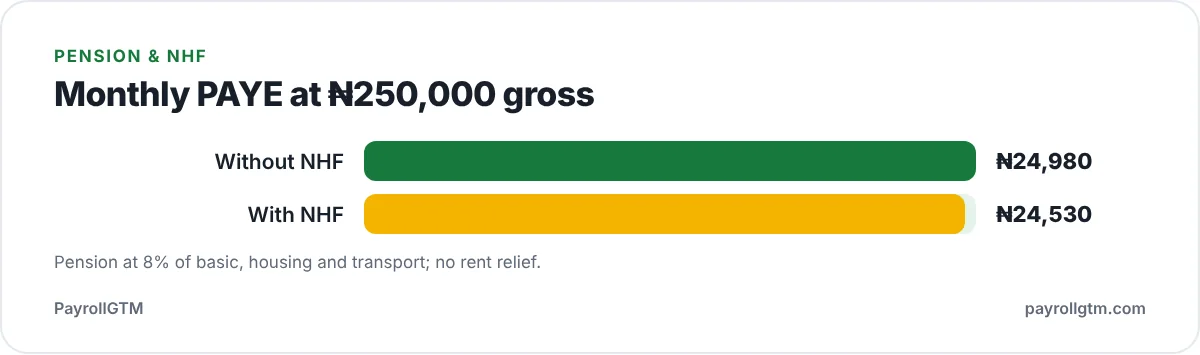
Fact. It costs less, because the contribution reduces taxable income when properly claimed. We ran Segun's figures through the site's PAYE tool for the 2026 bands.
| No NHF | With NHF (₦3,000) | |
|---|---|---|
| Gross a month | ₦250,000 | ₦250,000 |
| Pension 8% of ₦210,000 | ₦16,800 | ₦16,800 |
| Chargeable income a year | ₦2,798,400 | ₦2,762,400 |
| PAYE a month | ₦24,980 | ₦24,530 |
| Take-home a month | ₦208,220 | ₦205,670 |
Joining NHF costs Segun ₦2,550 of take-home, not ₦3,000, because PAYE falls by ₦450 a month (15% tax on the ₦36,000 a year contributed). The deduction only works if it is recorded and evidenced. See which deductions reduce PAYE in 2026.
Myth: you can always get an NHF refund
Fact, with a limit. Under the NHF Act, refunds normally arise at age 60 or retirement, or on incapacity, provided there is no FMBN loan outstanding. What is unclear is whether someone who opts out earlier can reclaim what was already deducted. We have not found a source that settles it, and we will not guess. If you have a staff member with years of deductions who wants out, ask FMBN in writing what it will do and keep the reply. Do not refund anything yourself from company funds in the meantime, and do not tell staff the money is "gone" either.
Deducting without a valid basis is a dispute waiting to happen: the employee can demand repayment, and a payroll that overdeducts looks sloppy to an auditor. Not remitting what you did deduct is worse. Reconcile what you deducted against what FMBN received before changing anything. Our common payroll mistakes list shows how often this gap appears.
Myth: NHF replaces the pension housing option
Fact. They are separate. Pension is compulsory for employers with 3 or more staff and sits in the employee's RSA. NHF is a housing savings fund run by FMBN. An employee can use up to 25% of their RSA balance as equity for a residential mortgage under a PenCom guideline, whether or not they have ever paid into NHF; the rules are in the RSA withdrawal for housing guide. Confirm the current conditions with PenCom or the PFA before planning around it.
Setting up the payroll sheet
Add two columns beside basic salary: "NHF opt-in (Y/N)" and "NHF amount". The amount formula should multiply basic by 2.5% only where the first column says Y. Then:
- Total the NHF column every month and agree it to the payment you make to FMBN. A difference means someone was deducted who had not opted in, or someone was missed.
- Record the date of any change. An employee who opts out in June has deductions January to May and none after, and your year-end figures should show that.
- Carry the NHF total per employee into the annual Form H1 workings, since it affects the chargeable income you report. Our Form H1 guide lists the other columns.
Mixed workforces are where errors breed. A company with a contract-to-hire arrangement for a former civil servant, say, can have staff on different footings in the same payroll run. Mark each person's status once, on the master list, not in someone's head.
Sample wording for staff
Employers often ask for a sentence they can copy. This is a plain version, which you can adapt:
I, [name], employee number [number], confirm that I have been told that contributions to the National Housing Fund are voluntary for private-sector staff. I choose to [continue / stop] contributing 2.5% of my monthly basic salary to NHF with effect from the [month] payroll. Signed [name], [date].
Keep it with the personnel file and make a note in the payroll sheet. If someone later wants to rejoin, they can sign a new one. Show the line on the payslip under its own name; how to read a Nigerian payslip explains where deductions normally sit, and the payroll run steps show where the opt-in list fits before you approve payments.
What to tell staff who ask
Expect three questions. "Is it a tax?" No, it is a savings fund held for the employee by FMBN, though contributions can reduce taxable income when claimed. "Will I get a house from it?" Contributions are meant to support access to FMBN mortgage loans, and the terms are set by FMBN, not by you, so point people to the bank. "Can I stop?" In the private sector, yes, in writing, with the refund question left to FMBN as above.
One thing to avoid: shifting salary between basic and allowances to change the NHF base. The pension base already includes housing and transport, and the split should reflect how the job is actually paid. It is not a lever for NHF.
This area has changed once already and agencies can issue new guidance. For deductions on behalf of staff, confirm remittance instructions and any refund process with the Federal Mortgage Bank of Nigeria (fmbn.gov.ng). For a public-sector employer, your accounts office will tell you the statutory position.