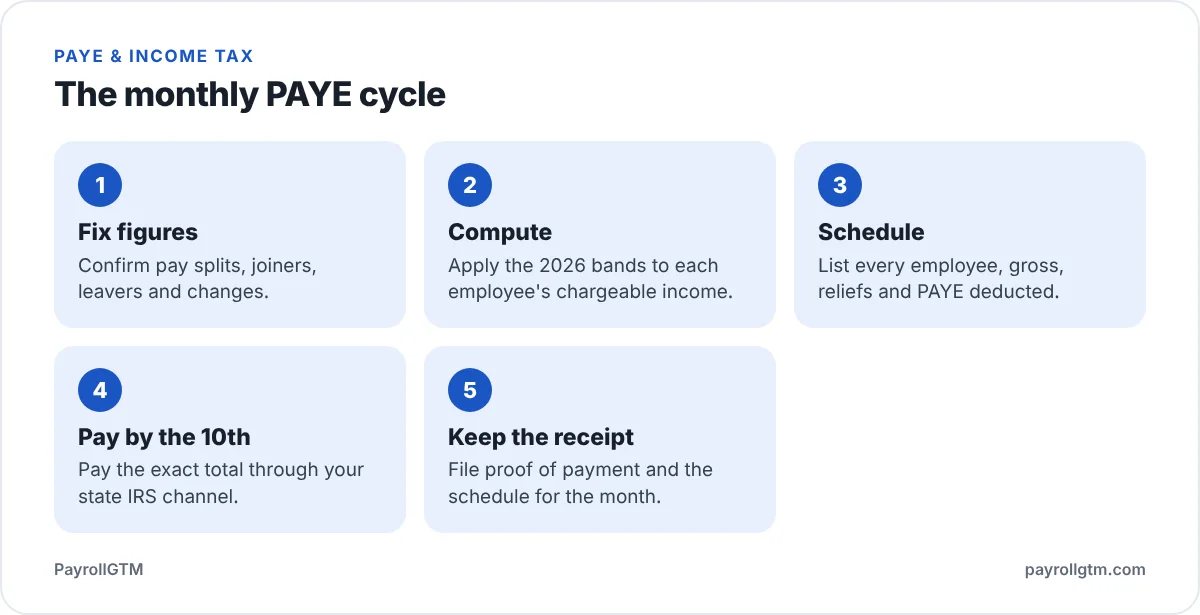
PAYE deducted from staff pay in a month is due to your state Internal Revenue Service by the 10th of the following month, usually with a schedule listing each employee and the tax taken. Salaries paid in October are therefore remitted by 10 November. That is state practice rather than a single federal date, so confirm the exact cut-off and payment channel with your state IRS when you register.
This guide follows one month of the cycle from payslip to receipt. It does not cover which authority your staff belong to; for that, see which tax authority gets the PAYE.
Step 1: Fix the payroll figures before anything is paid
The remittance is only as good as the payroll behind it. Before approving salaries, check that every employee's gross is split into basic, housing and transport plus any other allowances, because pension is calculated on the first three. The salary structure decides the pension line, and the pension line decides taxable pay.
Then confirm who joined, left or changed pay this month. A new hire who started on the 20th, a resignation, a promotion backdated by two months: each changes the tax figure. Arrears from an earlier month belong in the month they are paid, which is covered in how back pay is handled in payroll.
Step 2: Compute PAYE for each person
The method for 2026 is the same for everyone: annual gross, less 8% employee pension, less any evidenced reliefs such as rent relief, gives chargeable income. Apply the bands (first ₦800,000 at 0%, next ₦2,200,000 at 15%, next ₦9,000,000 at 18%, and so on), then divide the annual tax by 12. The old consolidated relief allowance no longer applies. If you are working backwards from a promised take-home figure, use the net-to-gross method.
Step 3: Prepare the PAYE schedule
Most state IRS offices want the tax to arrive with a schedule, either uploaded on an e-filing portal or handed in with proof of payment. Formats differ by state, so ask for your state's template. The content is nearly always the same.
| Column | What goes in it | Common error |
|---|---|---|
| Employee name and Tax ID | Name as on the tax record, plus the Tax ID or the number your state IRS issued | Missing or mistyped ID, so the credit is not matched |
| Gross pay for the month | Total taxable earnings including allowances | Leaving out a bonus or overtime |
| Pension and other reliefs | Employee 8% and any other deduction you are claiming for them | Claiming rent relief with no evidence on file |
| Taxable pay | Gross less the reliefs | Using last year's relief rules |
| PAYE deducted | The tax taken from the payslip | Schedule differs from the payslip by a few naira |
| Total | Sum of the PAYE column | Total does not equal the amount actually paid |
Keep the schedule in the same order as your payroll register so that anyone checking it can tick line against line. The same data feeds the annual return, which is why the Form H1 filing in January becomes easy when twelve monthly schedules are tidy.
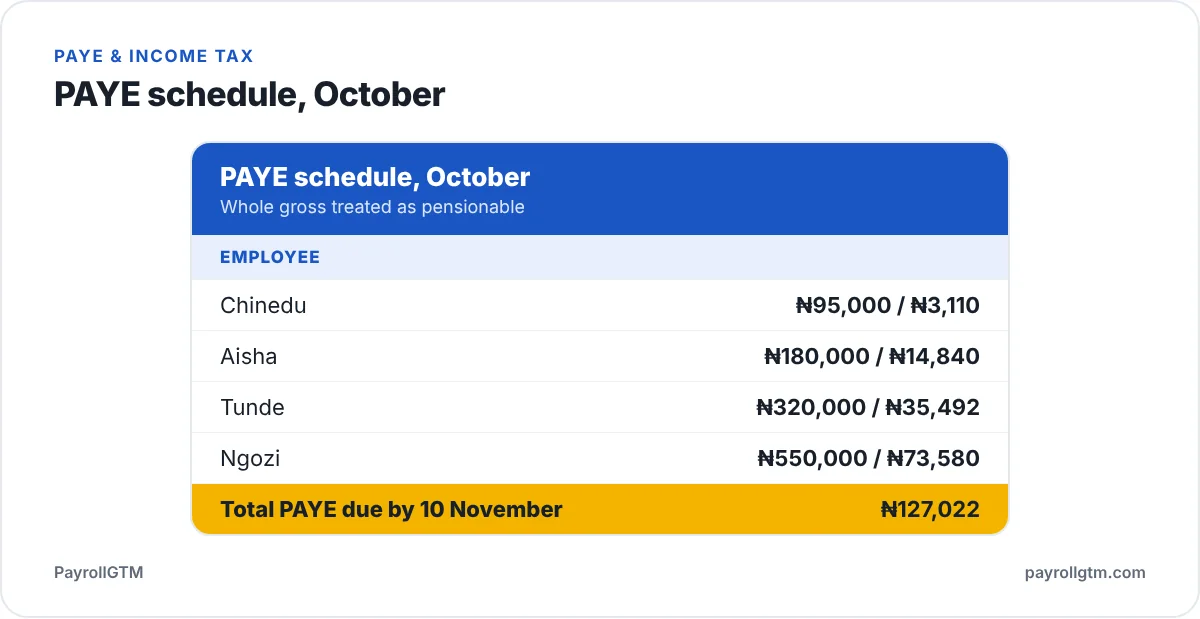
Step 4: Pay, and pay the right amount
Pay the exact total on the schedule. If you pay ₦127,000 against a ₦127,022 schedule, the balance sits as an arrear on your account. Use the channel your state IRS tells you to use (portal, designated bank or a remittance code), and put the employer name and the month in the payment narration so the payment can be matched.
Do not net the PAYE against what the business thinks it is owed elsewhere, and do not hold it back because cash is tight. The money was deducted from employees, so it is not the business's cash to spend. A common pattern in small firms is to remit pension and PAYE only after salaries and rent are sorted; by the 10th the account is empty and the month slips.
Step 5: Keep the receipt and file the proof
Save the payment evidence, the schedule and any acknowledgement your state IRS gives, in one folder per month. An auditor will ask for these, and so will an employee who is changing jobs and needs proof that tax was paid on their salary. See how to prepare for a payroll tax audit for how long to keep them and what else is asked.
Also match the PAYE paid against your payroll ledger at month end. If the ledger says ₦127,022 and the bank says ₦127,022, you are done. If they differ, find out why before the next payroll.
Situations that trip up the schedule
Staff living in different states. PAYE follows the employee's state of residence, not the office address. A Lagos shop with one cashier who lives in Ogun State may owe two state IRS offices, each with its own schedule. Collect a current home address for every employee at hiring and update it when someone moves.
A leaver who is paid late. If Segun resigns on the 15th and his final pay is processed in the next month, the tax on that final pay belongs on the schedule for the month it is paid. Do not leave him off because he is no longer on the staff list.
Salary paid in two parts. Some employers pay half the month's salary early and the balance later. Tax the month as a whole, and remit by the 10th after the month in which the last part is paid, unless your state IRS tells you otherwise.
A schedule with no tax. An employee earning ₦70,000 a month pays no PAYE, because the first ₦800,000 a year is taxed at 0%. Still list them with a nil figure. A complete list is what lets the annual return reconcile.
What a late remittance costs
The penalties below are as reported in practice; confirm the exact rate and interest with your state IRS before relying on them. Reported figures are 10% of the unremitted tax plus interest at the prevailing CBN rate. On the ₦127,022 above, the 10% alone is about ₦12,702, with interest on top and the original tax still owed.
Late is not the only way to get this wrong. Under-deducting because a salary rise was not reflected, using the wrong pensionable base, or leaving a casual worker off the schedule all create a gap that the state IRS can assess from your records later. The Nigeria Tax Administration Act 2025 allows the tax authority to make an administrative assessment from available records where you have not filed. For the wider list of default charges, see penalties for late PAYE and other payroll defaults.
Pension has its own, separate clock: contributions go to each employee's RSA within 7 working days of paying salaries, with 2% a month on late amounts. Do not treat the two as one deadline; read the pension remittance rules and calendar them separately.
A one-month calendar to copy
- Last working day before payday: freeze changes, review variances against last month.
- Payday: pay salaries, issue payslips.
- Within 7 working days of payday: remit pension to the PFAs.
- By the 5th of next month: finalise the PAYE schedule and get payment approved.
- By the 10th: pay and save the receipt.
Setting your internal date at the 5th gives you a buffer for a portal that is down or a signatory who is away. If you also want the whole run laid out end to end, read the step-by-step payroll run. Employees have a separate duty to file their own annual returns, explained in whether employees file annual tax returns, so keep the monthly records clean enough to give them if asked.