The penalty depends on what you missed. A late Form H1 costs ₦100,000 for the first month and ₦50,000 for each month after (Nigeria Tax Administration Act s.96). Late pension remittance costs 2% of the unremitted contribution for each month of delay (Pension Reform Act s.11), on top of the contribution itself. For PAYE, the figures commonly reported are 10% of the unremitted tax plus interest, and 40% where tax should have been deducted but was not. Treat the reported figures as a guide and confirm them with your state IRS.
The penalties side by side
This table lists the main payroll defaults for a private employer, the penalty, and how firm our source is.
| Default | Penalty | How firm is it |
|---|---|---|
| Employer annual return (Form H1) filed late | ₦100,000 first month, ₦50,000 each month after | Stated in NTAA s.96 |
| PAYE deducted but not remitted on time | 10% of the unremitted tax plus interest at the prevailing CBN rate | Reported. Confirm with your state IRS |
| PAYE not deducted when it should have been | 40% administrative penalty on the tax | Reported. Confirm with your state IRS |
| Pension contribution remitted late | 2% of the unremitted amount for each month of delay | Stated in PRA s.11 |
| No group life cover | Not priced here, we have no confirmed figure | Duty under PRA s.4(5), see the group life guide |
| No tax assessment because you did not file | Tax authority can assess you from the records it has (NTAA s.34) | Stated in NTAA s.34 |
NSITF, ITF and CAC each have their own consequences for late payment or filing. We do not state their amounts here because they are set in other laws and notices. See the linked guides for each, and ask the agency for the current figure.
Worked example: pension paid four months late
A Port Harcourt firm has 8 staff on ₦300,000 a month, all of it pensionable. The statutory minimum is 8% from the employee and 10% from the employer. The firm forgets to remit one month's contributions and pays them four months after the deadline.
Per employee: employee 8% = ₦24,000, employer 10% = ₦30,000, total ₦54,000.
For 8 staff: 8 × ₦54,000 = ₦432,000 unremitted for that month.
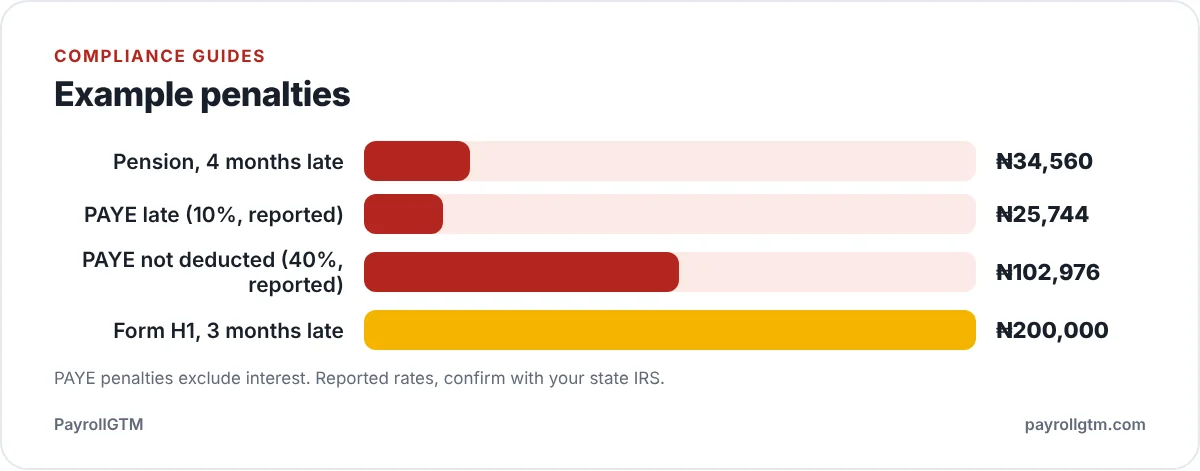
Penalty: 2% × 4 months = 8% of ₦432,000 = ₦34,560.
Total paid: ₦432,000 + ₦34,560 = ₦466,560.
The ₦34,560 looks small, and that is the trap. The contributions are the employees' money, and the delay also means four months of missing investment growth in each RSA, plus a compliance record that may cause trouble when you apply for a PenCom compliance certificate. If the firm has done this for a whole year, the figure is twelve times larger before any other consequence. Use the pension remittance deadline guide to see the 7-working-day rule that starts the clock.
Worked example: PAYE not remitted
The same 8 staff each pay PAYE of ₦32,180 a month on ₦300,000 (taken from the PAYE calculator with the whole gross as pensionable). Total PAYE for the month is 8 × ₦32,180 = ₦257,440.
If the ₦257,440 is deducted from payslips but not paid to the state IRS by the 10th of the next month, the reported 10% penalty is ₦25,744, plus interest at the prevailing CBN rate for the days outstanding.
If instead the firm never deducted the tax at all, the reported 40% administrative penalty on ₦257,440 is ₦102,976, and the firm may also be asked to account for the tax itself. The employee cannot recover it from the firm simply by asking, so payroll should deduct it correctly in the first place.
The monthly routine is covered in PAYE remittance deadlines and how to pay.
Worked example: Form H1 filed three months late
The annual return of employees' emoluments (Form H1) is due on 31 January. Suppose a firm files in the third month after the deadline. Using the stated amounts, the penalty runs ₦100,000 for the first month, then ₦50,000 for the second and ₦50,000 for the third: ₦100,000 + ₦50,000 + ₦50,000 = ₦200,000. Whether a part month counts as a full month is a point to confirm with your state IRS, so do not rely on our count to the day. Our Form H1 guide lists what the return needs, and the penalty stops growing the month you file, so file even if the schedule is imperfect and correct it later.
Paying the wrong amount is also a default
Late is only one way to fail. The other is paying on too small a base. The statutory minimum is calculated on at least basic, housing and transport, but many small firms apply it to basic salary alone because the payroll template was set up that way.
Each of the 8 staff earns ₦300,000: basic ₦150,000, housing ₦75,000, transport ₦45,000, other allowances ₦30,000. The correct pensionable pay is ₦270,000, so 18% is ₦48,600 a month. The firm has been paying 18% of basic only, ₦27,000. The shortfall is ₦21,600 per person a month. Across 8 staff over 12 months: ₦21,600 × 8 × 12 = ₦2,073,600 of contributions never paid, before any monthly penalty on the shortfall.
This is an easy default to fall into and an easy one to spot, because checking it needs only a payslip and a pension schedule. Check how pension contributions are calculated against your own salary structure now. If you find a gap, treat it like any other: pay the back contributions into the RSAs and write to PenCom.
How to fix a default after the fact
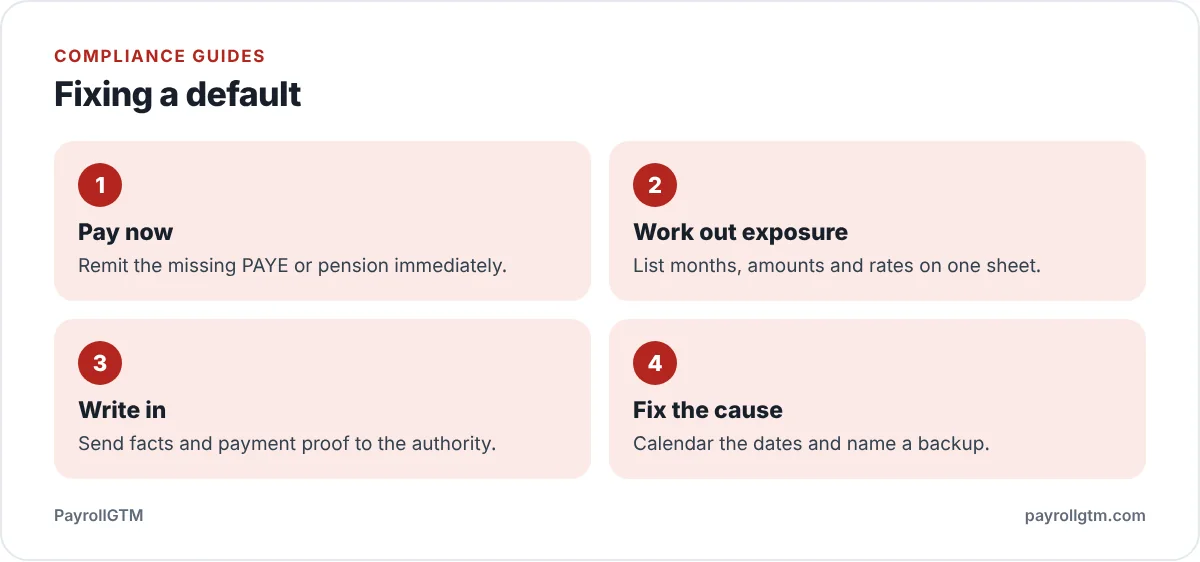
If you find a default in your own records, work in this order:
- Stop the loss. Remit the missing PAYE or pension now. Interest and monthly penalties both grow with time.
- Calculate your own exposure. Put the months, amounts and the penalty rate on one sheet. Use the stated or reported rates above and mark which is which.
- Write to the authority. Send a short letter to the state IRS (or PenCom for pension) stating what happened, the period, the amount paid and your payment evidence. Ask whether a penalty waiver or a voluntary disclosure route exists. We cannot promise one does. Ask in writing and keep the answer.
- Fix the cause. Most defaults come from one person holding the whole process or from cash being spent before the remittance date. Put the dates in a calendar and assign a backup. The payroll compliance calendar is a starting point.
If a tax audit is already underway, read how to prepare for a payroll tax audit before you send anything.
Where small employers get caught
- Staff were paid but the pension schedule was never sent to the PFAs, so the money sat in the bank. See the common payroll mistakes.
- The firm never registered for PAYE with the right state, so nothing was remitted at all. Check the registration checklist.
- Group life cover lapsed. The employer pays the premium, and the cover must be at least 3 times annual total emolument, see the group life requirement.
- The CAC annual return was ignored for years, a separate filing with its own penalties covered in the CAC annual returns guide.
Penalty rules and administrative practice change, and states apply them differently. Before paying any assessed figure, ask the authority for the computation in writing.