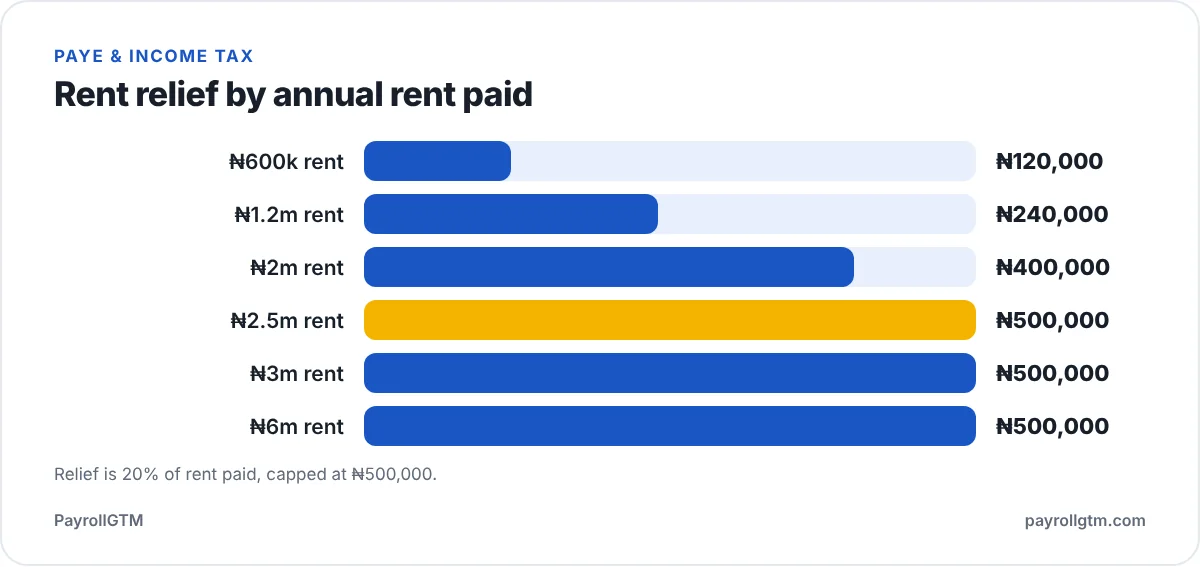
Rent relief under the Nigeria Tax Act 2025 is 20% of the annual rent you actually pay, capped at ₦500,000 a year. Rent of ₦2.5 million or more reaches the cap, so a tenant paying ₦3 million still gets ₦500,000 off taxable income, not ₦600,000. It reduces the income your PAYE is worked out on; it is not a refund of 20% of your rent.
You do not get it automatically. It replaced the old Consolidated Relief Allowance from 1 January 2026, and it only applies if you show your employer (or your state IRS) proof that you pay rent. This guide walks through the claim in order, with real figures. For how it fits into the wider calculation, see how rent relief replaced the old CRA.
Step 1: Check that you qualify
The relief is for rent paid by the individual, for the place where they live. Three situations trip people up.
- Your employer pays your rent. If the company rents the flat and you just live in it, you are not paying rent, so there is nothing to claim. Housing provided by an employer is a different matter, covered in benefits in kind such as company housing.
- You live in your own house. No rent, no rent relief. Interest on a loan for an owner-occupied house may be a separate deduction if properly evidenced, but that is a different claim.
- Your family pays. If your brother or father pays the landlord, the rent is not yours. Claim only what comes out of your own pocket.
The relief is based on rent paid in the tax year, not the rent written on the agreement. A tenant who moves in on 1 October and pays a year's rent upfront in October has paid one year's rent in that tax year, and that is the figure to use. A tenant who pays half-yearly and has paid only the first half by December has paid half.
Step 2: Work out the relief
The arithmetic is two lines: take 20% of the rent paid in the year, then compare the answer with ₦500,000 and use whichever is smaller.
This table shows what different annual rents give you.
| Annual rent paid | 20% of rent | Relief you get |
|---|---|---|
| ₦600,000 | ₦120,000 | ₦120,000 |
| ₦1,200,000 | ₦240,000 | ₦240,000 |
| ₦2,000,000 | ₦400,000 | ₦400,000 |
| ₦2,500,000 | ₦500,000 | ₦500,000 (cap reached) |
| ₦3,000,000 | ₦600,000 | ₦500,000 (capped) |
| ₦6,000,000 | ₦1,200,000 | ₦500,000 (capped) |
Someone in a ₦6 million flat in Lekki and someone in a ₦2.5 million flat in Ikeja get the same relief. Past ₦2.5 million, extra rent buys you no extra tax saving.
Step 3: See what it saves in real money
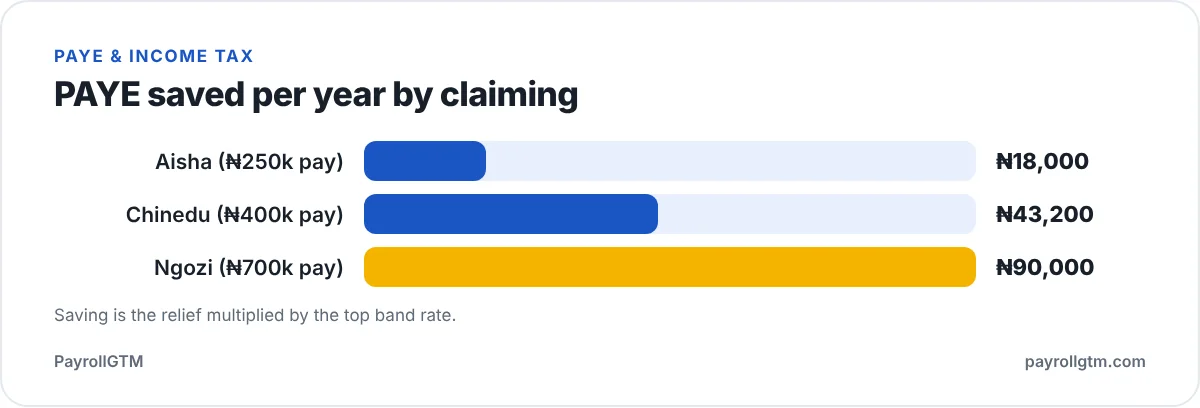
Relief is deducted from income before the tax bands are applied, so the saving is the relief multiplied by your top band rate. Someone whose last naira falls in the 15% band saves 15 kobo per naira of relief; someone in the 18% band saves 18 kobo. We ran each case through the same calculation method used on the PAYE calculation page, treating the whole salary as pensionable.
Annual pay is ₦3,000,000. Pension at 8% is ₦240,000. Without a claim, chargeable income is ₦2,760,000 and PAYE is ₦294,000 a year (₦24,500 a month). Her rent relief is 20% of ₦600,000 = ₦120,000, so chargeable income falls to ₦2,640,000 and PAYE to ₦276,000 (₦23,000 a month). She saves ₦18,000 a year, or ₦1,500 a month, because her top band is 15%.
Annual pay is ₦4,800,000 and pension is ₦384,000. Without a claim, chargeable income is ₦4,416,000 and PAYE is ₦584,880 a year (₦48,740 a month). Relief is ₦240,000, so chargeable income becomes ₦4,176,000 and PAYE ₦541,680 (₦45,140 a month). The saving is ₦43,200 a year, ₦3,600 a month, at the 18% band.
Annual pay is ₦8,400,000 and pension is ₦672,000. Without a claim, chargeable income is ₦7,728,000 and PAYE is ₦1,181,040 a year (₦98,420 a month). Twenty per cent of her rent is ₦600,000, but the cap holds it to ₦500,000. Chargeable income becomes ₦7,228,000 and PAYE ₦1,091,040 (₦90,920 a month). She saves ₦90,000 a year, ₦7,500 a month. Had she paid ₦2.5 million in rent instead, the result would be identical.
So the claim is worth between a few hundred and a few thousand naira a month for most salaried staff. It is still worth the paperwork. Forgetting it for a full year at Ngozi's level costs ₦90,000.
Step 4: Gather the documents
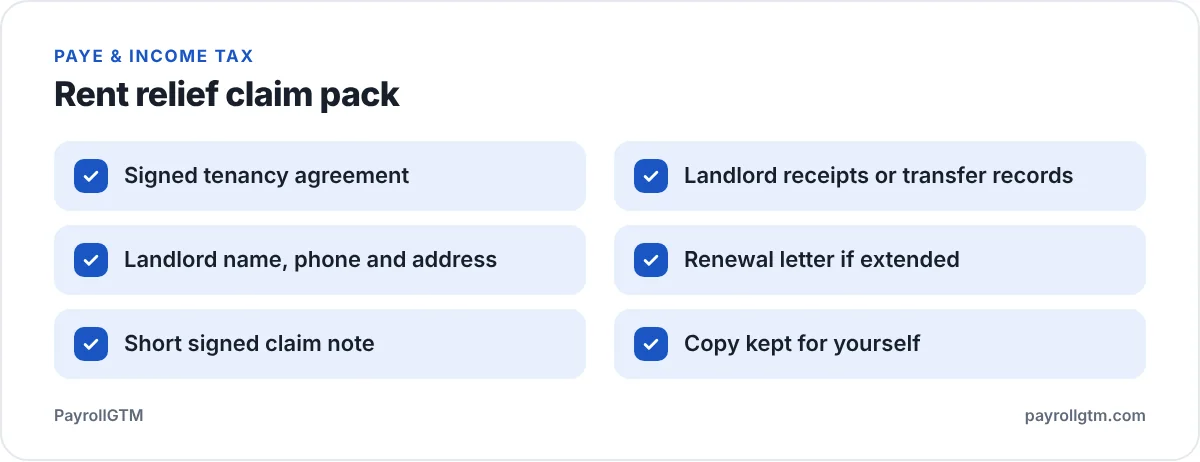
The Act gives the relief on rent actually paid, which means you should expect to prove it. We do not have a published list of the exact documents each state IRS accepts, so your employer's payroll team and your state IRS will tell you what evidence they take. The usual set is:
- The signed tenancy agreement showing the address, the annual rent, the term and both names.
- Receipts from the landlord or agent for each payment, or bank transfer records that show the landlord's account name.
- The landlord's full name, phone number and address, since a payroll officer may need them on the claim form.
- Any renewal letter if the agreement ran out and the landlord extended it informally.
Pay by bank transfer where you can. A transfer record with the landlord's name next to the amount is much easier to defend than a handwritten note for cash. If you pay an agent, ask for a receipt that names the landlord and the flat. In Lagos and Abuja many landlords insist on cash or on one lump payment through an agent, and these are the claims that end up short of paper.
Step 5: Give the claim to payroll
Most employers will want the claim once a year, early in the year, so they can build it into monthly PAYE from January. A short written note with the documents attached is usually enough: your name, staff number, address of the flat, annual rent, landlord name, and the attached agreement and receipts. Keep a copy.
What happens next depends on the employer. A careful payroll team will check that the rent paid supports the figure, enter the relief on your payroll record and recalculate PAYE from that month. Your payslip should then show a lower PAYE line. If it does not change, ask for the calculation. A common office mistake is entering the relief but forgetting to reduce taxable pay, which leaves the payslip looking right while the PAYE is unchanged.
If you missed the January window, send the claim as soon as you have the documents. Ask payroll how they handle the months already run: some will recompute the whole year and take the difference off later months, others will leave it for your annual return. The practice is not uniform, so ask rather than assume. For how annual returns fit in, see whether employees file annual tax returns in 2026.
What if your rent changes during the year
Rent changes are common: a renewal at a higher price, a move to a new flat, or a landlord who accepts a lump sum later than agreed. The relief follows what you pay in the tax year.
Tunde pays ₦150,000 a month (₦900,000 a year) until June, then moves to a flat at ₦2,400,000 a year, paid upfront in July. Rent paid in the year is ₦450,000 (six months) plus ₦2,400,000 = ₦2,850,000. Twenty per cent is ₦570,000, so the cap applies and his relief is ₦500,000. His payroll team needs both agreements and both sets of receipts, and should adjust from July when the new payment is evidenced.
If you stop paying rent mid-year (you buy a house, or move in with family), tell payroll. Relief based on rent you no longer pay should not carry on. This is the point that second-year claims most often get wrong: staff submit last year's agreement again and nobody checks whether it still applies.
Where rent relief does not help
Because it only lowers taxable income, it does nothing for someone who already pays no PAYE. An employee on the national minimum wage is outside PAYE anyway, as covered in whether minimum wage is taxable, and the first ₦800,000 a year is taxed at 0% in any case, so relief on that slice saves nothing. It also does not fix a second job. If you work for two employers, the rent claim should go to one of them, not both; the interaction is explained in PAYE for a second job or two employers.
It sits alongside other deductions, not instead of them. Pension, health insurance and other evidenced items stack on top, as set out in deductions that reduce PAYE in Nigeria. Self-employed people claim differently, since there is no employer to run it through; see tax for freelancers and the self-employed. To see your own net pay after the claim, try the payroll calculator or read salary after tax in Nigeria in 2026.
One honest limit: the procedure for submitting evidence is set by each state IRS and each employer, and may change as the new tax administration rules settle. Ask your payroll officer for the form, and if the state IRS has issued its own guidance, follow that.