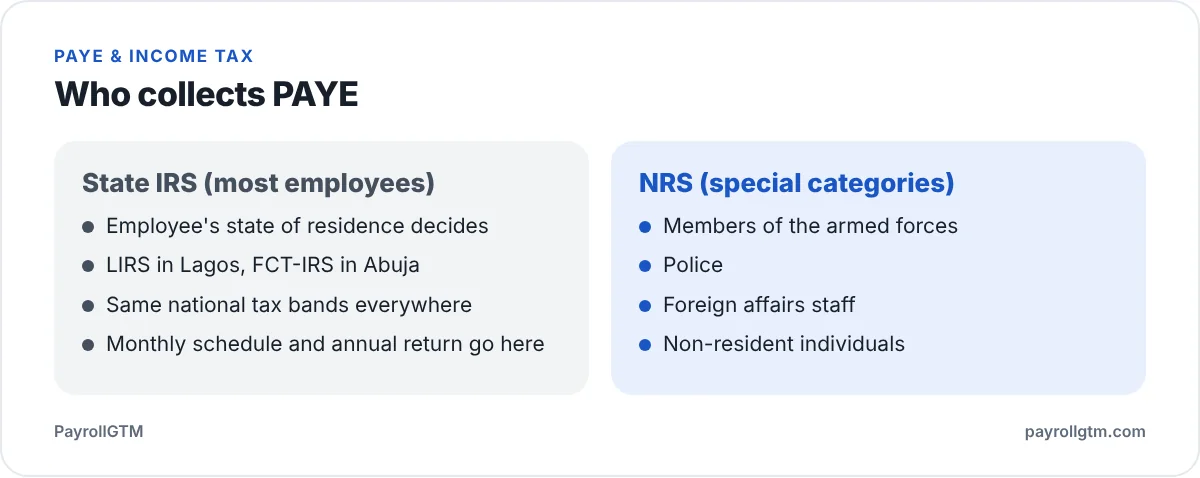
PAYE goes to the State Internal Revenue Service of the state where the employee lives, not the state where the company is registered or where the office stands. For a worker living in the Federal Capital Territory that office is FCT-IRS. A few categories of employee, such as members of the armed forces, police and foreign affairs staff, and non-residents, are handled by the Nigeria Revenue Service (NRS) instead.
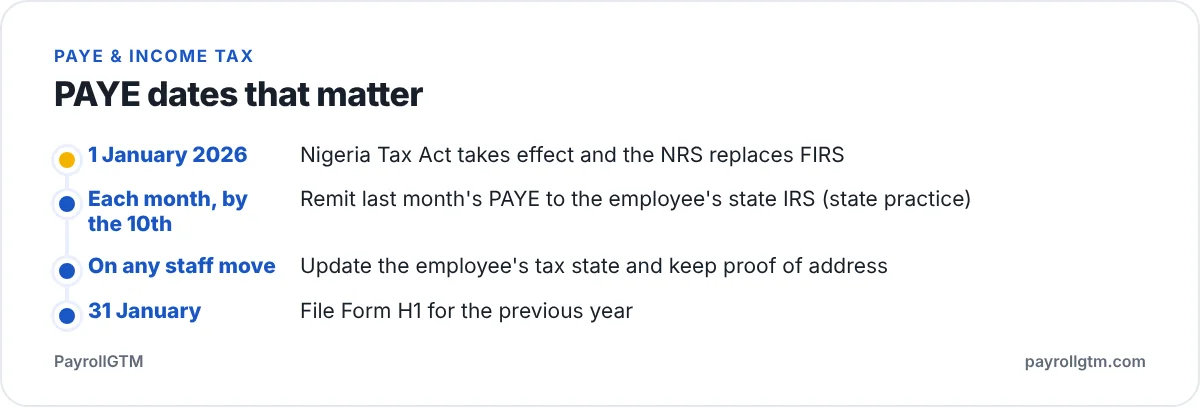
If you still have "FIRS" in your payroll notes, update it. The Federal Inland Revenue Service was replaced by the NRS from 1 January 2026, the same day the Nigeria Tax Act 2025 took effect. For ordinary private-sector employees, though, the NRS is not the office you pay PAYE to.
Which office collects PAYE for a normal private-sector employee?
The state IRS for the employee's state of residence. In Lagos that is LIRS, in Ogun the Ogun State Internal Revenue Service, in Abuja FCT-IRS, and so on. The employer deducts the tax from salary and sends it to that office, with a schedule listing each employee.
The rate card is national: the same bands apply in Kano and in Port Harcourt (0% on the first ₦800,000 a year, then 15%, 18%, 21%, 23% and 25%). Only the collector changes. If you want the arithmetic itself, see how to calculate PAYE in Nigeria in 2026.
Which categories go to the NRS instead?
As we read the rules, the NRS takes PAYE for members of the armed forces, the police, staff of the foreign affairs ministry posted abroad, and non-resident individuals. Most small and medium employers will never have an employee in any of these groups. If you do, for example a former police officer who has left the service and now works for you, ask your state IRS to confirm the status before you decide where the money goes.
We have not seen a published list that settles every edge case, so treat this as the general rule and confirm in writing when an employee does not fit neatly.
What if the employee lives in Ogun but works in Lagos?
This is the commonest real-life case, and the answer follows residence, not the workplace.
Chinedu earns ₦360,000 a month (basic ₦200,000, housing ₦100,000, transport ₦60,000) and works on Lagos Island. He lives in Sagamu, Ogun State, and pays ₦1,200,000 a year in rent. Using the PAYE tool we use across the site:
- Annual gross: ₦4,320,000
- Employee pension at 8% of ₦360,000: ₦28,800 a month, ₦345,600 a year
- Rent relief: 20% of ₦1,200,000 = ₦240,000
- Chargeable income: ₦4,320,000 - ₦345,600 - ₦240,000 = ₦3,734,400
- Tax: ₦0 on the first ₦800,000, ₦330,000 on the next ₦2,200,000, ₦132,192 on the remaining ₦734,400, so ₦462,192 a year
- Monthly PAYE: ₦38,516
That ₦38,516 belongs to the Ogun State IRS, not LIRS, even though the payslip is produced in Lagos.
In practice, some commuting employees are surprised when a Lagos office asks about them. If a state IRS queries you, the clean answer is the employee's proof of address: a tenancy agreement, a utility bill in their name, or a signed residence declaration kept on file. Whether a state accepts a declaration alone or insists on a document varies, so ask. Do not assume that "we have always paid Lagos" settles it.
How do I find out where each employee lives for tax?
Ask on the onboarding form and keep evidence. A good minimum is the home address as it appears on a utility bill or tenancy agreement, plus the state, plus a line saying the employee will tell payroll within 30 days of moving. Change that 30 days to whatever suits you; the point is that someone owns the update.
Then add a "tax state" column to your payroll sheet next to each name. When you send the monthly schedule, you filter by that column. If you use the same form for pension and rent relief, you also collect the evidence for claiming rent relief in the same sitting. Also record each person's Tax ID; the Tax ID and NIN guide explains what has been reported about the new unified system.
What if my staff live in several states?
Then expect to deal with several state IRS offices, because each collects on the employees resident in its state. A Lagos head office with a branch in Abuja and one remote worker in Enugu has three collectors.
A Lagos firm has 14 employees. Eleven live in Lagos, two in Abuja (Aisha and Ibrahim) and one in Ogun (Segun). Each month it prepares three schedules: eleven names for LIRS, two for FCT-IRS and one for Ogun. Three payments, all due by the 10th of the following month under normal state practice.
Whether you must register as an employer separately in each state, or whether a state accepts a single registration with a schedule for non-resident staff, differs from state to state, and we cannot give you a rule that holds everywhere. Call the state IRS before the first payroll that includes someone living there. For the registration steps in your home state, see how employers register for PAYE with the state IRS.
Paying every employee's PAYE to the state where the company is registered because that is where the account was opened. If the tax belonged to another state, the money is still owed there. Reported penalties for unremitted PAYE are 10% of the tax plus interest, so a year of misdirected payments for even a handful of people can turn into a real bill. Confirm the current penalty with the state concerned.
Does the same rule apply to remote workers and contractors?
For a remote employee on your payroll, yes: their state of residence decides, wherever your office is. Our guide on remote and hybrid work policies suggests collecting a current address every time someone relocates.
A genuine contractor is not on PAYE at all; they handle their own tax. Do not use that to avoid PAYE for someone who is really an employee. The test is about how the relationship works in practice, covered in employee or contractor classification.
What changes when an employee moves state mid-year?
Treat the move date as the switch. Salary paid before it is reported to the old state, salary after it to the new one, and the annual return should reflect that split. Say Hauwa moves from Kaduna to Abuja in July: January to June PAYE goes to the Kaduna state IRS, July onward to FCT-IRS. Write the move date on her file and tell both offices if either asks. How a state wants a part-year employee shown on its schedule is a point to confirm with it directly.
Where do the annual returns go?
To the same place. The employer's annual return of employees' emoluments (Form H1) is due by 31 January for the previous year, and you send it to the tax authority collecting PAYE for those staff, so a multi-state employer may file in more than one state. States can run their own forms or portals, so ask each one for its current template. Details are in the Form H1 guide.
Separately, employees have their own filing duty under the Nigeria Tax Administration Act even where the employer files; read whether employees file annual tax returns before you tell staff they are covered.
Questions to put to the state IRS
When a case does not fit the general rule, these are worth asking in writing, so you have an answer to show if another office queries you later:
- Does the office accept a signed residence declaration, or does it want a document?
- Do we need a separate employer registration in your state for staff living here?
- Which form or portal do you want for the monthly schedule and the annual return?
- What is the current penalty and interest rate for late or wrong-state remittance?
Keep the reply with your payroll file. For the monthly timetable itself, see PAYE remittance deadlines and how to pay.