Under the old Personal Income Tax Act, an employee on ₦350,000 a month paid about ₦40,675 in PAYE. Under the Nigeria Tax Act rules for 2026, the same person pays ₦40,964 with no rent claim, and ₦36,464 if they claim ₦300,000 of rent relief on ₦1,500,000 of rent. The structure changed completely; for many mid-income employees the result barely moved.
The biggest winners are low earners, who now sit mostly inside a ₦800,000 zero band, and renters with evidence. The people who gain least are salaried staff who rent nothing and earn around ₦350,000 to ₦500,000. This article puts the two systems side by side so you can see which group you are in, and what an employer has to change on the payroll sheet.
The two methods in one view
The old rules applied to income up to 31 December 2025. The new ones apply from 1 January 2026.
| PITA method (to 2025) | Nigeria Tax Act (from 2026) | |
|---|---|---|
| Main relief | Consolidated Relief Allowance (CRA): the higher of ₦200,000 or 1% of gross, plus 20% of gross | None automatic. A zero-rated first ₦800,000 instead |
| Rent | No separate rent relief | 20% of rent actually paid, capped at ₦500,000, with evidence |
| Pension | Employee pension deducted | Employee pension (8%) deducted |
| Bands | 7%, 11%, 15%, 19%, 21%, 24% on ₦300,000, ₦300,000, ₦500,000, ₦500,000, ₦1,600,000, then the rest | 0% on ₦800,000, then 15%, 18%, 21%, 23%, 25% (top rate above ₦50,000,000) |
| Collector | State IRS (employees), FIRS for some groups | State IRS (employees), Nigeria Revenue Service (NRS, formerly FIRS) for some groups |
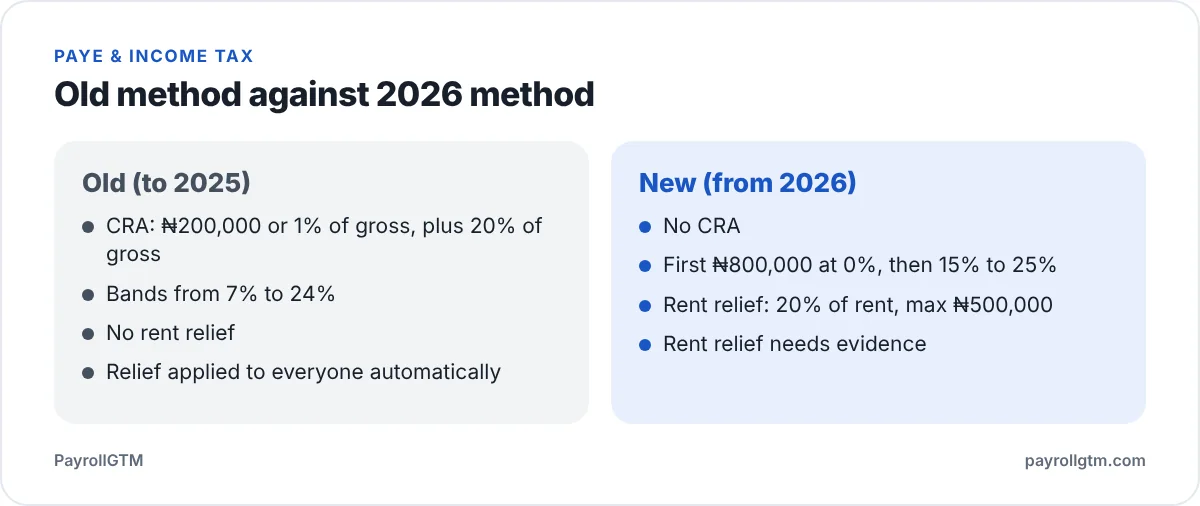
One thing sounds minor and is not: the CRA was automatic. Every employee got it whether or not they paid rent. The new system gives the equivalent value through the zero band for everyone, and then asks renters to prove what they pay.
The same salary under both systems
Take Obinna, an engineer in Port Harcourt. His gross is ₦350,000 a month: basic ₦175,000, housing ₦87,500, transport ₦52,500 and ₦35,000 other. Pensionable pay is ₦315,000, so employee pension is ₦25,200 a month, ₦302,400 a year under both systems.
- Annual gross: ₦4,200,000.
- CRA: 1% of gross is ₦42,000, which is less than ₦200,000, so ₦200,000, plus 20% of gross (₦840,000) = ₦1,040,000.
- Taxable income: ₦4,200,000 - ₦302,400 - ₦1,040,000 = ₦2,857,600.
- 7% on ₦300,000 = ₦21,000. 11% on ₦300,000 = ₦33,000. 15% on ₦500,000 = ₦75,000. 19% on ₦500,000 = ₦95,000. 21% on the last ₦1,257,600 = ₦264,096.
- Annual tax ₦488,096, monthly PAYE ₦40,675, take-home ₦284,125.
- Chargeable income: ₦4,200,000 - ₦302,400 = ₦3,897,600.
- 0% on ₦800,000 = ₦0. 15% on ₦2,200,000 = ₦330,000. 18% on ₦897,600 = ₦161,568.
- Annual tax ₦491,568, monthly PAYE ₦40,964, take-home ₦283,836.
The difference is ₦289 a month. Now add what is new: Obinna rents a flat for ₦1,500,000 a year and gives HR the tenancy agreement and rent receipts. Rent relief is 20% of ₦1,500,000 = ₦300,000. Chargeable income falls to ₦3,597,600, annual tax to ₦437,568, and monthly PAYE to ₦36,464. Take-home is ₦288,336, which is ₦4,211 a month better than in 2025.
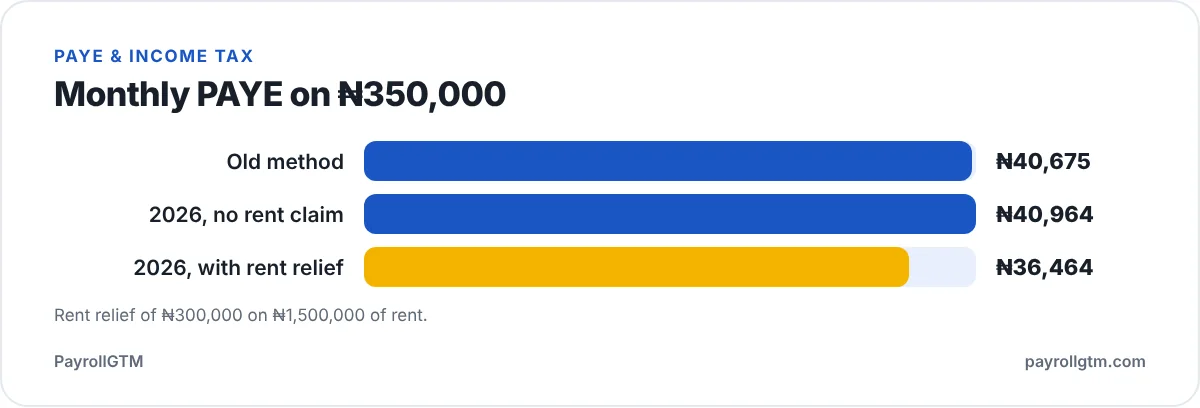
So the headline for a renter is real: the relief moved from "everyone" to "people who can show rent". If Obinna pays no rent, or cannot document it, he is where he was.
Where each salary level lands
We ran six salaries through both methods, each split 50% basic, 25% housing, 15% transport and 10% other, with no rent claim, no NHF and no other deduction. Monthly PAYE:
| Monthly gross | Old method | 2026 method | Change |
|---|---|---|---|
| ₦80,000 | ₦3,573 | ₦1,136 | ₦2,437 lower |
| ₦120,000 | ₦7,580 | ₦6,680 | ₦900 lower |
| ₦250,000 | ₦25,387 | ₦24,800 | ₦587 lower |
| ₦350,000 | ₦40,675 | ₦40,964 | ₦289 higher |
| ₦500,000 | ₦66,027 | ₦66,020 | ₦7 lower |
| ₦1,000,000 | ₦153,387 | ₦149,540 | ₦3,847 lower |
Read this as a rough guide, not a promise. Our old-method column follows the textbook CRA calculation described above and ignores things such as the old minimum tax rule and individual reliefs, so a real 2025 payslip could differ slightly. The 2026 column is exact for the stated inputs. For a full table of take-home pay at more salary levels, see salary after tax in Nigeria for 2026.
Why the lowest earners gain the most
Consider Zainab, a shop attendant in Kaduna on ₦80,000 a month (basic ₦40,000, housing ₦20,000, transport ₦12,000, other ₦8,000). Her pension is 8% of ₦72,000 = ₦5,760 a month, or ₦69,120 a year.
- Old: annual gross ₦960,000. CRA is ₦200,000 (1% of gross is only ₦9,600) plus 20% of gross, ₦192,000, so ₦392,000. Taxable income: ₦960,000 - ₦69,120 - ₦392,000 = ₦498,880. Tax: 7% on ₦300,000 = ₦21,000, plus 11% on ₦198,880 = ₦21,877, so ₦42,877 a year, or ₦3,573 a month.
- New: chargeable income ₦960,000 - ₦69,120 = ₦890,880. First ₦800,000 at 0%; 15% on ₦90,880 = ₦13,632 a year, or ₦1,136 a month.
Her take-home rises from ₦70,667 to ₦73,104, about 3.4% more. Her employer is not paying her less, but the change is visible on the payslip. Anyone earning the national minimum wage of ₦70,000 or less pays nothing at all.
Mistakes employers and employees make in the switch
- Claiming rent the employer pays. Rent relief is for rent the individual pays out of their own pocket. If the company provides the flat or reimburses the rent, there is nothing to claim. Check the benefits-in-kind position instead, in tax on company housing and other benefits.
- Taking 20% of rent with no cap. On rent of ₦4,000,000 the relief is ₦500,000, not ₦800,000.
- Expecting a refund for 2025. Income earned in 2025 stays under the old rules. The new method starts with 2026 pay.
- Using the old CRA because "the figures looked close". As the table above shows, they look close at ₦350,000 and ₦500,000 and are far apart at ₦80,000. Close at one salary is not a reason to keep a repealed formula.
The gain at the top is real but different in cause. At ₦1,000,000 a month the old 24% band started at ₦3,200,000 of taxable income, while the new 21% band covers chargeable income between ₦12,000,000 and ₦25,000,000. A high earner who also rents and claims the full ₦500,000 relief saves a further ₦90,000 a year if their top rate is 18%, or ₦105,000 at 21%.
What an employer must change
If you still run a 2025 payroll sheet in 2026, you are deducting the wrong amount for most staff.
- Delete the CRA column and replace the band table with the 2026 one. The step-by-step PAYE calculation gives the order of operations.
- Ask staff who rent to claim. Collect the tenancy agreement and receipts, record the annual rent, and apply 20% capped at ₦500,000. Keep copies; the state IRS can ask for them at audit. The rent relief claim guide has the document list.
- Check the exemption for minimum-wage earners. Staff on ₦70,000 a month or less pay no PAYE; see whether the minimum wage is taxable.
- Review part-year changes. If January to March was deducted on the old basis, the difference is a correction, not a surprise for the employee. How to handle it is covered in back pay and salary corrections.
- Update your own checklist. The January 2026 payroll changes checklist covers pension, Form H1 and the new tax authority names.
What did not change
Employee pension is still 8% of basic, housing and transport, with the employer adding at least 10%. Bonuses, 13th-month pay and leave allowances are still part of taxable income; the effect of timing is explained in PAYE on bonuses and leave allowance. A second job is still taxed with no second zero band; read PAYE for multiple employers before adding up two payslips.
Self-employed people follow a different filing route, covered in tax for freelancers and the self-employed.