Back pay is the difference between what an employee was paid and what they should have been paid, settled in a later month. It carries pension and PAYE like any other pay, but both are worked out against the year the money relates to, not as a one-off windfall. The cleanest way to handle it is to recompute the whole year and pay the gap, which is what the example below does.
The situation: a raise approved late
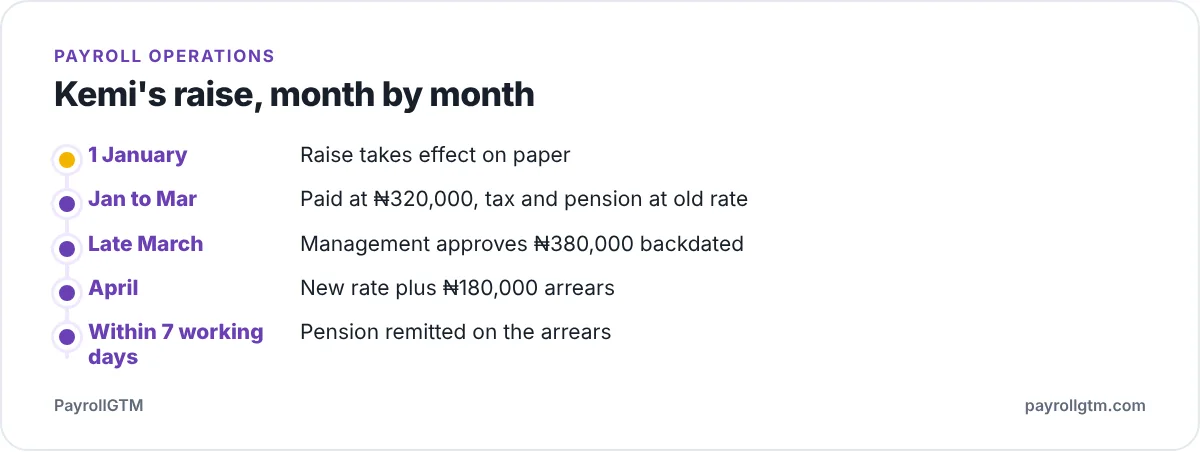
Kemi is an accounts officer. Her gross was ₦320,000 a month. Management approved a raise to ₦380,000 in the last week of March, effective 1 January. January, February and March salaries were already paid and PAYE and pension already remitted at the old figures. The raise first shows on the April payslip, so April must also carry three months of arrears.
Her package splits into basic ₦228,000, housing ₦95,000 and transport ₦57,000 at the new rate (all three are pensionable, so the whole ₦380,000 counts). Before the raise it was basic ₦192,000, housing ₦80,000 and transport ₦48,000.
Step 1: compute the arrears per component
Do it line by line, not on the total, because the components can be pensionable or not. Here the uplift is ₦60,000 a month (₦36,000 basic, ₦15,000 housing, ₦9,000 transport), and three months of it is ₦180,000. Write the working on a sheet and keep it with the approval letter.
| Component | Old | New | Monthly uplift | 3 months |
|---|---|---|---|---|
| Basic | ₦192,000 | ₦228,000 | ₦36,000 | ₦108,000 |
| Housing | ₦80,000 | ₦95,000 | ₦15,000 | ₦45,000 |
| Transport | ₦48,000 | ₦57,000 | ₦9,000 | ₦27,000 |
| Total | ₦320,000 | ₦380,000 | ₦60,000 | ₦180,000 |
If the raise had only touched a non-pensionable allowance, say a ₦60,000 "responsibility allowance" outside basic, housing and transport, the pension line on the arrears would be zero. Check what was actually approved before you assume.
Step 2: pension on the arrears
Pension follows the pensionable part of the arrears. All ₦180,000 is pensionable here, so the employee 8% is ₦14,400 and the employer 10% is ₦18,000, a total of ₦32,400 into Kemi's RSA. Those contributions are due within 7 working days of the salary payment that contained the arrears, so they go on the April remittance schedule, ideally as a visible separate line. Late remittance attracts the 2% monthly penalty described in the 7-working-day pension rule, and "we only noticed the arrears later" is not a defence an auditor will accept.
Step 3: the PAYE catch-up
PAYE is an annual tax spread over the months, so the question is: what is the right total tax for the year, and how much has already been withheld? We used the payroll calculator logic for each figure.
Annual gross at the new rate: ₦380,000 x 12 = ₦4,560,000. Pension at 8%: ₦364,800. Chargeable income: ₦4,195,200. Tax: 0% on the first ₦800,000, 15% on the next ₦2,200,000 (₦330,000), 18% on the remaining ₦1,195,200 (₦215,136). Annual PAYE: ₦545,136.
Already withheld or due on normal payslips: January to March at the old rate, ₦35,492 x 3 = ₦106,476. April to December at the new rate, ₦45,428 x 9 = ₦408,852. Total ₦515,328.
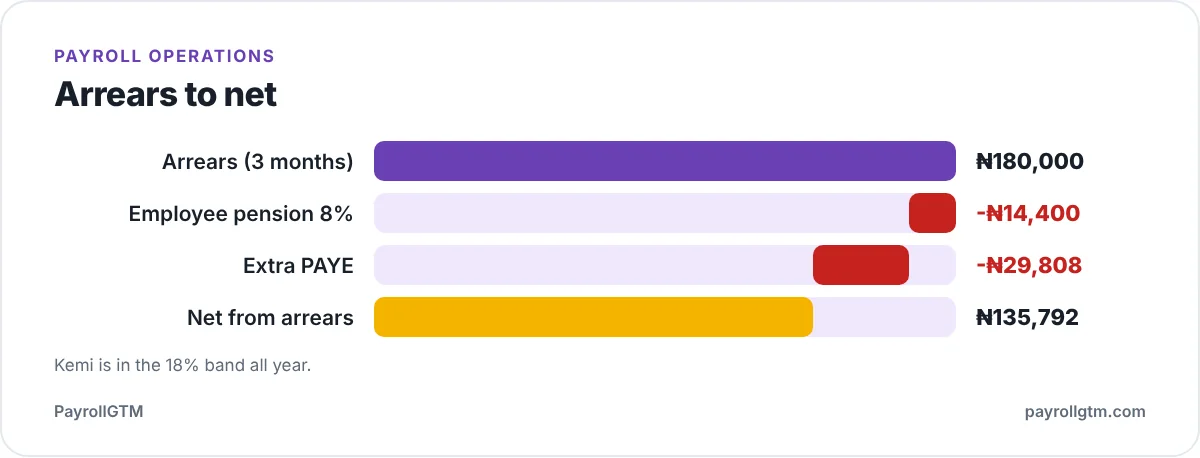
Shortfall: ₦545,136 - ₦515,328 = ₦29,808. Check: the arrears less pension is ₦180,000 - ₦14,400 = ₦165,600, and ₦165,600 x 18% = ₦29,808. Same answer.
Kemi sits in the 18% band for the whole year, so the extra tax on the arrears is simply 18%. For someone near a band edge, the arrears can push part of the year's income into a higher band, which is another reason to recompute the year rather than apply a flat percentage.
Her April payslip then looks like this.
| April payslip line | Amount |
|---|---|
| Gross salary (new rate) | ₦380,000 |
| Arrears, January to March (raise effective 1 January) | ₦180,000 |
| Employee pension 8% (on ₦560,000) | -₦44,800 |
| PAYE, normal April amount | -₦45,428 |
| PAYE on arrears | -₦29,808 |
| Net pay | ₦439,964 |
Arrears net of pension and tax come to ₦135,792 (₦180,000 - ₦14,400 - ₦29,808). Add her normal new net of ₦304,172 and you get ₦439,964. If the arithmetic does not reconcile this way on your own payslip, something has been missed.
What to tell the employee before payday
A larger-than-usual credit with an even larger deduction line draws questions on payday. Send a short note a few days earlier: the months the arrears cover, the gross amount, the pension and tax taken, and the net they should expect. Kemi's note would say she will receive about ₦135,792 on top of her new salary. It costs five minutes and prevents the "where is my money" message to HR.
Three mistakes recur. First, paying arrears in cash or a separate transfer outside payroll, which leaves no PAYE or pension record. Second, taxing only the arrears and forgetting the month's own PAYE changed with the new rate. Third, forgetting that a raise changes the employer's other costs: the NSITF 1% and, for employers above the threshold, the ITF 1%, are both worked out on the higher payroll.
Arrears that cross a tax year
If a raise approved in January 2026 is backdated to October 2025, part of the money relates to a year taxed under the old rules (the 2025 PITA bands and the old relief system), while the payment falls in 2026. The Nigeria Tax Act changed the bands from 1 January 2026, and we have no confirmed official guidance on which year's rules apply to such arrears. Ask your state IRS in writing, keep the reply, and tell the employee what you were told. The same caution applies to the January 2026 payroll changes.
When you overpaid
The opposite problem is just as common: a salary paid twice, a leaver paid for a month they did not work, a raise keyed in wrongly. The first rule is not to simply cut the next salary. Wages should be paid in full unless a lawful deduction applies, and deductions for recovery normally need the employee's written agreement. Our guide on lawful deductions from wages covers the limits.
- Tell the employee in writing the same week: the amount, the month, the reason and the evidence (bank statement line, payroll register).
- Agree repayment: lump sum, or instalments that leave a fair take-home. A ₦40,000 duplicate payment recovered at ₦10,000 a month for four months is reasonable. Half a salary for one month is not.
- Get the employee to sign the agreement. Keep it in the personnel file.
- Treat tax carefully. If the overpayment was salary in the same year, reverse it through payroll and recompute the year. If it falls in a closed year, ask the state IRS rather than adjusting old returns yourself.
- Where a pension contribution was overpaid, tell the PFA. Recovering it is a PenCom and PFA process, not a payroll deduction.
Document every correction
Auditors look at corrections hard because they are where errors and fraud hide. Keep for each one: the approval (letter or email from someone with authority), the arrears working sheet, the recomputed PAYE, the revised remittance schedules, the payslip, and a note of who prepared and who checked. Your payslip layout should show arrears as its own line with the months covered. For the run itself, see how to run payroll step by step, and add arrears to your monthly reconciliation so they are matched to approvals. If the raise changes the structure rather than just the total, how salary is split into basic, housing and transport decides what counts for pension.