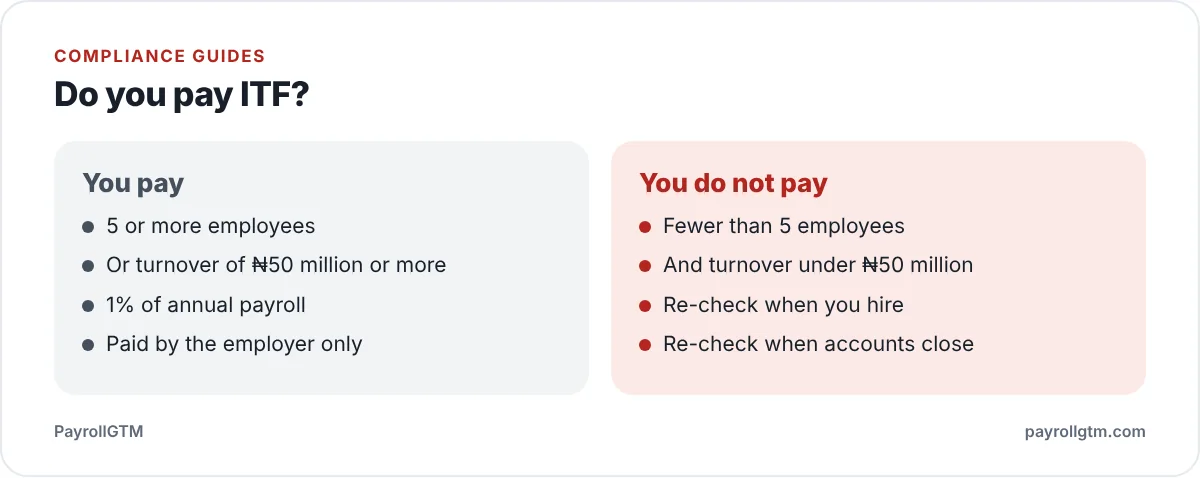
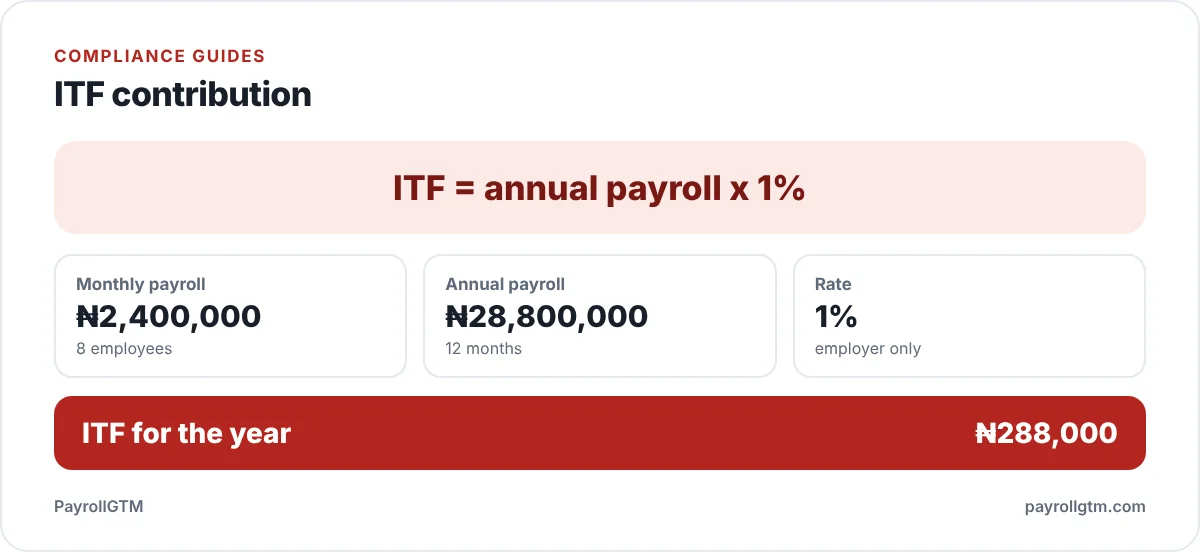
You pay ITF if your business has 5 or more employees, or an annual turnover of ₦50 million or more. The contribution is 1% of annual payroll, paid by the employer alone, never deducted from staff pay. A company with 8 employees and a monthly payroll of ₦2,400,000 owes ₦288,000 a year.
Step 1: do you have to pay?
Two tests, and either one is enough. Under the Industrial Training Fund Act (as amended in 2011), an employer is caught if it has 5 or more employees or a turnover of ₦50 million or more a year. Meeting one test is not cancelled by failing the other.
That means a trading company with 3 employees and ₦64 million turnover pays, while a 4-person consultancy turning over ₦20 million does not. Count carefully. The ITF's own guidance decides how part-time and casual staff are counted, and we do not have a figure we would quote, so if you sit at 4 or 5 and your staff mix is irregular, ask the ITF directly before you decide you are out.
| Business | Employees | Turnover | Pays ITF? |
|---|---|---|---|
| Bola's bakery, Ibadan | 6 | ₦32m | Yes (headcount) |
| Ibrahim's import agency, Kano | 3 | ₦64m | Yes (turnover) |
| Yetunde's design studio, Lagos | 4 | ₦20m | No, under both tests |
If you are under both tests today, check again each time you hire and each time you close the year's accounts. Many young businesses cross ₦50 million without noticing because they watch profit and not turnover. The first-year payroll compliance guide lists what to register as you grow.
Step 2: work out the annual payroll
The rate is 1% of annual payroll. Payroll means the total pay you give employees in the year, and we are confident that it covers more than basic salary: housing, transport and other regular allowances are normally part of it. Whether a given item, such as a one-off bonus, a benefit in kind or a payment to a contractor, falls inside the ITF's definition is a point to confirm with the ITF. Do not drop allowances from the base just to shrink the bill.
The cleanest way to get the figure is from your payroll register: add the twelve monthly gross totals. A payroll reconciled each month, as described in common payroll mistakes, makes this a five-minute task.
- Total monthly gross pay: ₦2,400,000
- Annual payroll: ₦2,400,000 x 12 = ₦28,800,000
- ITF at 1%: ₦28,800,000 x 1% = ₦288,000
- Set aside each month: ₦288,000 / 12 = ₦24,000
Where headcount changes during the year, add what you actually paid, month by month, and do not annualise the December figure. A firm that grew from ₦1.2 million a month in January to ₦2.4 million by December has a lower payroll than ₦28.8 million, and the bill follows the real total.
- Headcount test: fails (3 is under 5). Turnover test: passes (₦64m is over ₦50m). He pays.
- Monthly payroll ₦900,000, so annual payroll is ₦10,800,000.
- ITF at 1%: ₦108,000 for the year, or ₦9,000 a month set aside.
How ITF differs from the other payroll charges
Owners often mix up the four charges that sit on a payroll. Only some come out of the employee's pay, and each has its own trigger.
| Charge | Who pays | Rate | Who it applies to |
|---|---|---|---|
| PAYE | Employee (employer deducts) | Graduated bands | Every taxable employee |
| Pension | Employee 8%, employer 10% | 18% minimum in total | Employers with 3 or more employees |
| NSITF | Employer only | 1% of total monthly payroll | Employers (registration obligations apply) |
| ITF | Employer only | 1% of annual payroll | 5 or more employees, or turnover of ₦50m or more |
The practical lesson is that a business with 3 or 4 people can owe pension and NSITF without yet owing ITF. Treat each as a separate yes or no. Staff also bring a group life duty, covered in group life insurance for employers.
Step 3: pay it, and do not guess the date
ITF is an annual payment by the employer. The due date and the payment channel are set by the ITF and can change, so we are not stating either here. Get both from the ITF through its website, itf.gov.ng, or from your nearest ITF contact. Ask for the official remittance instructions in writing, and keep the evidence of payment.
Make the accrual a monthly habit in the books. Chinedu's ₦24,000 a month is easy to carry. A single ₦288,000 payment that nobody planned for is how SMEs end up paying late. The amount also belongs in your wider cost picture: with the 10% employer pension and the 1% NSITF contribution, the on-cost of payroll is well above salary. The NSITF contribution guide covers the other 1%.
Step 4: should you claim reimbursement?
The ITF runs a reimbursement scheme. In principle, an employer that spends money on approved training for its own staff can apply to recover part of its contribution. The rules about what training qualifies, how much comes back, what paperwork is required and by when are the ITF's to set, and we do not have them in our sources. So treat reimbursement as an option to investigate, not as income you can count on.
What to do before you spend on training:
- Ask the ITF whether the course and the trainer qualify before you pay.
- Get written training records: attendance, certificates, invoices and proof of payment.
- Keep the evidence together with your ITF payment receipt for that year.
- Do not book the reimbursement as received until the ITF has approved it.
Even if you never claim, a small training budget is not wasted. A firm that pays ₦288,000 in ITF and spends nothing on training has funded the system and gained nothing from it.
Records to keep
- Twelve months of payroll registers, with gross pay per employee.
- Your headcount list for the year and your turnover figure from the accounts.
- ITF payment receipts and any letters from the ITF.
- Training evidence, if you plan a reimbursement claim.
An auditor or the ITF may ask for the payroll that backs the figure you paid, and the payroll record-keeping guide sets out how long to keep such papers. The turnover figure should match what you file with the CAC; see CAC annual returns.
Questions owners ask
Can I deduct ITF from my staff? No. It is an employer cost. A payslip line called "ITF" is a sign that someone has misunderstood the levy, and it should never be deducted from pay. The rules on what you may take from wages are in wage payment and lawful deductions.
Does the owner's own pay count? It depends on whether the owner is an employee on the payroll. A director who draws a salary through payroll is in the register; one who takes dividends is not paid through it. If you are unsure which way your accounts treat the owner, ask your accountant before you compute the base.
Is ITF a tax-deductible expense? Ask your accountant how it is treated in your company's tax computation. We do not state a rule here.
What goes wrong
Other slips: reading the 5-employee test and ignoring the turnover test, using basic salary only as the base, and having no one named as responsible. If payroll is outsourced, say in the contract who pays ITF and who is liable; when payroll outsourcing makes sense covers what to ask your provider. A new business should add ITF to its list in the employer registration checklist.