The most expensive payroll mistakes in a small Nigerian business are the quiet ones: pension worked out on the wrong base, a remittance that slips past its date, a leaver who stays on the list. None of them needs bad intent. They come from a busy person, layered rules and nobody checking. This list covers 15 of them, with the usual cause, the cost and the fix. Where a rule changed in 2026, the correct current position is given.
Mistakes with pay and records
1. No written contract on day one
The business hired fast and planned to paper it later. The Labour Act expects written particulars within 3 months of starting, and until then pay, notice and duties rest on memory. Use one template for everyone and issue it on the first day. Our note on what an employment contract should contain has the clauses.
2. A salary structure nobody can explain
Allowances get added one raise at a time until nobody can say what the pensionable pay is. Fix the structure into a few named components (basic, housing, transport, others) and write them into the offer letter. See how to design the structure.
3. Ghost and leftover employees
Leavers are not taken off the list, so they are paid for one or two more months. The fix is a monthly confirmation from HR of who is active, and a check that every bank credit matches a name on that list. More controls are in our guide to payroll fraud.
4. Deductions with no consent
A manager takes money off a salary for a broken item or for lateness. That turns a small loss into a wage complaint. Deduct only what the law requires or what the employee agreed to in writing. The limits are in our guide to lawful deductions.
Mistakes with tax
5. Using pre-2026 tax rules
Spreadsheets built on the old PITA bands, or on the Consolidated Relief Allowance, are wrong for 2026. The CRA no longer exists. The current bands start with 0% on the first ₦800,000 a year, then 15%, 18%, 21%, 23% and 25%. Test your workbook against a known figure each January, and use the payroll calculator as a cross-check.
6. Rent relief with no paperwork
The employee says they pay rent and payroll applies the relief. Relief is 20% of the rent actually paid, capped at ₦500,000 a year, and it needs evidence such as a tenancy agreement and receipts. Without them, the state IRS can disallow it and assess the difference. Our guide to claiming rent relief lists the documents.
7. Benefits in kind nobody told payroll about
A manager gives a car, housing or school fees and payroll never hears of it. Keep a register of benefits and reconcile it before year end. See how benefits in kind are taxed.
8. Paying PAYE to the wrong office
PAYE normally goes to the state IRS of the employee's state of residence (LIRS in Lagos, FCT-IRS in Abuja). The Nigeria Revenue Service (NRS, formerly FIRS) handles certain categories only. A payment sent to the wrong place is not credited. Read where PAYE goes if your staff live in more than one state.
9. Remitting monthly but never filing the annual return
Monthly payments are made and the annual employer return (Form H1) is forgotten. It is due by 31 January for the previous year. The late filing penalty is ₦100,000 for the first month and ₦50,000 for each month after. See the Form H1 guide.
Mistakes with pension and statutory levies
10. Pension on basic salary only
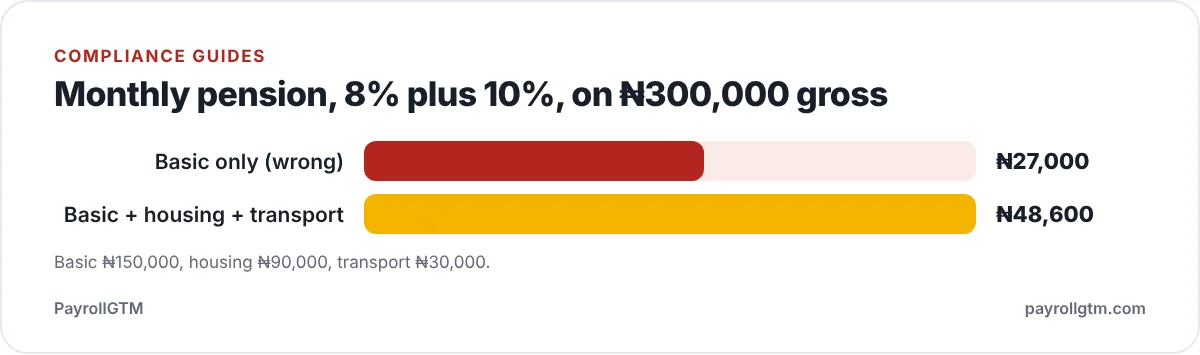
It looks simpler and cheaper. The statutory base is at least basic, housing and transport, so basic-only leaves contributions short. Take an employee paid ₦300,000 a month, made up of ₦150,000 basic, ₦90,000 housing and ₦30,000 transport.
Correct base: ₦150,000 + ₦90,000 + ₦30,000 = ₦270,000. Employee 8% = ₦21,600. Employer 10% = ₦27,000. Total ₦48,600 a month.
Basic only: 8% of ₦150,000 = ₦12,000 and 10% = ₦15,000. Total ₦27,000.
Shortfall: ₦21,600 a month, or ₦259,200 a year for this one employee, before any late-payment penalty.
The method is explained in how to calculate pension contributions.
11. Leaving out staff on probation or contract
Pension is seen as a benefit for confirmed staff. It is not: the Pension Reform Act applies to employers with 3 or more employees, and employees are covered from the first month. Read who must be enrolled for the grey cases.
12. Late remittances
The cash is spent before the statutory amounts are set aside. Pension is due within 7 working days of paying salaries, with a penalty of 2% of the unremitted amount for each month of delay. PAYE is normally due by the 10th of the following month (confirm with your state IRS). Move the amounts to a separate account on payday and schedule the payments in advance.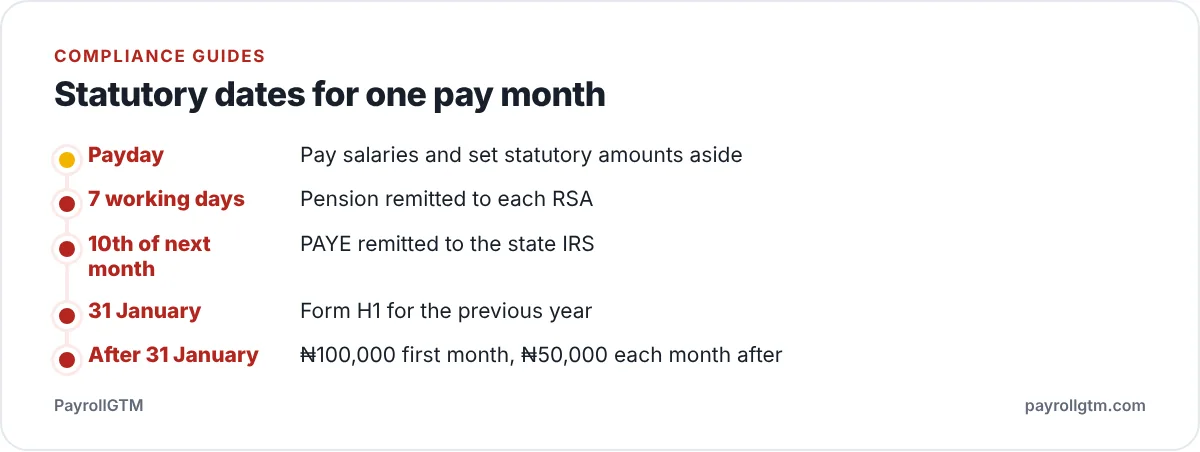
13. A lapsed group life policy
Nobody owns the renewal date. The Pension Reform Act requires the employer to hold cover of at least 3 times annual total emolument, and the employer pays the premium. Put the renewal in the calendar and update the insured list when pay or headcount changes. See the group life rule.
14. Deducting NHF from everyone
Older advice says the 2.5% National Housing Fund deduction is compulsory for all private-sector staff. Since the Business Facilitation Act 2022, private-sector employees are not compulsorily covered, and a deduction should only be made where the employee opts in. It stays compulsory in the public sector. See the NHF position.
15. Forgetting NSITF and ITF
NSITF is 1% of total monthly payroll, paid by the employer and never deducted from staff. ITF is 1% of annual payroll for employers with 5 or more employees, or turnover of ₦50 million or more. Both are employer costs that small firms often leave out of their budget. See NSITF and ITF.
Controls that catch most of these
Three habits cover a large share of the list. First, a second person reviews every pay run before money moves, and a backup can run payroll if the usual person is away. Second, statutory amounts go into a separate account on payday. Third, a short review each year, such as the annual payroll audit checklist, finds what the monthly routine missed. If you are setting up for the first time, the January 2026 changes checklist is a good starting point.
A ten-minute self-test
Answer yes or no. Nine or ten yes answers means your payroll is in good shape. Six to eight means a few gaps to close this quarter. Five or fewer means book a proper review.
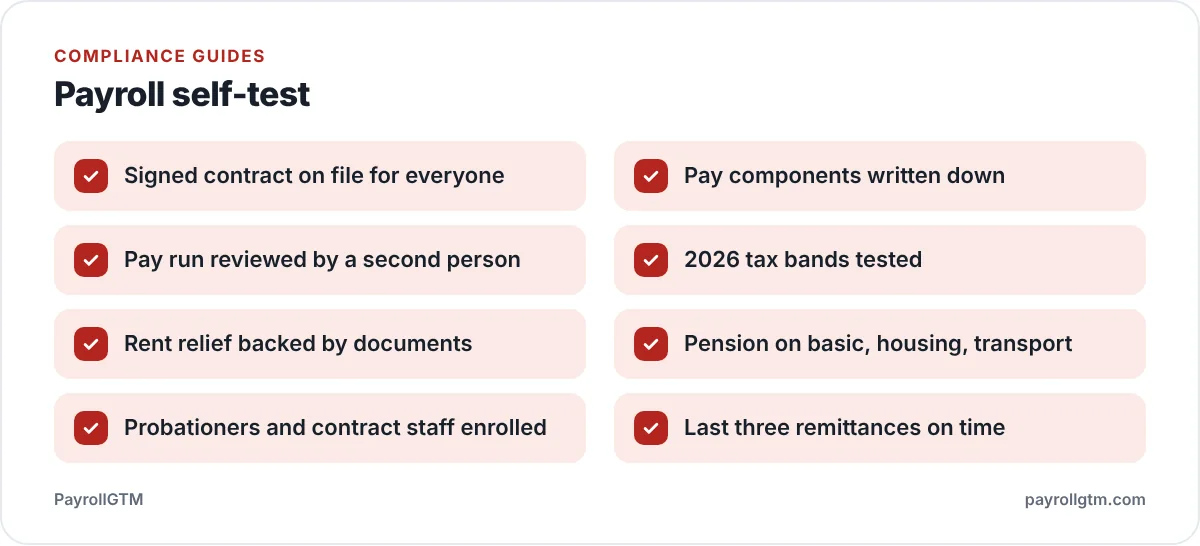
If you find a past error, correct it before anyone else finds it, and fix underpaid staff first. Money owed to employees and to authorities grows each month, so deal with that before housekeeping. Confirm penalties and how to regularise arrears with your state IRS or PenCom, because practice differs.