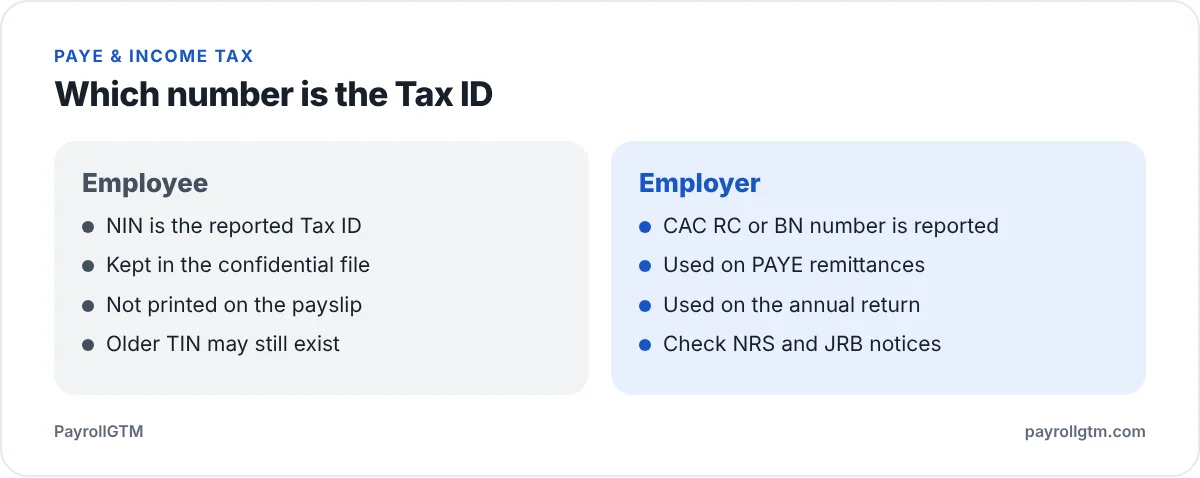
Yes, every employee who earns taxable pay needs a Tax ID, and the Nigeria Tax Administration Act 2025 (ss.6 to 8) puts that duty on every taxable person, not only on companies. For an individual, the Tax ID is reported to be the National Identification Number (NIN); for a business it is the CAC registration number. Payroll should collect the number at onboarding, because without it you cannot file the employee's PAYE records cleanly.
Does every employee really need a Tax ID?
The Act's rule is that a taxable person must be registered and identified for tax. An employee whose salary falls under PAYE is a taxable person even if the employer deducts everything and the employee never visits a tax office. The practical reason payroll cares is simple: the state IRS matches the PAYE schedule you send to individual taxpayer records, and an identifier that does not match is a line that gets queried.
Employees on the minimum wage are a common question. Someone earning ₦70,000 a month or less pays no PAYE, but they still have a NIN, and recording it costs you nothing. Our guide on whether minimum wage is taxable explains why the tax is nil, which is a separate matter from whether the person is identified.
Is the NIN now the Tax ID for an individual?
It is reported to be. The announcement described individuals using their NIN as their Tax ID, so a person who already holds a NIN should not need a separate number from scratch. We have not seen a rule that tells employers to stop collecting the old tax identification number held by employees who registered before 2026, so for now treat both as useful: record the NIN, and record any older TIN the employee already has.
What we cannot tell you is whether your state IRS has already switched its PAYE schedules to NIN-only. Lagos, Abuja and other states run their own systems and their own timing. Ask your state IRS officer, or look at the column headings on the latest schedule template they gave you. If the template has a "TIN" column and a "NIN" column, fill both.
What is the Tax ID for the business itself?
For a registered company or business name, the CAC registration (RC or BN) number is reported to become the Tax ID. That matters for the employer side of PAYE: the number on your remittance, your Form H1 and your registration with the state IRS should be consistent. If you have not yet registered as an employer, start with how employers register for PAYE with the state IRS.
A sole proprietor who trades without registering a business name has a gap here. Their personal NIN is the only identifier they have, and that is one more reason to register the name with the CAC before hiring. Registration steps are outside what we can verify here, so use the CAC's own current instructions.
What should payroll collect at onboarding?
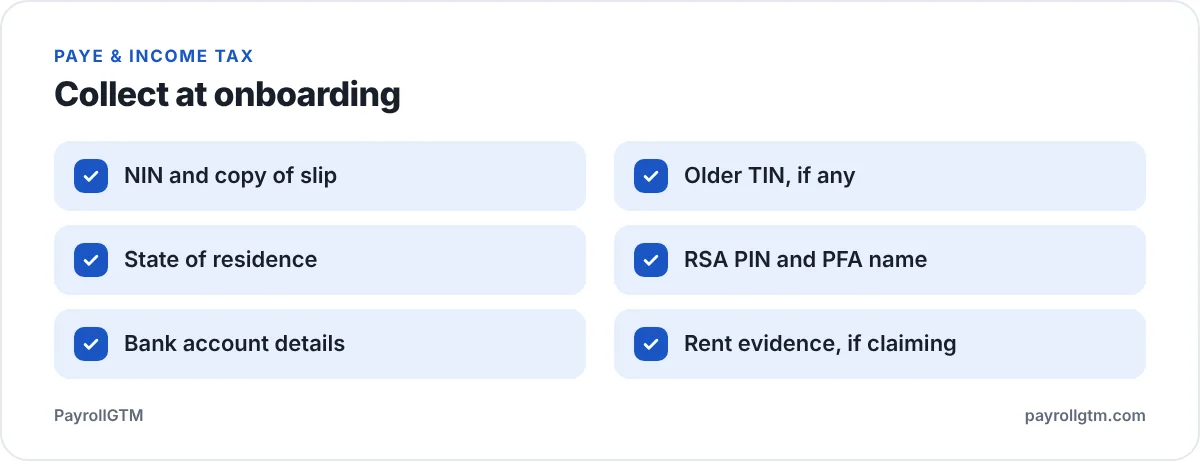
Ask for the items in the table on the first day, not at the first payroll run. The Tax ID is one line among several, and collecting them together is cheaper than chasing them in month two.
| Item | Why payroll needs it | If it is missing |
|---|---|---|
| NIN (11 digits) and a copy of the slip or card | Reported Tax ID for the individual, and identity check | Start payroll, record the gap, set a date to fix it |
| Older TIN, if the person has one | Matches earlier records at the state IRS | Not an obstacle; many staff have none |
| State of residence and home address | Decides which state IRS receives their PAYE | Ask again; do not guess from the office address |
| RSA PIN and PFA name | Pension remittance within 7 working days | Help them open one, see the pension guides |
| Bank account name and number | Salary payment | Hold the first payment until verified |
| Rent evidence, if they will claim rent relief | Rent relief is 20% of rent paid, capped at ₦500,000 | No relief until evidence arrives |
The residence line matters more than most employers expect. PAYE goes to the state where the employee lives, so a Lagos office with staff living in Ogun State has a filing question for each of them. The new-hire onboarding checklist places this inside the wider first-week routine.
What if an employee has no NIN?
Do not refuse to pay them. Wages are due for work done whether or not an ID has been captured, and deducting PAYE does not depend on having the number in your file. Record "NIN pending" on the employee record, give a written reminder with a date, and keep a note of what you asked for and when.
The employee gets the NIN through the National Identity Management Commission; its site is nimc.gov.ng. Enrolment can take time, and some people have a NIN slip but have lost the number. Telling them early is kinder than discovering the gap in January when the annual return is due. If the gap is still open at filing time, ask your state IRS how they want a line without an identifier presented. Do not invent a number and do not leave the employee off the schedule.
Where does the Tax ID go on payroll records?
Put it in the employee master file, next to the pension PIN, not on the payslip. A payslip is passed around, photographed and emailed, and a national identity number is the kind of detail that should not travel on it. Under the Nigeria Data Protection Act 2023 you are expected to collect personal data for a stated purpose and protect it, so restrict who can see the NIN column and keep ID copies in a locked folder. The detail is in our note on employee data protection and payroll.
The fields most employers need are:
- NIN, with a status of "verified", "pending" or "not provided"
- Legacy TIN, where the employee has one
- State of residence, because it decides the state IRS
- Date the ID was collected and who collected it
The same record feeds the annual schedule. When it is time to file, you will want the number in the same column every time, which is why Form H1 for the annual employer return is quicker for payrolls that kept this tidy all year.
Does the employer's work replace the employee's own registration?
No. The employer deducts and remits PAYE, but the employee remains a taxable person with their own duties, including a personal return in some cases. NTAA s.14(3) says employees must also file even where the employer has filed, and a state IRS may run its own process, so check with yours. Our guide on whether employees must file annual returns covers when that bites.
People with two jobs have a particular reason to hold a single, correct identifier, because both employers' records must trace to one person; see PAYE for second jobs.
A short script for HR
When you onboard, say it plainly: "We need your NIN for tax records. It goes in your confidential file and not on your payslip. If you do not have it yet, tell us and we will give you a date to bring it." Then record the answer. That sentence, plus a dated note, covers most of what an auditor will look for. If you are preparing for a review, see how to prepare for a state IRS payroll audit.