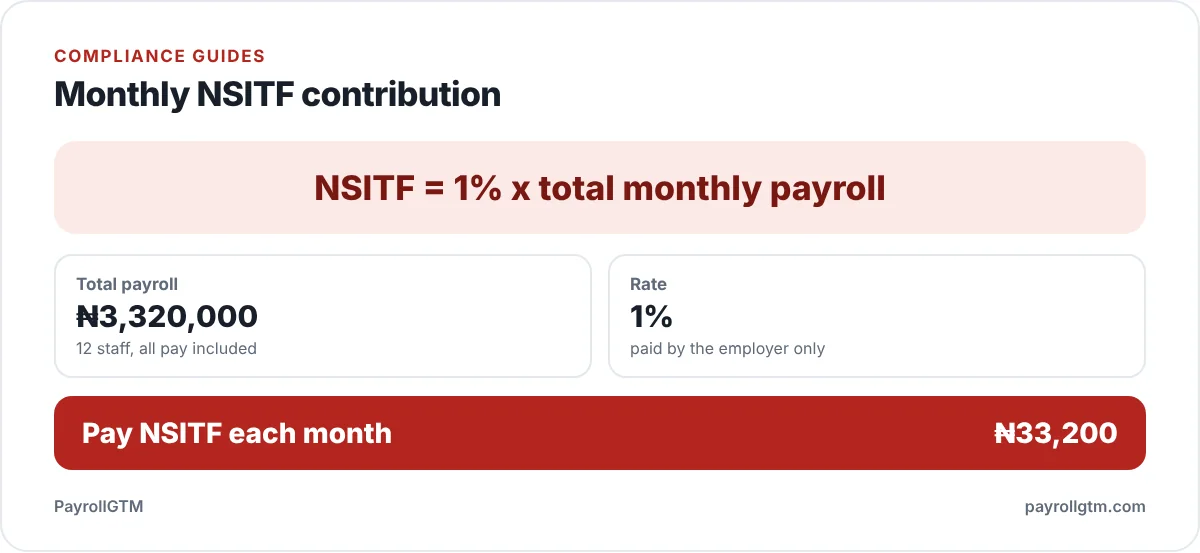
The Nigeria Social Insurance Trust Fund (NSITF) collects the Employees' Compensation contribution, which is 1% of the employer's total monthly payroll. The employer pays it from its own funds. Nothing is deducted from staff, and nothing for it should appear as a deduction on a payslip. A business with a monthly payroll of ₦3,320,000 owes ₦33,200 a month, or ₦398,400 a year.
The contribution comes from the Employees' Compensation Act 2010, which pays compensation to a worker injured, made ill or killed through work, or to their dependants. This guide follows the steps from registration to a monthly payment. Where we are not sure how the NSITF's own process currently works, we say so and tell you what to ask.
Who must register and pay
The Act applies to employers generally, and registration is an obligation for a business with employees. We have not given a headcount threshold, because the sources we rely on do not state a safe one. If you run a business with even two paid staff, ask the NSITF, or look at the NSITF website, whether you must register, rather than assuming a small size exempts you.
It sits alongside the other employer costs: pension, group life insurance, and the ITF levy for larger employers. The employer registration checklist shows how NSITF fits with the rest of your setup, and a new business should read payroll compliance in the first year before choosing its order of registrations.
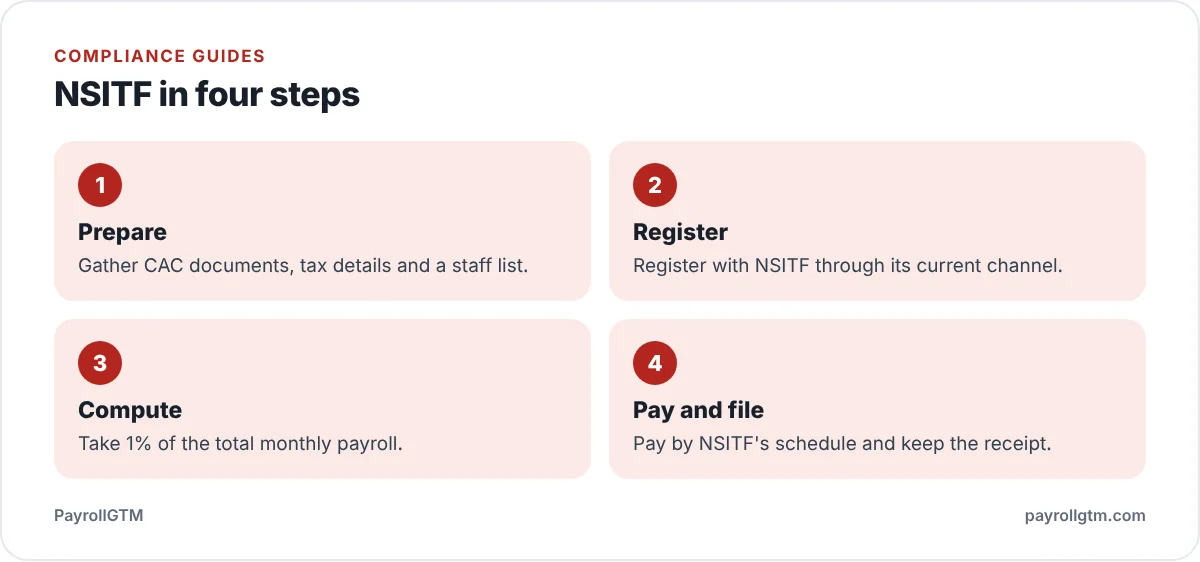
Step 1: Prepare the documents
NSITF will want proof the business exists and a record of who works there. In principle that means the CAC registration documents (certificate or status report), the business's tax identification, a list of employees with their roles and pay, and contact details for the person who will deal with NSITF. Exact requirements, forms and any fee can change, so ask for the current list before you start. Do not pay a third party who promises a "quick certificate" without seeing it on NSITF's own channel.
If your CAC annual returns are overdue, sort that first, because several agencies ask for evidence of good standing. See CAC annual returns.
Step 2: Register with NSITF
Registration is done with NSITF, through its offices or the channel it currently publishes. After registration you should receive an employer identification or registration record and instructions for making contributions. Keep this safe; it is what a bank or a procurement officer will ask to see later.
Treat portal steps with caution. Websites that list a screen-by-screen process often go out of date, and we are not reproducing one. Confirm the live process with NSITF directly.
Step 3: Work out the 1% each month
The base is total emoluments for the month, meaning the whole payroll, not only basic pay. Add up what you pay all staff in the month, then take 1%. The table shows a 12-person business. The figures are the monthly gross for each group.
| Group | Headcount | Monthly pay each | Monthly total |
|---|---|---|---|
| Managing director | 1 | ₦900,000 | ₦900,000 |
| Managers | 2 | ₦450,000 | ₦900,000 |
| Officers | 3 | ₦260,000 | ₦780,000 |
| Assistants | 4 | ₦140,000 | ₦560,000 |
| Driver and cleaner | 2 | ₦90,000 | ₦180,000 |
| Total payroll | 12 | ₦3,320,000 | |
| NSITF at 1% | ₦33,200 |
The business therefore adds ₦33,200 to its cost of employing these staff each month. That cost is above the salaries and the 10% employer pension (₦332,000 on this payroll if the whole gross is pensionable). Our employer cost calculator adds these lines together so you can see what a hire really costs.
Whether a working owner-director counts as an employee for this purpose depends on how they are engaged and paid. If the managing director takes a salary through payroll, ask NSITF whether it belongs in the base.
Step 4: Pay and keep the record
Make one person responsible, and name a back-up for when they are on leave. A levy that belongs to nobody is the one that gets missed. Put the payment date in the same calendar as PAYE and pension so the three are seen together.
Pay through the channel NSITF gives you and keep the receipt with the payroll records for that month. We cannot give you a safe due date from our sources, so ask NSITF what its schedule is and put it in your payroll calendar next to PAYE and pension. Do not leave this to the end of the year; a backlog of a year's contributions is far harder to explain than one late month.
A tidy way to run it: at the same time as the PAYE schedule is prepared, the payroll officer computes 1% of the same total payroll figure. Both numbers then come from one source. The wider routine is in common payroll mistakes of Nigerian SMEs, where a missed levy is one of the usual gaps.
What the scheme pays for
In principle the Employees' Compensation scheme provides compensation if a worker is injured, develops a work-related disease or dies because of work. Details of what qualifies, the evidence needed and the amounts are set by the Act and NSITF's process, which this guide does not reproduce. The employee-side steps are in workplace injury claims under the Employees' Compensation Act.
It is different from health insurance and from group life cover. Health insurance pays treatment for ordinary illness, and the employer's group life insurance pays out on death under the pension law. NSITF is the one that responds to a workplace accident or work-related disease.
How hires, raises and bonuses change the bill
Because the base is the whole payroll, the contribution moves with every pay change. Hiring one more officer on ₦260,000 adds ₦2,600 a month, or ₦31,200 a year. A 10% across-the-board raise lifts the payroll to ₦3,652,000 and the contribution to ₦36,520. Bonuses and other cash emoluments paid in a month are part of that month's total, so a December bonus round raises December's figure. Check with NSITF how your base is defined for irregular payments, since the sources we rely on speak only of total emoluments.
Budget for it as a fixed percentage on top of the payroll. Founders who price a service from salaries alone, then add pension, group life, NSITF and ITF afterwards, usually find their margin was thinner than they thought.
Mistakes that cost money
- Not registering at all. The business pays nothing for months, assumes nobody has noticed, and then needs a clean record for a tender or bank facility. Arrears and any penalty NSITF applies then arrive together.
- Using basic pay as the base. That understates the contribution. Use total emoluments for all staff.
- Leaving out casual or short-contract workers whose pay runs through the business. Ask NSITF how they should be treated rather than guessing.
- Charging staff. See the warning above.
Records NSITF or an auditor may ask for
- The registration evidence from NSITF
- A monthly payroll total with your calculation of 1%
- Payment receipts
- Accident register, with dates and what was done
- Employee list with start and end dates
If you use an outside provider for payroll, make sure it knows this levy is part of the monthly run; when outsourcing payroll makes sense explains what to hand over and what to keep an eye on. For the other employer levy based on payroll, read the ITF guide. If you are starting the year with a fresh checklist, compare it against the January 2026 payroll changes.