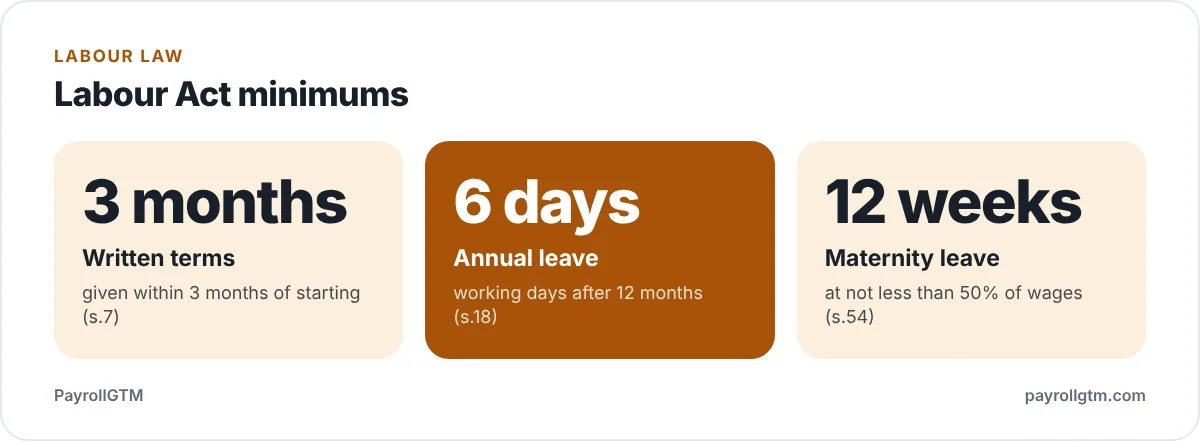
The Labour Act (Cap L1, Laws of the Federation of Nigeria 2004) sets minimum floors for private employment: written terms within 3 months, notice of termination from 1 day to 1 month depending on service, at least 6 working days of paid annual leave after a year, up to 12 working days of paid sick leave, 12 weeks of maternity leave and a set process for redundancy. It does not replace the contract. Most of what an employee is actually paid, and when, comes from the offer letter and handbook.
This page is a map for employers. Each section gives the rule, where it comes from and which guide goes further. Where the Act is silent, it says so, because the common mistake is to quote a rule that does not exist.
The Act at a glance
The table lists the main duties and the lines you cannot go below. Contracts can give more, never less.
| Topic | What the Act says | Section | Go deeper |
|---|---|---|---|
| Written terms | Give the worker a written statement of terms within 3 months of starting | s.7 | what an employment contract must cover |
| Notice to end employment | 1 day, 1 week, 2 weeks or 1 month depending on length of service; pay in lieu allowed | s.11 | notice and severance |
| Sick leave | Up to 12 working days a year with pay on a certificate from a registered medical practitioner | s.16 | annual, sick and maternity leave |
| Annual leave | At least 6 working days with pay after 12 months of continuous service | s.18 | same guide |
| Redundancy | Inform the union or workers' representative, apply last in, first out, pay as agreed | s.20 | doing redundancy lawfully |
| Maternity | 12 weeks, usually 6 before and 6 after birth, at not less than 50% of wages, plus reduced working time for nursing | s.54 | maternity leave guide |
Written terms: s.7 and the 3-month limit
Every worker is entitled to a written statement of the main terms within 3 months of starting. It should name the parties, the job title, pay and how often, hours, leave, notice and the place of work. Most employers do this at hiring through an offer letter, which is better, because disputes start in the first weeks.
Missing paperwork does not make the employment invalid, but it makes every later disagreement harder to settle, since the employer cannot show what was agreed.
Notice: the minimum under s.11
The Act sets minimum notice by length of service, summarised in the figure below. A contract can set longer notice for either side, and pay in lieu of notice is allowed.
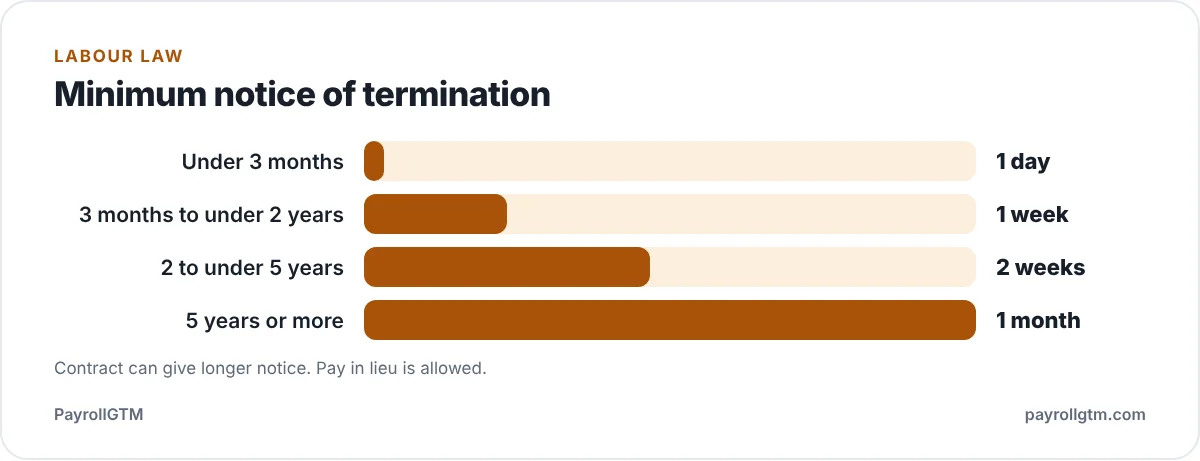
These are floors. A senior manager's contract may say 3 months, and that is binding in the usual way. A common handbook mistake is writing "7 days" for everyone because the Act mentions a week; after 5 years' service the minimum is a month. Resignation is the mirror image, and how to resign and what final pay includes covers it from the employee's side.
Leave, sick days and maternity
The statutory minimum for annual leave is 6 working days after 12 months of continuous service, with more for young persons. Employers in practice often grant 15 to 21 days or more by contract, and that contract figure is what applies. The claim that the Act gives 24 days is wrong. Sick leave is up to 12 working days a year on the certificate of a registered medical practitioner.
Maternity leave is 12 weeks at not less than 50% of wages under the Act. Some contracts and state laws pay full wages, and those terms govern if they are better. There is no federal statutory paternity leave for private-sector employees, so any paternity leave you give is a policy choice. A written policy is easier to apply fairly.
Public holidays work differently: the Public Holidays Act lists federal days and the Minister can add more, and pay rules usually come from the contract. See public holidays, pay and work rights.
Pay, deductions and the minimum wage
Wages are paid in legal tender, and the Act restricts what an employer can deduct from them. Set-offs for a loan, a shortage or a fine need a lawful basis and the worker's agreement where the law requires it; the practical rules are in wage payment and lawful deductions.
The national minimum wage is ₦70,000 a month under the National Minimum Wage (Amendment) Act 2024 and applies to employers with 25 or more employees. Smaller employers are outside the Act's scope but many still pay at or above it, and it is a sensible benchmark when you hire. Overtime has no flat statutory rate for most private employees. Overtime pay comes from the contract, handbook or a collective agreement, and 1.5 times is common practice, not law.
Redundancy under s.20
If you must cut jobs, the Act requires you to tell the union or the workers' representative, to apply last in, first out subject to skill and family responsibility, and to pay redundancy payments as agreed or as the collective agreement provides. It does not set a formula for the sum. Skipping the notification step is the commonest procedural failure.
Who the Act covers and who it does not
The Act defines a "worker" and, in some respects, excludes people doing administrative, executive, technical or professional work. For those staff the courts apply the contract and common law. That does not mean managers have no rights; it means the rights come from different places. Whether your accountant or branch manager is inside the Act is a question for a lawyer, and the guide on managers and professionals sets out the usual approach.
Status also matters. Casual, fixed-term and permanent staff are treated differently for notice and benefits, and the guide to casual, fixed-term and permanent employees explains where the lines fall. Contractors are outside employment law altogether if the relationship is genuinely independent.
A quick audit for this week
Pull five personnel files at random and check four things. Is there a signed offer letter or contract, and does it list pay, hours, leave and notice? Does the notice clause meet the s.11 floor for that person's length of service? Is leave recorded, and is the figure at or above 6 working days after a year? For women who have gone on maternity leave in the past two years, was the pay in line with the Act or the better contract term?
Most small firms find gaps in the first two. Fixing them costs a letter and a signature, and it is far cheaper than discovering the gap in front of the National Industrial Court. Keep what you find in the file, with the date you corrected it, and apply the same corrected wording to every new hire from then on.
What the Act does not cover
- Probation: no statutory length or special notice. It is a matter of contract.
- Paternity leave in the private sector: none by federal law.
- A flat overtime rate: none for most private employees.
- Severance pay on ordinary termination: none beyond notice, unless the contract or a collective agreement provides.
- Tax, pension and levies: separate laws, in the PAYE, pension and compliance guides on this site.
The Labour Act sets the floor, the contract builds the room, and the handbook shows how the room is run. If a point is not in your contract and not in the Act, check the current position with a Nigerian employment lawyer or the Federal Ministry of Labour before acting.