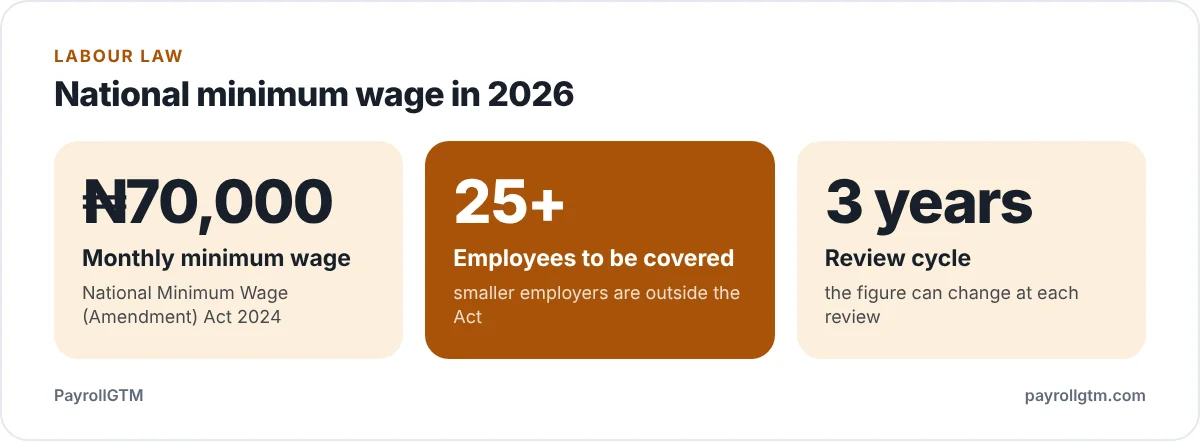
The national minimum wage is ₦70,000 a month, set by the National Minimum Wage (Amendment) Act 2024 and reviewed every 3 years. It binds employers with 25 or more employees. Smaller employers are outside the Act, but many pay at least ₦70,000 anyway because staff, and the labour market, expect it.
- Who must pay ₦70,000 and who is outside the Act
- Whether allowances and part-time work change the answer (and where we are not certain)
- What a ₦70,000 employee really costs you, with the numbers
- What underpaying costs, and what to check this month
How much is the minimum wage in 2026?
₦70,000 per month. It replaced the ₦30,000 figure that many older articles and payroll templates still carry. If your spreadsheet has a "minimum wage" cell with ₦30,000 or ₦40,000 in it, that cell is out of date.
The Act sets a floor and does not stop you paying more. It is also reviewed every 3 years, so the figure will change at some point. Put the review date in your calendar rather than waiting to hear about it on the news, because a new figure needs a new payroll run and often new contract letters. The January 2026 payroll changes checklist is a good place to record the date you last checked.
Does my business have to pay it?
The Act applies to employers with 25 or more employees. Below that, it does not legally bind you. Two cautions.
- Counting heads. Whether casual staff, part-timers and long-serving "contract" workers count towards the 25 depends on how they are really employed, not what the offer letter calls them. If you are near the line, ask a labour lawyer or the Federal Ministry of Labour and Employment before you assume you are exempt. See casual, fixed-term and permanent employees for how status is judged.
- Growing into it. A shop with 22 staff that hires 3 more in March has crossed the threshold. Check the headcount whenever you hire, not once a year.
Even when you are below 25, other costs still follow the pay: pension is due once you have 3 employees, and the employer levies are described below.
Do allowances count towards the ₦70,000?
We cannot give you a firm yes or no, and we would be wary of anyone who does without reading your contracts. The Act speaks of a minimum wage, and employers use different structures: a flat ₦70,000 with no breakdown, or ₦40,000 basic plus housing, transport and other allowances making up ₦70,000. Whether the second structure complies depends on how "wage" is read and on your contract and any collective agreement.
The safest practice is the one that cannot be argued with: make sure basic salary alone is ₦70,000 or more for any worker the Act covers. If that is too expensive, take written advice before you rely on allowances to reach the figure. Pension is a separate point, since the legal minimum base is basic, housing and transport together, which is why the split matters. How to structure basic, housing and transport shows what each choice does to your pension and tax lines.
What about part-time and casual workers?
Nothing in our sources gives a statutory pro-rata formula, so treat the following as practice rather than law. For a part-time worker, employers normally pay a share of ₦70,000 equal to the share of full-time hours worked. Someone on 3 days of a 5-day week would then get ₦70,000 x 3/5 = ₦42,000. Paying less than that per hour than a full-time colleague on the minimum invites a dispute.
Write the working pattern into the contract and keep attendance records. For how to prorate a month, including a worker who joins mid-month, see how to prorate salary for part of a month. Overtime is a separate matter that the contract decides.
Is a ₦70,000 salary taxed?
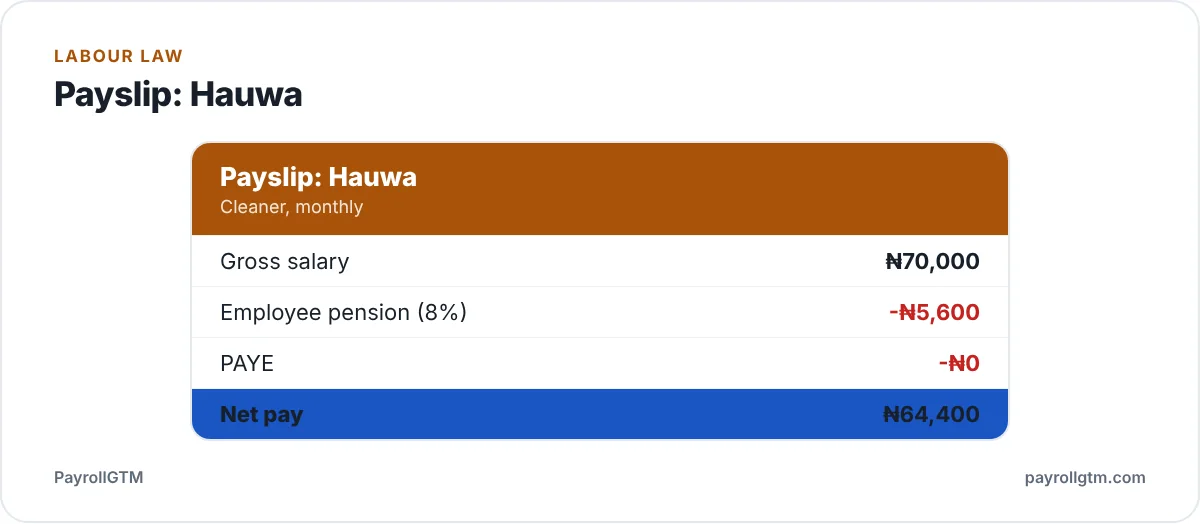
No PAYE. Employees at or below the minimum wage are exempt, and the first ₦800,000 a year is taxed at 0% in any case. The employee still pays 8% pension. Running the figures for a cleaner at ₦70,000 in the calculator gives:
- Employee pension at 8%: ₦5,600
- Pay that counts for tax: ₦64,400 a month, or ₦772,800 a year, under the ₦800,000 zero band
- PAYE: ₦0
- Net pay: ₦64,400
The full explanation, including what happens once pay rises above the minimum, is in is the minimum wage taxable in 2026. Note that the net is below ₦70,000 because of pension. That is a lawful deduction, not an underpayment, as long as the gross figure on the payslip is ₦70,000 or more.
What does a ₦70,000 employee really cost me?
More than ₦70,000. The employer pays 10% pension on top, and the levies are charged on payroll. For one worker at ₦70,000 with the whole amount pensionable, in a business that pays both levies:
| Item | Monthly cost |
|---|---|
| Gross salary | ₦70,000 |
| Employer pension (10%) | ₦7,000 |
| NSITF (1% of payroll) | ₦700 |
| ITF (1% of payroll, if you qualify) | ₦700 |
| Total before insurance | ₦78,400 |
Group life premiums and any HMO plan are extra, and their price depends on the insurer. For who owes each levy, see group life insurance requirements, health insurance through NHIA and HMOs and NSITF contributions. Budget for the ₦78,400, not the ₦70,000.
What happens if I underpay?
We do not have a penalty figure from the Act that we are willing to quote, so we will not make one up. What we can say with confidence is the exposure you build up. A worker underpaid is owed the difference, and arrears grow every month the error stays in your payroll.
Pension and PAYE are calculated on pay, so a wrong salary produces wrong pension and tax remittances too. That is the kind of error described in common payroll mistakes of Nigerian SMEs.
What does it cost to bring a worker up to ₦70,000?
Raising pay also raises everything calculated on pay. Take Segun, a store assistant paid ₦55,000 whose employer must lift him to ₦70,000. The raise is ₦15,000, but the employer's real extra cost per month is higher:
- Salary increase: ₦15,000
- Employer pension at 10% of the increase: ₦1,500
- NSITF and ITF at 1% each of the increase: ₦150 + ₦150 = ₦300
- Total extra cost: ₦16,800 a month, or ₦201,600 a year per worker
Segun's own pension deduction rises from ₦4,400 to ₦5,600, so his take-home rises by ₦13,800, not ₦15,000. Tell staff this before the first payslip, or the pension line will look like an error. Put the new salary in a signed letter or contract variation with an effective date.
Checks to run this month
- Count employees, including anyone you treat as casual who works regular hours.
- List every salary below ₦70,000 and decide whether the Act binds you. If it does, raise them.
- Look at how each low salary is built. Make basic pay the safe number.
- Recalculate pension and levies on the new pay.
- Write the date of the next 3-year review into your compliance calendar.
The Federal Ministry of Labour and Employment (labour.gov.ng) can confirm how the Act applies to your headcount and pay structure.