Partly. The Labour Act defines "worker" in a way that, in some respects, leaves out people who do administrative, executive, technical or professional work, so a manager or an engineer cannot assume that every Labour Act provision applies to them in the same way as it does to a clerk or a driver. That does not mean managers have no rights. Their contract, the employer's handbook, other statutes and common law fill the gap. This guide sorts the common beliefs into what is true, what is false and what is uncertain. It is general information, and for any real dispute you need a Nigerian employment lawyer.
Myth: "The Labour Act protects every employee equally"
Fact: The Act is built around the idea of a "worker", and its definition carves out people exercising administrative, executive, technical or professional functions in some respects. How far the carve-out goes depends on the provision and on how a court reads the person's actual duties, not on their job title alone. A "Supervisor" who mostly does manual work can be a worker. A "Manager" with no real executive function might be one too. A senior accountant, an engineer or an HR head is more likely to fall in the excluded group for some purposes.
For an employer, the practical point is that you cannot settle the question by labelling people. Two people called managers can be treated differently by a court. For an employee, the point is that "the Labour Act does not apply to me" is rarely the end of the matter, because the contract still binds both sides.
Myth: "Managers can be sacked with no notice"
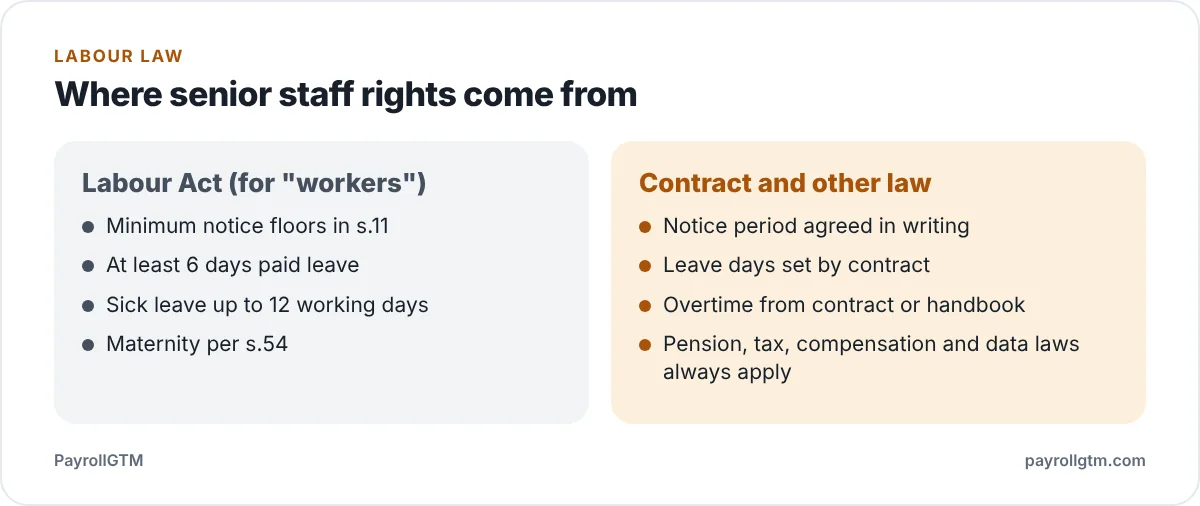
Fact: Notice for professional and senior staff is mainly a matter of what the contract says. Where the contract gives a period (one month, three months), that period is what both sides are held to. The Labour Act's minimum notice (1 day for under 3 months, 1 week for 3 months to under 2 years, 2 weeks for 2 to under 5 years, 1 month for 5 years or more) is a useful floor and many employers use it for everyone, but whether it formally binds a given senior employee is the very point in doubt. A termination without the notice the contract requires can lead to a claim for the pay for that period, and the National Industrial Court of Nigeria hears employment disputes.
Details on how notice and final pay work are in termination notice and severance and, from the employee's side, how to resign in Nigeria. For the limits on dismissal, read wrongful dismissal and the National Industrial Court.
Myth: "Annual leave, sick leave and maternity leave do not apply to professionals"
Fact: This is where the uncertainty bites and where good practice is clearest. The statutory figures (at least 6 working days of paid annual leave after 12 months, up to 12 working days of paid sick leave on a medical certificate, and 12 weeks of maternity leave at not less than 50% of wages) are written for workers. Whether a professional can sue on them as statutory rights is open to argument. In real workplaces, nobody sensible treats a manager as having no leave. Most contracts give more than the minimum, often 15 to 21 days or more, and a senior woman who is pregnant expects maternity leave under her contract and, in some states, under state rules or policy that are better than the Act. See annual, sick and maternity leave in Nigeria.
If you are an employer, write the leave entitlement into the contract for every grade. That removes the argument. If you are an employee and your offer letter is silent on leave, ask for it in writing before you accept.
Myth: "If the Act does not cover you, you have no legal protection"
Fact: Employment is mainly governed by contract, and the courts apply common law principles to it. The contract is enforceable whether or not the Labour Act reaches the employee. Other statutes also apply regardless of seniority, including the Pension Reform Act (pension and group life), the Employees' Compensation Act (workplace injury and illness, see employees' compensation and injury claims), the tax laws, and the Nigeria Data Protection Act for personal data. Fair hearing and process, where the contract or the handbook promises it, also bind the employer, and no employer can dismiss someone for a reason that breaches a statute.
Myth: "A manager's overtime and working hours are covered by the Labour Act"
Fact: There is no statutory flat overtime rate for most private employees. Overtime comes from the contract, the handbook or a collective agreement. Managers are often expected to work beyond the standard day, and many contracts say salary covers all hours. If that is what you have agreed, it holds. If it was never written down, the dispute is about what was agreed in practice. See working hours, overtime and rest days for how most employers set this.
What an employer should do about it
- Do not rely on the exclusion. Treat every employee as entitled to notice, leave, written terms and fair process. The cost of doing so is small. The cost of litigating the definition is not.
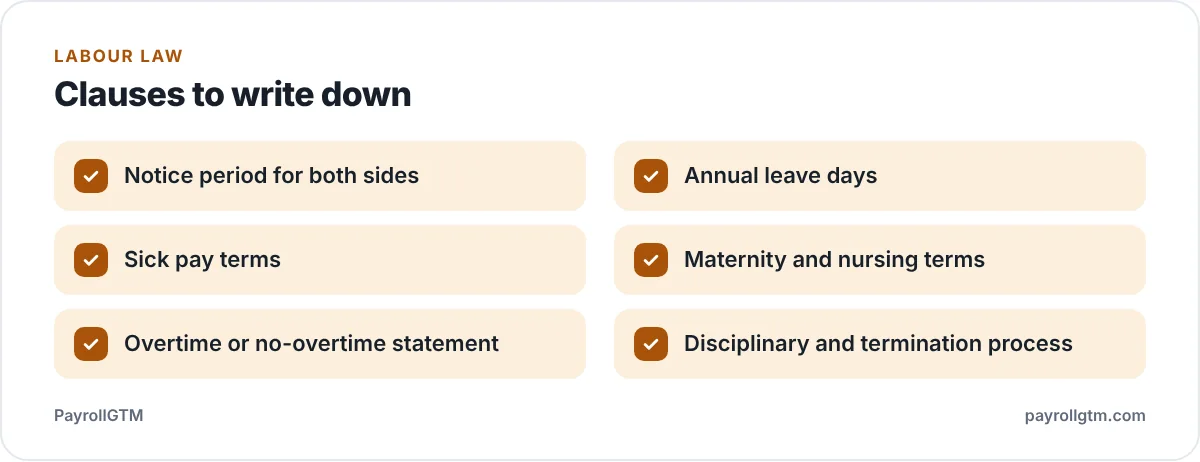
- Write everything into the contract. Notice, leave, sick pay, maternity, overtime, bonus, termination, confidentiality. The employment contract essentials list the clauses.
- Keep the handbook consistent. If the handbook promises a disciplinary hearing to "all staff", that promise reaches managers too. See the employee handbook guide.
- Classify by duties, not title. A mixed role (a "supervisor" who also does manual work) may be a worker for the Act's purposes.
The employer duties that clearly apply to everyone are covered in Nigerian Labour Act employer obligations, and the difference between permanent, fixed-term and casual staff is in casual, fixed-term and permanent employees.
What an employee should do about it
- Read your contract before you sign. Look for notice, leave, sick pay and termination terms. If a point matters to you and is missing, ask for it to be added.
- Get promises in writing. A promise of "three months' notice" or "full pay maternity leave" made in a meeting is hard to prove later.
- Keep your own file. Offer letter, contract, handbook version, payslips, appraisal letters.
- Take advice before you act. If you are about to be terminated or you plan to sue, see a lawyer who handles employment matters in Nigeria before you sign any settlement.
A worked scenario: the senior accountant
Obinna is finance manager at a Kano company. His letter says "employment is subject to the staff handbook" and nothing else. After four years he is dismissed with one week's pay, and he asks whether the company had to give more. The employer says he is a professional, so the Labour Act does not apply. At four years of service the Act's floor would be 2 weeks (1 month starts at 5 years), so it would add little even if it applied. The real argument is the handbook. If the handbook says "one month's notice or pay in lieu for all confirmed staff", that is the figure both sides will argue from, and the employer's "the Act does not apply" point does not help at all. The lesson is not who wins. It is that the handbook and the contract decided the case, and the Act's definition barely mattered. Write them well.