No Nigerian law requires a small business to have an employee handbook, but the Labour Act does expect you to give each worker a written statement of their terms within three months of starting, and a handbook is the cheapest way to cover the rules everyone shares. Ten to twenty pages in plain English is enough for most businesses with under 50 staff.
A handbook answers the questions new staff are too shy to ask: when is pay day, how do I book leave, what if I am sick, who do I go to with a problem. Without one, two supervisors give two answers, and the argument starts when the owner sides with one of them.
Handbook, contract and offer letter: what goes where
The employment contract holds one person's terms: job title, pay, start date, notice. The handbook holds the rules that apply to everybody: leave procedure, conduct, expenses, use of phones. The contract should say the handbook applies and that the contract wins if the two conflict.
A handbook cannot take away what the law gives. A policy offering less than the statutory minimum for notice, sick leave or maternity leave will not stand, and it makes you look careless in front of the National Industrial Court. Use the handbook to state the legal floor, and add anything extra you choose to give. The Labour Act's definition of "worker" excludes some administrative, executive, technical and professional staff in some respects, so senior people may be governed mainly by their contracts. Apply the handbook to everyone anyway, and check the position for managers with a lawyer. We explain the limits in whether the Labour Act covers managers and professionals.
The legal floor your handbook must respect
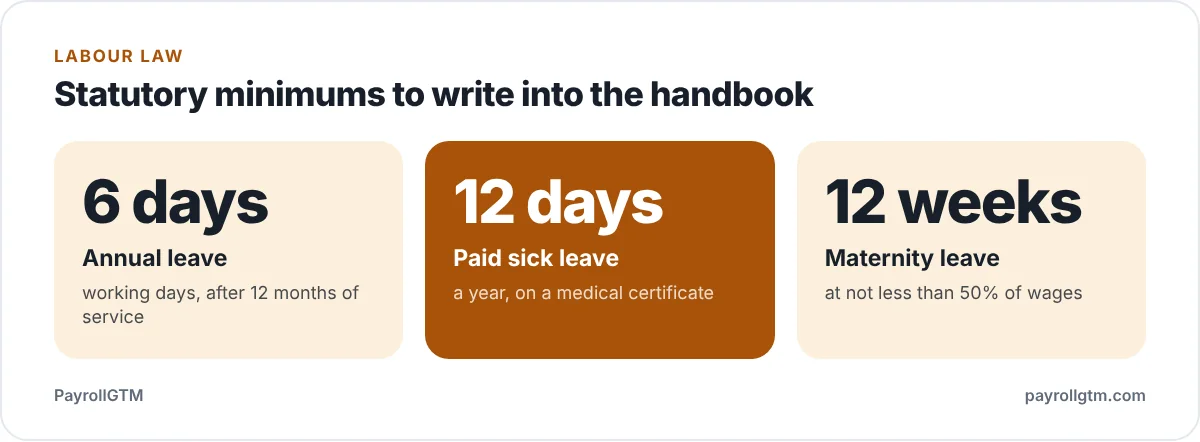
Write these minimums into the leave, sickness and termination sections, then add your own improvements.
| Topic | Statutory minimum | Note for the handbook |
|---|---|---|
| Annual leave | 6 working days paid leave after 12 months' continuous service | Many employers give 15 to 21 days or more by contract. State your number. |
| Sick leave | Up to 12 working days a year on a certificate from a registered medical practitioner | Say who receives the certificate and by when. |
| Maternity leave | 12 weeks, usually 6 before and 6 after birth, at not less than 50% of wages | Your contract or state law may give full pay. Say which applies. |
| Paternity leave | No federal statutory right for private-sector staff | Any days you offer are a policy choice. Say so. |
| Notice of termination | 1 day (under 3 months), 1 week (3 months to under 2 years), 2 weeks (2 to under 5 years), 1 month (5 years or more) | You may set longer notice. Pay in lieu is allowed. |
| Written terms | Within 3 months of starting | Issue the contract and handbook on day one. |
The full leave rules are in our guide to annual, sick and maternity leave, and a ready-made leave policy template saves you drafting from scratch.
Ten sections for a small business handbook
- About the company. One page on what you do and how you expect people to work together. Be specific, not a slogan.
- Employment basics. Employment types, working hours, public holidays, timekeeping, and how probation and confirmation work.
- Pay and benefits. Pay date, how pay is built, pension, group life cover, overtime (a matter of contract, not a fixed legal rate), expense claims and salary advances. Align it with the rules in wage payment and lawful deductions.
- Leave. Types of leave, how to apply, who approves, and how many days can be carried over.
- Conduct and discipline. Examples of minor and serious misconduct, the steps you follow, and the right to respond. Point to your disciplinary procedure rather than repeating it. A separate code of conduct can sit alongside.
- Grievances. How to raise a complaint, who listens, how long you take to reply, and a route that bypasses the person complained about.
- Health and safety. Fire exits, first aid, accident reporting, and how workplace injury claims are handled.
- Respect at work. A clear statement against harassment and discrimination and how to report it.
- Technology, data and confidentiality. Acceptable use of phones, email and social media, and what personal data you keep about staff. The background is in employee data protection under the NDPA.
- Leaving the company. Notice, handover, return of property and final pay. See offboarding and final settlement.
Policies small businesses forget
Most handbooks cover leave and discipline and skip the topics that cause real arguments later.
- Remote work. Who may work from home, how hours are recorded, and who pays for data and generator fuel.
- Expenses. What can be claimed, which receipts you need and how fast claims are paid.
- Conflicts of interest. What happens when a supplier offers a gift, or a staff member runs a side business that overlaps with yours.
- Social media. What staff may post about the company and customers.
- Speaking up. A promise that reporting fraud or a safety risk in good faith will not be punished.
- Lateness and attendance. Set the rule once, in writing. We cover it in an attendance and lateness policy.
Each needs a paragraph, not a chapter. If you hire remote staff, the remote and hybrid work policy goes further.
Sample wording you can adapt
Handbook language should sound like a person wrote it. Here is a sick leave paragraph in that style.
If you are unwell and cannot come to work, please tell your manager by phone or message before your normal start time on the first day. If you are away for more than two working days, please send us a medical certificate from a registered doctor or clinic. Paid sick leave is up to 12 working days in a year. We keep your health information confidential and share it only with people who need it to manage your absence.
It sets a notification time, a documentation rule and the statutory figure, and a manager can apply it the same way every time. Replace "two working days" with your own threshold.
Writing tips that stop arguments
- Use plain words. If a school leaver cannot follow a paragraph, rewrite it.
- Give examples. Instead of "reasonable notice", write "tell your manager at least two working days before leave starts".
- Use the same terms as the contract and payslip. "Basic salary" should not become "base pay" in section 3.
- Keep discretion visible. Where a bonus or promotion is at your discretion, say "may". A promise of "annual increments" becomes an expectation.
- Add a version number and date on the first page and in the footer.
Rolling it out and keeping it current
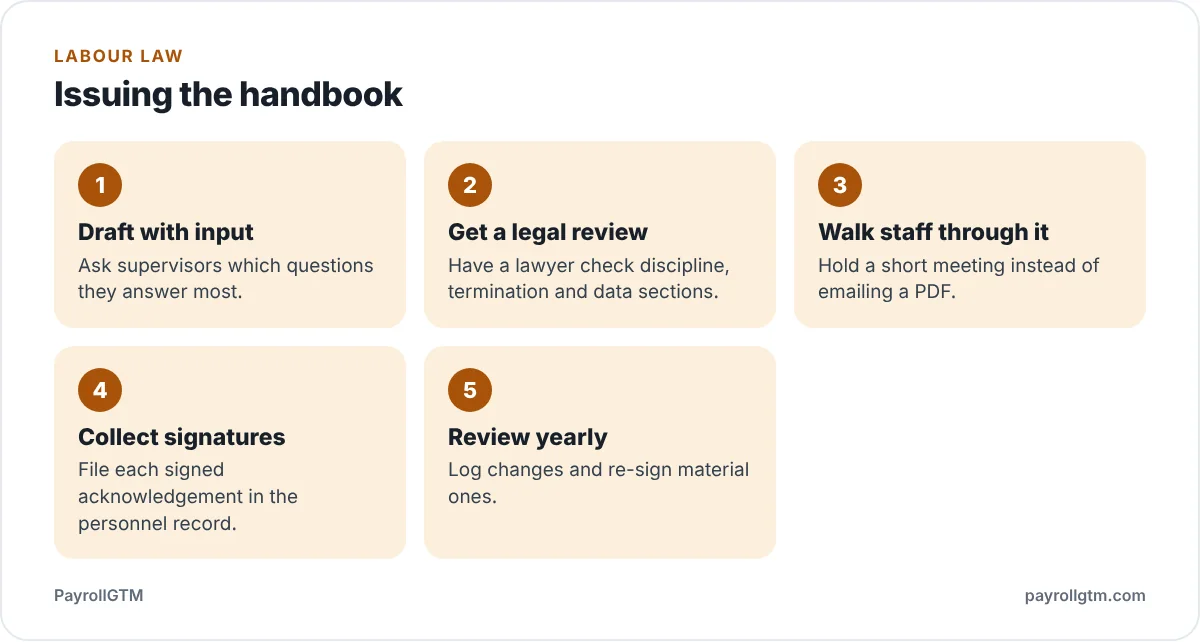
A signed acknowledgement is your proof that staff saw the rules. Without it, "nobody told me" is hard to answer. Review the handbook once a year and whenever something material changes, such as a new tax rule, a new office or a change in leave practice. Keep a short change log, tell staff what changed and collect fresh signatures for material changes. Changes to personal contract terms need the employee's agreement, so get advice before using a handbook update to cut benefits.
Common questions
Is a handbook legally required?
No, but written terms are. The handbook is how most small employers deliver the common ones.
Can I change the handbook without consent?
Procedural policies within your discretion can usually be updated with notice. Anything that changes a contractual term needs agreement. Take legal advice on material changes.
Do union rules affect it?
If your staff are unionised, a collective agreement may override parts of it. See trade unions and collective bargaining for small employers.
This is general information, not legal advice. Have a lawyer review the discipline, termination and data sections before you issue the first version.