A public holiday in Nigeria is a day off for covered employees, and monthly-paid staff keep their normal salary for it. If you are asked to work on one, what you get in return (extra pay, time off in lieu or nothing) depends on your contract, handbook or collective agreement, because there is no flat federal overtime rate for most private employees. The list of holidays itself comes from the Public Holidays Act and from announcements by the Minister.
Who decides which days are public holidays?
The Public Holidays Act lists the standing federal holidays, and the Minister can declare an additional day by announcement, usually through a broadcast and a circular a day or two before. States can declare their own days within their territory too. For payroll, the rule is to check the official notice, not WhatsApp. Put the person who reads these announcements into your calendar: if nobody owns it, staff find out from the radio and managers find out from the staff.
The announcement will tell you the date and sometimes how a weekend holiday is handled. Follow what it says. If the notice is silent on a particular business such as a restaurant, a hospital or a security firm, the holiday still exists for the public; your business simply decides in advance how staff who must work will be compensated.
Do employees get paid on a public holiday?
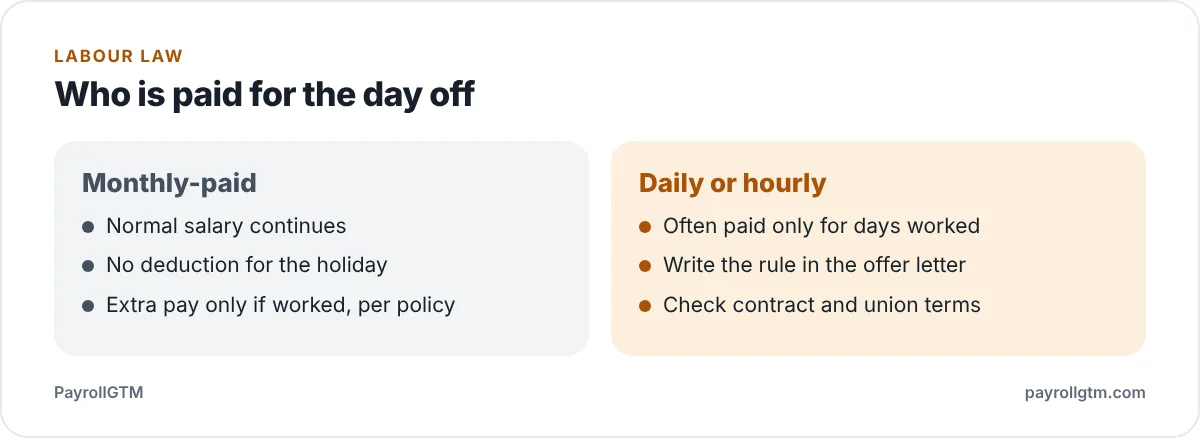
For monthly-paid staff, yes, in practice. Salary is a monthly figure, and a day off for a holiday does not reduce it. An employer who deducts a day's pay from a monthly salary for a public holiday is taking money the employee has earned, and the rules on lawful deductions are tight. See wage payment and lawful deductions before you adjust any payslip.
Daily-paid and hourly workers are where it gets less clear. The Labour Act is generally understood to treat the holidays as paid days for the workers it covers, but daily-paid casuals often are not paid for days they do not attend. If you pay by the day, write in the offer letter whether a public holiday is paid, and do not leave it to be discovered on the first holiday. Part-time and casual staff are discussed in casual, fixed-term and permanent employees.
Managers and professionals may fall outside the Labour Act in some respects. Their holiday pay is then a matter of contract, which is the subject of whether the Labour Act covers managers and professionals.
What if you have to work on a public holiday?
This is the most contested question, and the answer is "check the document". Where the contract or handbook is silent, there is no automatic statutory multiplier we can point to. Many employers pay an extra day's pay, or double pay, or give a day off in lieu, and these are practices, not law.
What a fair policy does is decide this before the holiday, tell staff in writing, and apply it evenly. Retailers, hospitals, hotels, security and logistics firms in Lagos or Abuja run on holiday shifts, so a rule that is vague costs the most there.
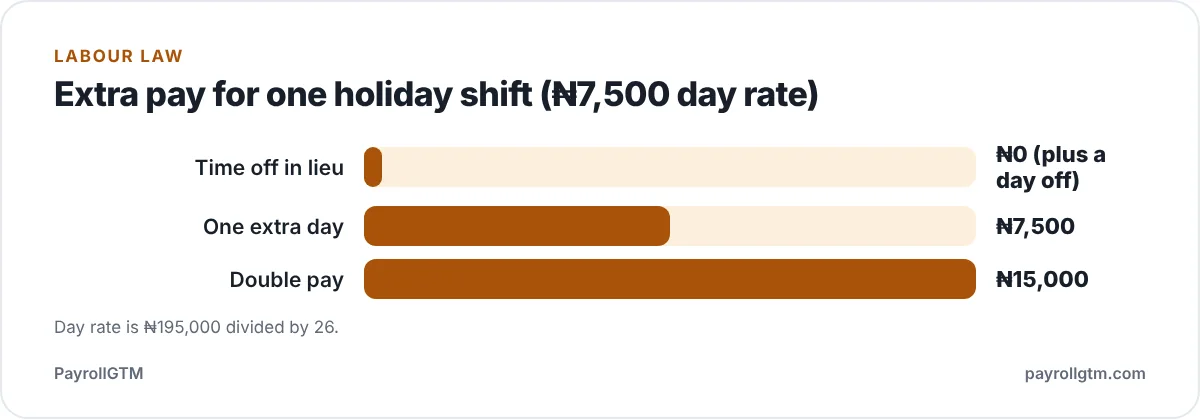
Option A, extra day's pay: he receives his normal salary plus ₦7,500.
Option B, double pay for the day: salary plus ₦15,000 (the holiday itself is already inside his salary, so the extra is two more days' pay).
Option C, time off in lieu: salary only, plus one paid day off within an agreed window, for example 30 days.
Any of the three can be lawful. Which one applies is a policy choice, and it should be the one in the handbook. The extra pay is taxable income, added to the year's PAYE base like other pay.
If someone refuses a holiday shift, the answer depends on whether the contract allows rostering on holidays. Do not discipline a person for refusing work the contract does not require. For wider rules on hours and rest days, read working hours, overtime and rest days.
What if the holiday falls on a weekend?
This depends on the announcement. Sometimes government names a replacement working day off, sometimes it does not. Do not assume. Where the notice gives a replacement day, give it to everyone who normally works Monday to Friday. Where it does not, your handbook should say what you do. A common, simple rule is: "if a public holiday falls on a Saturday or Sunday and no replacement day is announced, no replacement is given." Whatever you choose, write it down before a Saturday holiday arrives.
Staff who already work weekends, such as a shop open seven days, are in a different position and need their own line in the policy.
Does a holiday count against annual leave?
No. If a public holiday falls inside someone's annual leave, the usual position is that it is not charged as a leave day, but your leave policy should say so, because it changes the arithmetic for a two-week break over a festive period. Employers get this wrong in both directions: charging holidays against leave annoys people, and giving a refund of leave days without writing a rule invites disputes about who gets it. The annual, sick and maternity leave guide covers the base entitlement, and the maternity leave guide deals with the longer absence.
Sample handbook clause
Copy and adapt this. Change the bracketed parts to your own rule.
Public holidays. Employees are entitled to the public holidays declared by the Federal Government of Nigeria and, where applicable, the State Government. Monthly-paid employees receive their normal salary for the day. Where the company requires an employee to work on a public holiday, the employee will be paid [an additional day's pay / double pay for the day] or given [one day off in lieu within 30 days], as the company decides and tells the employee before the day. Where a public holiday falls on a weekend and no replacement day is announced, [no replacement day is given / the following Monday is observed]. Holiday days that fall within approved annual leave are not counted as leave days.
Put the clause into the employment contract or the handbook that the contract refers to. If you want the same rule written across the whole workplace, the employee handbook guide gives a layout. The employer duties that sit behind all of this are listed in the Labour Act obligations for employers.
Mistakes employers make
- Deducting a day's salary from monthly staff because the office was closed for a holiday.
- Rostering people to work without any announced compensation, then arguing about it afterwards.
- Saying one thing to the night shift and another to the day shift, so two groups know the rule differently.
- Copying a rate from a competitor's advert and calling it "the law".
Where you cannot tell which way a rule cuts, write to your state's labour office or the Federal Ministry of Labour and keep their reply.