In Nigeria the label on the contract matters less than how the work is actually done. A person who works regular hours under your supervision, month after month, is an employee for pension, PAYE and notice purposes whether you call them casual, contract or permanent. The three labels describe how long the relationship is meant to last, not how many legal duties you can skip.
Below is what each type means in practice, where the entitlements still apply, and why renewing the same "temporary" worker for years is the commonest way for a small employer to end up in front of the National Industrial Court.
What the three terms usually mean
None of these labels has a single definition that every Nigerian business uses, so what follows describes common practice, not a statutory test.
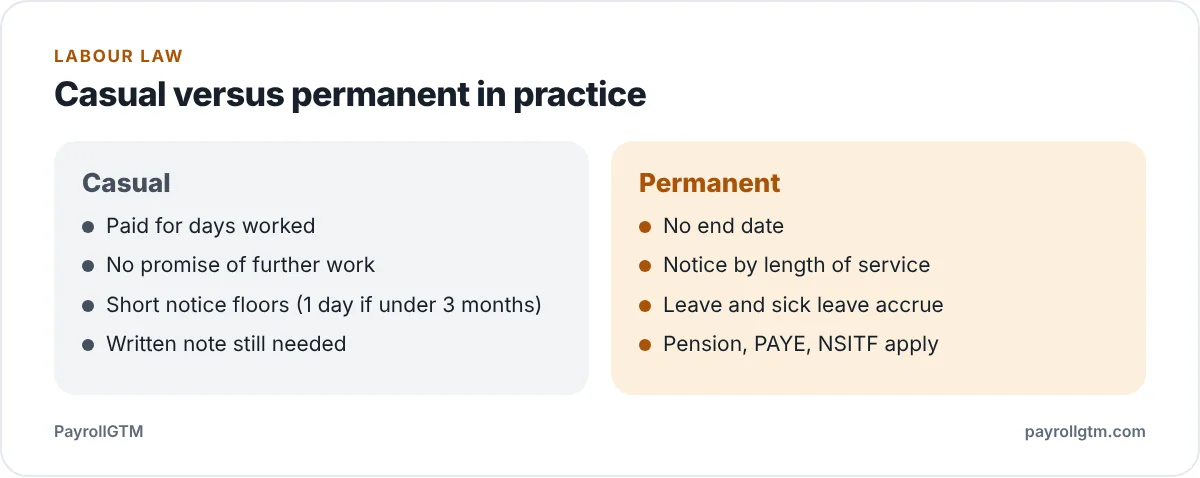
- Casual: engaged by the day or for a specific task, paid for the days worked, with no promise of further work. Think of a loader hired for a delivery week or an extra shop assistant during the December rush.
- Fixed-term (or contract): a defined start and end date, or tied to a project, with a written agreement. A twelve-month contract to cover a maternity absence is a typical case.
- Permanent: no end date. It continues until the employee resigns, retires or is lawfully terminated by notice, pay in lieu of notice, or for cause.
A separate category is the independent contractor, who runs their own business, invoices you and controls how the work is done. That is not employment at all, and the test for it is covered in employee or contractor classification. Many people on "contract" are really employees.
What still applies whatever the label
| Entitlement or duty | Casual | Fixed-term | Permanent |
|---|---|---|---|
| PAYE on salary | Yes, if they are an employee | Yes | Yes |
| Pension (employer with 3 or more employees) | Yes, once they are an employee on payroll | Yes | Yes |
| Written statement of terms within 3 months (s.7) | Applies where the Act covers the worker | Yes | Yes |
| Statutory notice (s.11 floors) | 1 day if under 3 months | Depends on the contract; ends on expiry | 1 day to 1 month by length of service |
| Annual leave (6 working days minimum after 12 months) | Rarely reached | Often reached on 12-month terms | Yes |
| Employer's NSITF contribution (1% of payroll) | Included in payroll | Included in payroll | Included in payroll |
| Minimum wage (₦70,000 a month, employers with 25 or more) | Applies to the basic wage, confirm how for part-time pay | Yes | Yes |
The pension row catches many small employers. The Pension Reform Act applies to employers with 3 or more employees, and a worker on a short contract still counts once they are an employee on your payroll. How that works for short engagements is set out in pension for contract and casual staff. The pension line can also be arranged so the employer pays the full 20%, which some firms use for contract hires, as described in the 20% rule.
The Labour Act does not reach everybody equally. Its definition of a worker excludes people doing administrative, executive, technical or professional functions in some respects, so a contract manager may rely mainly on their contract and the common law. Read whether the Act covers managers and professionals and ask a lawyer when the person is senior.
The "permanent casual" problem
Yetunde has cleaned a Lagos office for four years on a "daily-paid casual" basis. She has fixed days, uses the company's equipment, is told when to take leave and has no written contract. At the end of the third year she is told the daily rate will not be paid on the days the office is closed. A year later she is dismissed with no notice.
On these facts she would argue that she was an employee all along, and a court looking at the substance of the relationship would be unlikely to treat the word "casual" as decisive. We cannot cite a case for you, because our sources do not include one, but the pattern is consistent in practice: where the work is regular and continuous, the label gives way. For the employer the exposure is notice pay for four years of service (one month at the Act's floor for 5 years or more, two weeks at 2 to under 5 years), unpaid pension contributions, unpaid PAYE, and the cost of defending the claim. A dispute like this goes to the National Industrial Court (how wrongful dismissal claims work there).
Fixed-term contracts and renewals
A fixed-term contract ends on its date without notice if the contract says so, and that is its main advantage. The risks come at renewal.
- Repeated renewals. Renewing the same person every year for five years tends to create an expectation of continuing work. Our sources do not set a number of renewals that converts the role, so treat three or more renewals as a reason to decide: make the person permanent, or document why the work really is temporary.
- Ending early. Terminating before the end date usually breaches the contract unless it has an early termination clause. State one, with notice at least at the Labour Act's floors.
- No written terms. If the dates and end condition are not in writing, you will have trouble proving the engagement was temporary.
- End-of-term payments. Pay everything due on the last day, including accrued leave if your policy provides for it.
What to put in writing
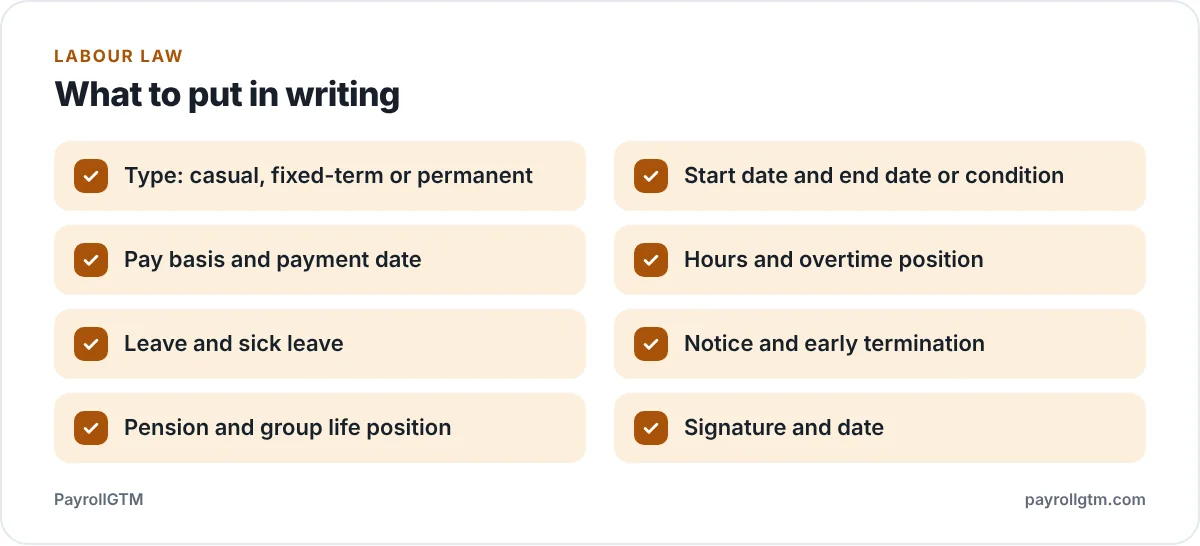
For every engagement, whatever the label, give a written statement within 3 months, which is the Labour Act's own time limit and in practice is best done on day one. Use the points in what an employment contract must contain. For casual workers the document can be one page.
The statement should state the type clearly, in plain words, for example: "This is a fixed-term contract from 1 March to 28 February. It ends on that date without further notice unless renewed in writing." Add the pay basis, hours, the position on overtime (see working hours, overtime and rest days), the leave you give, and your policy for pension and group life. Then include the same wording in the staff handbook so casual and fixed-term staff know the rules (employee handbook guide).
Keep the paperwork the same as for permanent staff
Whatever the contract type, put every person who is an employee on the payroll register with a name, a bank account, a start date and the days worked, and issue a payslip. A casual who is paid in cash from the till, with nothing recorded, is the worker for whom you cannot prove pension, PAYE or hours later. That record also protects you: if the person claims to have worked longer than they did, your attendance sheet and payslips are the answer. See the new hire onboarding checklist for the documents to collect on day one.
Which type to choose
| Situation | Better fit |
|---|---|
| Work that arises irregularly, no promise of more | Casual, paid per day, with a one-page statement |
| A project or cover with a known end | Fixed-term, with end date and early-termination clause |
| A role you expect to keep for a year or more | Permanent, with a probation period |
| A specialist who runs their own business | Contractor agreement, after checking the classification test |
Ibrahim runs a bakery with 12 staff and four weekend sellers. The sellers work every Saturday and Sunday for two years. He should either put them on a permanent part-time contract with pro rata pay and pension, or reduce their use to genuinely occasional days. Doing neither leaves him with workers who have the rights of employees and records that say otherwise.
If you are unsure whether a particular worker falls under the Labour Act, or how a renewal pattern will be read, ask an employment lawyer before the contract is signed. It costs far less than a claim.