Redundancy is a lawful way to end a job only when the role itself is no longer needed. Under section 20 of the Labour Act, you must tell the union or workers' representatives why and how many, select people on a "last in, first out" basis (adjusted for skill, ability and reliability), and use your best endeavours to negotiate redundancy pay. The Act sets no formula for the amount, so you need a written, consistent method.
The temptation is to act quickly and quietly. That is usually the mistake. A poorly run redundancy turns a hard business decision into a dispute at the National Industrial Court and damages the trust of the people who stay.
What redundancy is and is not
Redundancy means the job has gone or fewer people are needed, through a lost contract, a closed branch, a machine, or falling sales. It is not the same as dismissal for misconduct (where you allege wrongdoing) or for poor performance. Calling a dismissal "redundancy" to avoid a disciplinary process is risky, because a court looks at the real reason and at how people were chosen. If you hire someone into a similar role a few weeks later, the redundancy looks like a sham. For conduct cases, follow a fair disciplinary procedure instead.
What section 20 expects
In broad terms, section 20 expects three things from an employer facing redundancy: inform the union or workers' representatives of the reasons and the extent, apply last in, first out subject to relative skill, ability and reliability, and use best endeavours to negotiate payments for those discharged. Amounts usually come from the contract, a collective agreement or company policy.
The Labour Act's definition of "worker" excludes some administrative, executive, technical and professional staff in some respects, so senior people are governed mainly by their contracts. In practice, apply the same fair process to everyone. See whether the Labour Act covers managers and professionals and the overview of employer obligations under the Labour Act.
A fair redundancy process, step by step
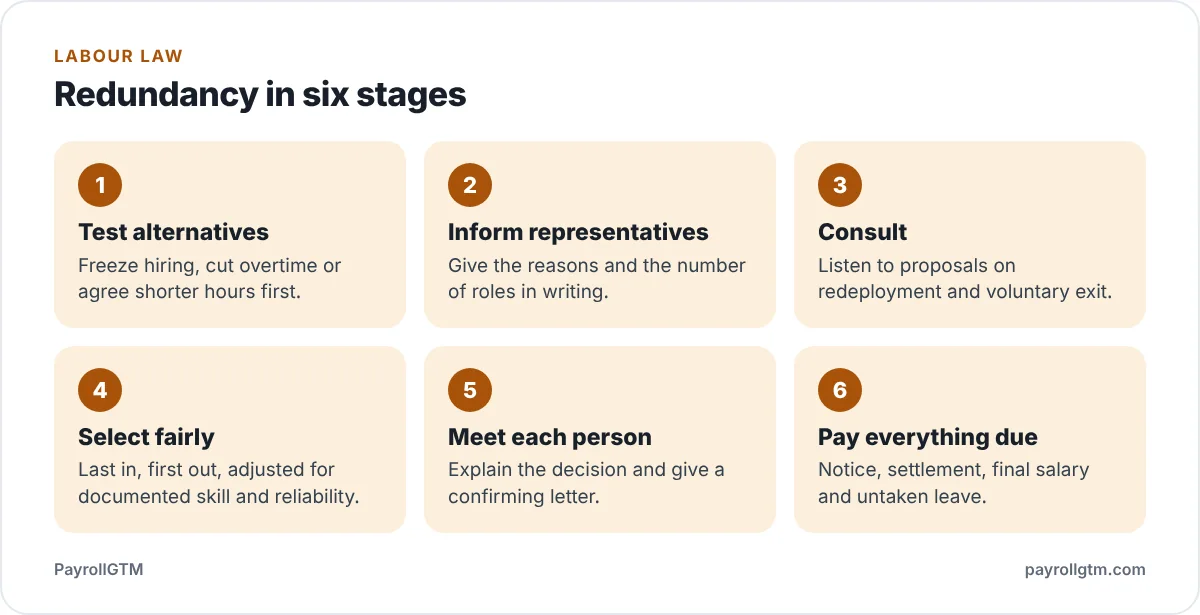
- Test the alternatives. Could a hiring freeze, agreed shorter hours, or less overtime avoid job losses? Writing down that you considered them strengthens your position.
- Define the roles affected. Say which positions are no longer needed and why, with a short business case that has figures.
- Inform the union or representatives. If there is no union, meet the affected staff as a group or choose representatives. Our note on trade unions and collective bargaining for small employers explains who to approach.
- Consult. Staff sometimes suggest redeployment or voluntary exit that you had not considered.
- Select fairly. Last in, first out within the affected group, adjusted for documented differences in skill, ability and reliability. Do not use criteria that discriminate, such as pregnancy, ethnicity or union activity.
- Offer redeployment where a suitable role exists.
- Meet each person individually. Explain the decision and the settlement, and give a letter confirming it.
- Give notice or pay in lieu. At least the statutory or contractual minimum.
- Pay everything due, promptly.
- Keep records: business case, selection criteria, minutes, letters.
How to calculate the settlement
Because the Act gives no formula, employers need a method they can defend. A common one is a fixed number of weeks of basic salary per completed year of service, plus notice (or pay in lieu) and any untaken leave. The weeks per year is your policy choice, not a legal rate. A weekly figure is annual basic divided by 52.
The statutory notice floors are 1 day (under 3 months' service), 1 week (3 months to under 2 years), 2 weeks (2 to under 5 years) and 1 month (5 years or more). Your contract may give more.

Apply the same formula to everyone in the same position and put it in writing. A generous, consistent formula is easier to defend than an unpredictable one.
Tax and pension on the payout
Do not guess how each element is taxed. The new Nigeria Tax Act raised the exemption threshold for compensation for loss of employment from ₦10 million to ₦50 million, but sources conflict on how some elements, such as gratuity, are treated. Read tax on redundancy and severance pay and confirm the treatment with your state IRS before paying. Salary and notice pay up to the last day still go through payroll, and the employer and employee pension for the final month must be remitted as usual within 7 working days. The employee's RSA stays with them, as described in what happens to your pension when you leave a job. The other elements of final pay are in offboarding and final settlement.
Selection pitfalls
- Choosing by personality. Disliking someone is not a criterion.
- Replacing quickly. Rehiring into the same role soon after exposes the exercise as a sham.
- Protected situations. Be careful with staff on maternity leave or who recently raised a grievance. If selection appears linked to those facts, expect a claim. Their leave rights are in annual, sick and maternity leave.
- Casual promises. A spoken promise of re-employment or a bonus can become an expectation. Put in writing only what you intend to honour.
- Different formulas for similar roles without a recorded reason.
Telling people
Tell people early and in person, with a written summary. Do not announce it by email to the people affected. Explain the reason and the numbers in plain language. Staff who feel respected are less likely to litigate and more likely to speak well of you when you hire again. Remaining staff also need an explanation of what has changed and who covers the work, or output drops.
Common questions
Do I have to pay redundancy benefits?
The Act expects best endeavours to negotiate them, and your contract or policy may require more. Offering nothing invites a dispute.
Can I choose by performance?
Skill, ability and reliability can adjust last in, first out, but the differences must be real and recorded.
What if I close the whole business?
The same principles of notice, fair treatment and payment of entitlements apply. Take legal advice, because closure also involves creditors and CAC filings.
This is general information, not legal advice. For a large exercise, consult a lawyer.