Nigeria has no single law that gives every private-sector employee overtime at 1.5 times pay. For most staff, working hours and overtime rates come from the contract, the staff handbook or a collective agreement, and the 1.5x figure you hear in offices is a common practice, not a statutory rate. That makes the written terms the whole story, so the first thing to do is read yours. The myths below are the ones that cause arguments in Lagos shops, Abuja offices and Port Harcourt site yards.
Myth: the Labour Act sets a flat overtime rate
Fact: It does not, for most private employees. The Labour Act (Cap L1) sets floors for matters such as notice, leave and written terms, but it does not hand every worker a fixed multiplier for extra hours. Where overtime is paid, the right comes from what the employer promised in the contract, the handbook or an agreement with a union.
That cuts both ways. An employer cannot be sued for failing to pay "the legal 1.5x" when no document promised it. Equally, an employer who put a rate in the handbook, or paid it consistently for years, will struggle to say it was optional. A promise in writing is enforceable like any other term, and the National Industrial Court is the forum for such disputes. If you are unsure whether your contract covers it, employment contract essentials lists the clauses that should be there.
Myth: 1.5x is the law, so 1.5x is always right
Fact: 1.5x is what many employers choose. Others pay 1.25x on weekdays and 2x on Sundays or public holidays, some pay a flat sum per shift, and some give time off in lieu. None of these is automatically wrong. What matters is that the rule is written, applied the same way to people doing the same work, and explained to staff before the first extra hour is worked.
A short clause is enough. Say who must approve overtime in advance, what counts as overtime (for example hours beyond 8 a day or 40 a week, the figures your business sets), how it is calculated, and whether it is paid or taken as time off. Without prior approval rules, staff can claim for hours the employer never wanted.
Myth: working hours are fixed by law at eight a day
Fact: Hours are set by the contract, subject to what the law and any sector rules allow. Eight hours a day and five or five and a half days a week are common patterns, not a universal legal rule. We do not state a statutory weekly maximum here because our sources do not confirm one for general private employment.
Sector rules differ. Banks, factories, hospitals, security companies, transport and oil-and-gas contractors may be bound by shift systems, regulator conditions or collective agreements that do not match a typical office. Ask the relevant regulator, your trade union or a labour lawyer before copying another industry's terms. The Labour Act's reach into managers and professionals is also limited in some respects, which we cover in whether the Act covers managers and professionals.
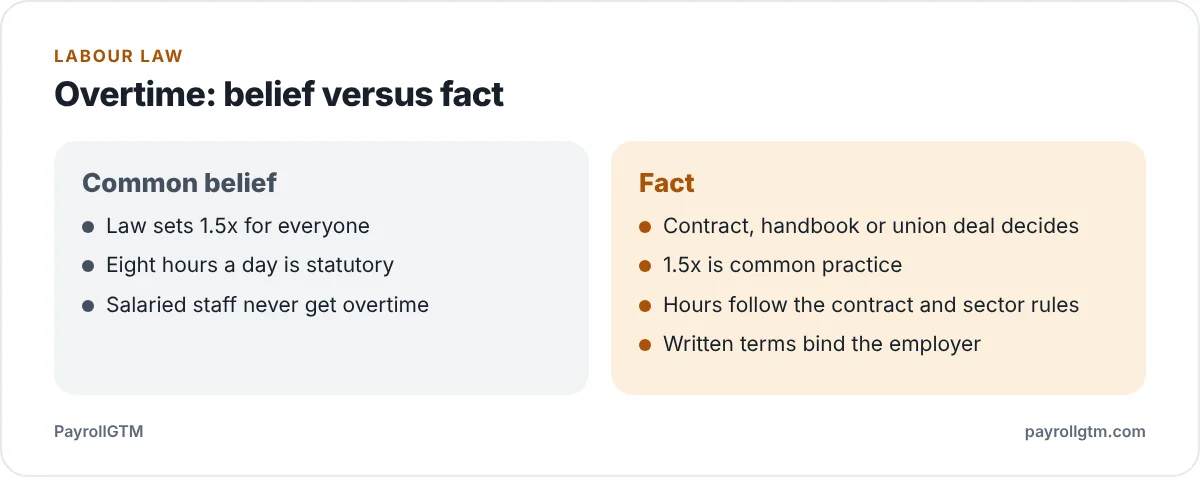
Myth: salaried staff are never owed overtime
Fact: It depends on the contract again. Some employers state that a salary covers all hours worked, particularly for supervisors and managers, and that is a legitimate agreement if clearly written and if the pay is not below any applicable minimum. But a clause saying "no overtime" does not cancel a separate promise in a handbook or shift schedule, and it does not authorise unlimited hours. A person paid a salary but working 70 hours a week with no rest may still raise a claim based on the contract as a whole.
For staff who are hourly or daily paid, such as casual and fixed-term workers, overtime language matters even more because the base is smaller.
How to calculate overtime pay: one common method
The method below is a convention many employers use, not a legal formula. Your contract can define it differently, and if it does, follow the contract.
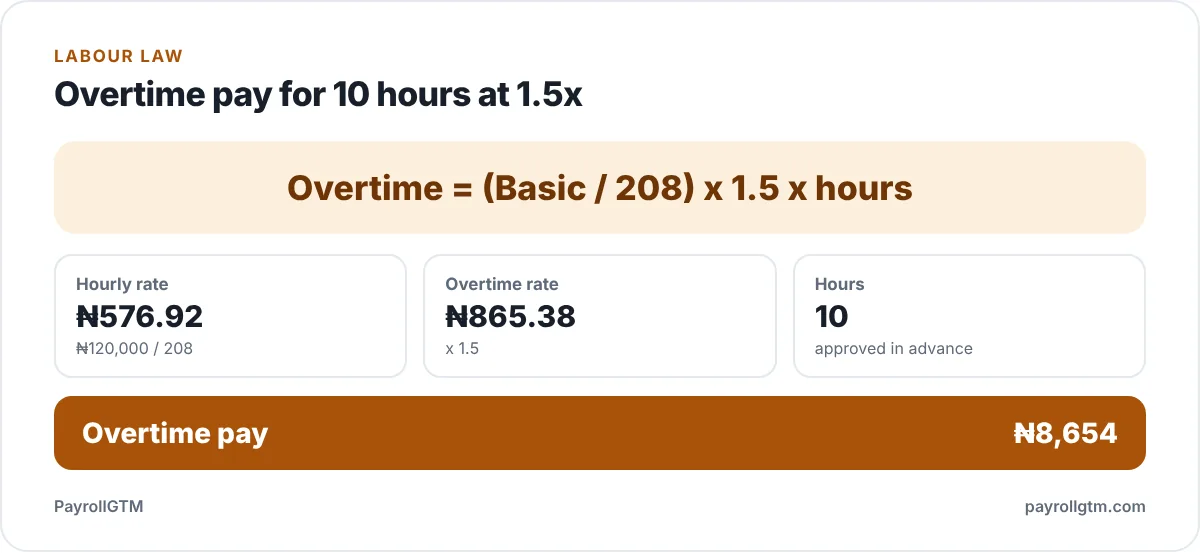
Hourly rate = monthly basic salary divided by (26 working days x 8 hours), which is 208 hours. Some businesses use total gross, or a 22 or 30 day month. Pick one, write it down, and use it for everyone.
Hourly rate = ₦120,000 / 208 = ₦576.92.
Overtime rate at 1.5x = ₦865.38 an hour.
Ten hours of overtime in the month = ₦8,654 (rounded).
On a Sunday under a 2x rule, eight hours would be ₦576.92 x 2 x 8 = ₦9,231.
Overtime is pay for work as an employee, so it joins the month's taxable income. Using our PAYE logic with her three allowances making up the pension base, PAYE on ₦200,000 is ₦17,600 and net pay ₦166,400. With the ₦8,654 added (gross ₦208,654, and assuming the contract does not make overtime pensionable), PAYE rises to ₦18,898 and net pay to ₦173,756, so she keeps about ₦7,356 of the ₦8,654. If the contract does include overtime in the pension base, the employee and employer shares rise as well. Check which your policy says before you build your payroll sheet; the step-by-step payroll run shows where an overtime line sits.
Myth: rest days and leave are optional extras
Fact: Paid annual leave of at least 6 working days after 12 months' continuous service, and paid sick leave of up to 12 working days a year on a medical certificate, are statutory minimums under the Labour Act. Many employers give more by contract. You cannot swap a worker's leave for overtime pay without agreement, and recurring seven-day weeks create risk of injury, which is also a compensation issue; see the Employees Compensation Act guide. Details of leave are in annual, sick and maternity leave.
For working on a public holiday, the pay depends on your contract, so read public holidays, pay and work rights and write the holiday rate into the handbook.
What to do if you think you are owed overtime
Start with your paperwork: the contract, the handbook and any WhatsApp or email instruction asking you to stay late. Keep a simple log with date, hours and who asked. Raise it with your manager or HR in writing, naming the clause or the practice you rely on and the amount you believe is due. Many cases end there, because employers would rather pay ₦30,000 than lose a trained person.
If the answer is no and nothing written promises overtime, your claim is weak; if there is a promise or a consistent past practice, you may escalate to your union or the National Industrial Court. Take advice from a lawyer or the Ministry of Labour before you do, because the contract wording will decide it.
Writing it down: a clause you can adapt
Normal working hours are 8:00 a.m. to 5:00 p.m., Monday to Friday, with a one-hour break. Overtime must be approved in writing by the line manager before it is worked. Approved overtime is paid at 1.5 times the hourly rate, calculated as monthly basic salary divided by 208, and is paid with the salary of the month following the overtime. Overtime on Sundays and public holidays is paid at twice the hourly rate. Staff in supervisory grades are paid a fixed allowance in place of overtime.
Adapt every figure to your business, and have a lawyer check it if your staff work shifts or in a regulated sector. Then put it in your employee handbook and in each contract. An exit grievance about unpaid overtime is much easier to settle when there is a signed clause; final pay on resignation shows where unpaid sums usually surface.
Employer duties more broadly are in the Labour Act employer obligations.