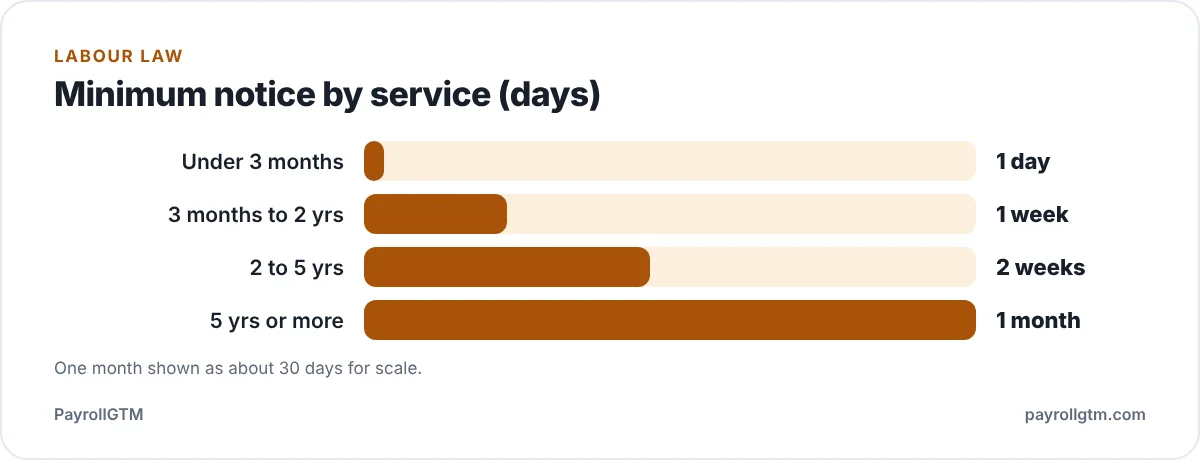
Under section 11 of the Labour Act, the minimum notice to end a contract is 1 day if the worker has served under 3 months, 1 week for 3 months to under 2 years, 2 weeks for 2 to under 5 years, and 1 month for 5 years or more. Either side can give it, and pay in place of notice is allowed. Severance pay is not automatic: the Act does not give every dismissed worker a lump sum.
That second point surprises many employees and many employers. A worker who is dismissed with proper notice is owed notice, final pay and whatever the contract or company policy promises. A genuine redundancy is different. This guide takes the decision in the order a manager has to face it.
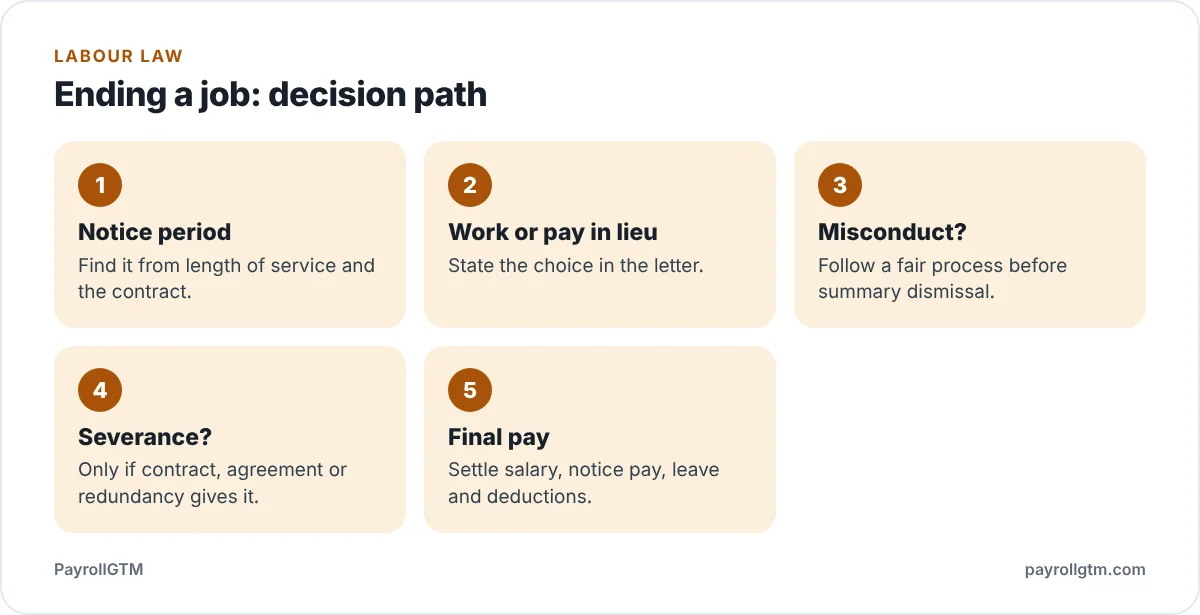
Step 1: find the notice period that applies
Length of continuous service on the last day decides the floor. Your contract can give longer notice, and it often does: 1 month for junior staff and 3 months for managers is common. The Act sets the minimum, so a contract cannot go below it.
| Service | Minimum notice (Labour Act s.11) |
|---|---|
| Under 3 months | 1 day |
| 3 months to under 2 years | 1 week |
| 2 years to under 5 years | 2 weeks |
| 5 years or more | 1 month |
Count service from the start date on the offer letter, not from confirmation. Probation does not pause the clock; see probation periods and confirmation for what you can and cannot do in that window. Check also whether the person is covered: the Act's definition of "worker" excludes some administrative, executive, technical and professional staff in some respects, so for senior people the contract and common law matter more. Does the Labour Act cover managers and professionals explains the limits, and a lawyer should check borderline cases.
Step 2: work the notice, or pay in lieu
Notice can be worked, or the employer can pay the equivalent wages and end employment at once. Say which in the termination letter, in writing, with the last working day and the last day of employment.
- Notice due: 2 weeks, because he has served 2 to under 5 years.
- Method A, weekly rate: ₦280,000 x 12 / 52 = ₦64,615 a week, so 2 weeks is ₦129,231.
- Method B, half a month: ₦280,000 / 2 = ₦140,000.
- The gap between methods is ₦10,769. Use whichever your contract or handbook states, and apply it the same way to everyone.
The Act does not tell us which method to use, and if the contract is silent it is a point to settle by agreement or legal advice. Pay in lieu should be based on what he would have earned: basic plus the regular allowances. Treat the payment as employment income for payroll, and confirm any PAYE treatment with your state IRS.
If the employee ends the contract and does not give the notice the contract requires, check the contract before deducting anything from final pay. Deductions are lawful only in set cases; see wage payment and lawful deductions.
When the contract asks for more than the Act
The section 11 table is a floor. Most written contracts in Nigerian offices ask for 1 month from junior staff and 3 months from managers, and the contract usually applies to both sides. If the contract says 3 months, giving only the statutory 2 weeks is a breach, even though 2 weeks is what the Act requires.
- The Act gives her at least 1 month. Her contract gives her 3 months, so 3 months applies.
- Pay in lieu for the full period: ₦450,000 x 3 = ₦1,350,000.
- If the employer pays only 1 month (₦450,000), the shortfall is ₦900,000 and she can claim it.
Where a contract is silent on notice, the Act's minimum fills the gap. Where it gives shorter notice than the Act, the Act's minimum still applies. Before you send a termination letter, find the notice clause and compare it with the table above, then use the longer of the two.
Step 3: is it misconduct that justifies dismissal without notice?
An employer may dismiss without notice for gross misconduct such as theft, fraud or violence. The right is real, but it is the part that reaches the National Industrial Court of Nigeria most often. Courts there look at whether the employer followed its own procedure and gave the worker a fair hearing where the contract or handbook calls for it. A summary dismissal with no query, no response and no hearing is the riskiest option an employer has.
So before dismissing for misconduct: put the allegation in writing, allow a reasonable time to answer, hold a hearing if your documents require one, record the decision and the reason. Read the disciplinary procedure guide first. If you cannot show a fair process, giving proper notice or pay in lieu is the cheaper course. What happens when it goes wrong is covered in wrongful dismissal and the National Industrial Court.
Whatever the reason, you cannot dismiss for a reason that breaches the law, such as pregnancy or joining a lawful union.
Step 4: is any severance owed?
There is no general right to a lump sum on termination. Money beyond notice and final pay is owed only if it comes from one of these:
- The contract or handbook. A clause such as "one month's salary for each completed year" is binding on the employer.
- A collective agreement, where there is a union.
- Redundancy. If the job disappears, section 20 requires the employer to inform the union or workers' representative, apply last in, first out (subject to skill and family circumstances) and pay redundancy payments as agreed or as the agreement provides. The process is in how to do redundancy lawfully, and the tax angle in tax on redundancy and severance pay.
- A negotiated exit. Some employers offer a package in return for a signed release. That is a deal, not an entitlement.
Calling a payment "severance" does not make it statutory. If your offer letter promised "a gratuity" or "end of service benefit", the clause decides the amount.
Step 5: the final pay checklist
A short letter is enough, so long as it carries the facts that matter later:
Dear [Name], this letter confirms that the company is ending your employment. You started on [date] and have served [period], so the notice due under your contract is [period]. We will pay you [amount] in lieu of notice, and your last day of employment is [date]. Your final pay, with a breakdown, will be paid on [date]. Please return company property to [person] by [date].
Whoever ended the contract, the employee should receive a clear statement of what is paid. The usual lines are:
- Salary up to the last day worked, prorated if the month is part-worked.
- Pay in lieu of notice, if the employer ends employment early.
- Any unused leave that the contract or policy says is paid out. The Labour Act does not itself say all leave must be cashed on exit, so read your leave policy.
- Approved expense claims and any commission or bonus already earned under the scheme rules.
- Deductions, only where lawful, such as an agreed loan balance.
- PAYE and the final month's pension remitted in the usual way.
Return of company property, an exit interview and the release of a reference letter normally sit alongside this; offboarding and final settlement gives the timeline. The employee's side is in how to resign in Nigeria: notice and final pay.
Mistakes that cost employers money
- Counting service from confirmation. An employee hired 26 months ago but confirmed only 20 months ago has served over 2 years and is owed 2 weeks, not 1 week.
- Verbal termination. It leaves no date for the notice to start. Always write the letter.
- Treating fixed-term and casual staff differently without checking. The rules turn on the real contract; see casual, fixed-term and permanent employees.
- Holding back final pay until the staff member clears. Salary earned is owed; take advice before withholding.
When the facts are unusual, a short consultation with an employment lawyer before the letter goes out costs less than a claim.