Maternity leave under the Labour Act is 12 weeks (section 54), usually taken as 6 weeks before and 6 weeks after the birth, and the Act sets the pay floor at not less than 50% of wages. Many employers pay full salary instead, and your contract or handbook may promise more than the Act does. For nearly everyone, those two documents decide what you actually get.
How long is maternity leave in Nigeria?
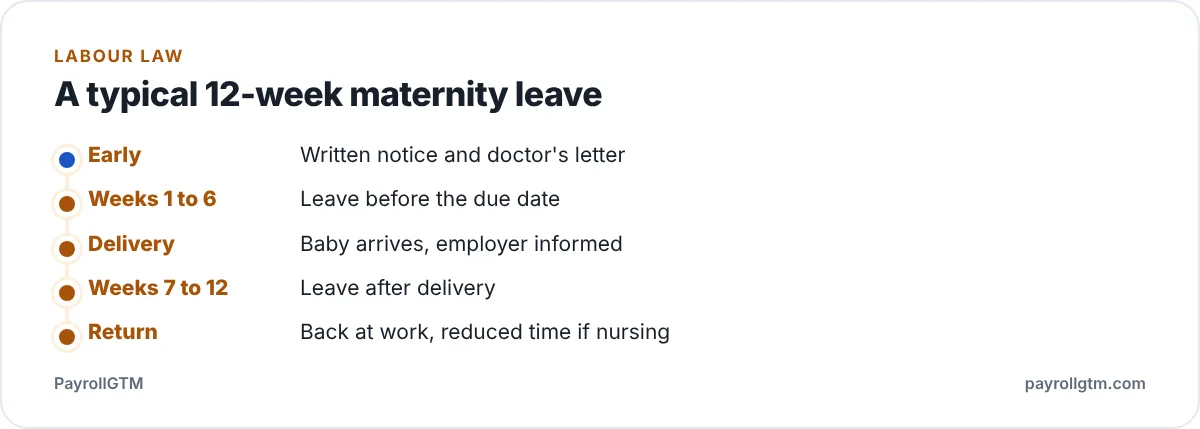
Twelve weeks. The common split is 6 before and 6 after the delivery, and a doctor's advice can shift the balance. Employers often let a mother take more of the leave after birth if the pregnancy has gone smoothly. Put the rule in the employee handbook so nobody has to bargain for it while eight months pregnant.
The 12 weeks are a minimum from the Labour Act, not a ceiling. A contract can give 14, 16 or more, and an employer who offers extra unpaid time after the 12 weeks is simply being generous. If you are in the leave policy stage, write the number down once and apply it to everyone in the same position.
How much must the employer pay?
At least 50% of wages for the leave. "Wages" here is where arguments start: does it mean basic salary only, or the whole package including housing and transport? The Act does not settle that in plain words for every payslip structure, so check how your contract defines pay. The safest policy for an employer is to define it as the monthly gross the employee would have received, and the safest check for an employee is to look at that definition before going on leave.
Full pay is common and sensible. Some states and many public-sector and multinational employers pay full salary, and a contract that says so binds the employer even though the Act only demands half. If you are told "the law says 50%", the right reply is "what does my contract say?"
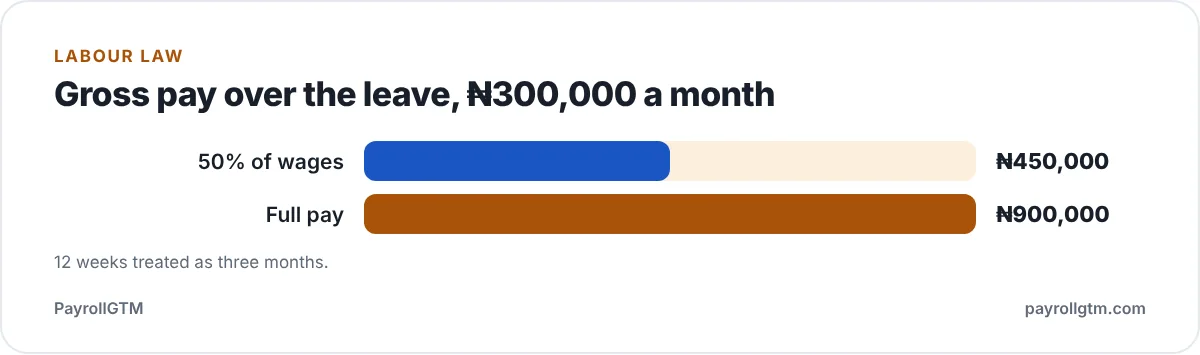
At 50% of wages: ₦150,000 a month, ₦450,000 over the leave.
At full pay: ₦300,000 a month, ₦900,000 over the leave.
Difference: ₦450,000 in gross pay.
For the three months, pension at 50% pay is 8% of ₦150,000 = ₦12,000 from Kemi and 10% = ₦15,000 from the employer, against ₦24,000 and ₦30,000 at full pay. PAYE is worked on the whole year: with nine months at ₦300,000 and three at ₦150,000, annual gross is ₦3,150,000, chargeable income after pension is ₦2,898,000 and annual PAYE is ₦314,700, compared with ₦386,160 for a full year at ₦300,000. The take-home gap is therefore smaller than the pay gap, but it is still real.
Does pension continue during maternity leave?
The pension rules work on the emoluments actually paid, so when pay drops to 50% the contributions on that pay drop with it, as the example shows. If the employer chooses full pay, full contributions continue. What matters is that the employer keeps remitting within 7 working days of paying the salary, and that the leave months do not become missed months. Ask payroll for your RSA statement when you return and check each month is there. The pension contribution method lets you test the figures. This is the standard reading rather than a specific PenCom ruling on maternity, so confirm with your PFA if you doubt it.
Group life cover and NSITF do not stop because someone is on leave. The employer's 1% NSITF contribution is on total payroll, and the leave pay is part of it.
What payroll should set up before the leave starts
- Record the leave start and return dates in the payroll system, so the pay level changes automatically and does not rely on someone remembering in month two.
- Write down which pay figure is being used (50% of gross or full pay) and send it to the employee. This is the document that settles any later disagreement.
- Keep the bank transfer date the same. A mother on leave should not find that her salary arrives a week later than her colleagues'.
- Do not delete her from the pension schedule. If the contribution is lower, it is still a contribution.
- Plan her return: confirm the role, the hours and any nursing arrangement a week before she is due back.
What notice and papers does the employee need to give?
The Act refers to a medical certificate. In practice the employee tells HR in writing as early as she reasonably can, attaches a letter from her doctor or hospital giving the expected delivery date, and agrees the start date of leave. Nothing in the Act we have confirmed fixes a number of weeks of notice, so follow your handbook. If there is no handbook, a letter along these lines works:
I am expecting my baby on [date]. I would like my maternity leave to start on [date] and I expect to return on [date]. Attached is the letter from [hospital]. Please confirm the leave dates and the pay I will receive during the leave.
An employer's reply should confirm the dates and pay in writing. Verbal approvals disappear when the HR manager changes.
Can an employer dismiss someone for being pregnant?
Treat it as a serious risk. The Labour Act gives a woman the right to take maternity leave, and ending her job because she is pregnant or because she took the leave can lead to a claim at the National Industrial Court. Employment disputes sit with that court, and judges look at the reason and the process. We are not giving legal advice on a specific dismissal; speak to a lawyer. For employers the practical rule is to treat pregnancy and leave as having no bearing on performance reviews, redundancy selection or contract renewals. If you are weighing whether to let someone go during the period, read how to do redundancy lawfully first.
What about nursing mothers?
The Labour Act gives nursing mothers reduced working time during working hours for a period after returning. Check the exact length of the break in the current text of the Act or ask the Ministry of Labour, as we are not stating it here. Employers can add more flexibility, for example a later start or a private room, at very low cost. For ideas on benefits that keep experienced staff, see low-cost benefits for small businesses.
Who is covered, and what about fathers?
The Act's definition of a worker excludes some administrative, executive, technical or professional staff in some respects, and courts apply the contract and common law to them. If you are a manager or professional, the answer to "am I covered?" is in your contract; see whether the Labour Act covers managers and professionals. Fixed-term and casual staff raise the same question, covered in casual, fixed-term and permanent employees.
There is no federal statutory paternity leave for private-sector employees. Any days off for a new father come from the contract, handbook or goodwill. The wider picture of annual, sick and maternity leave is in annual, sick and maternity leave, and your obligations as an employer are listed in the Labour Act employer duties.