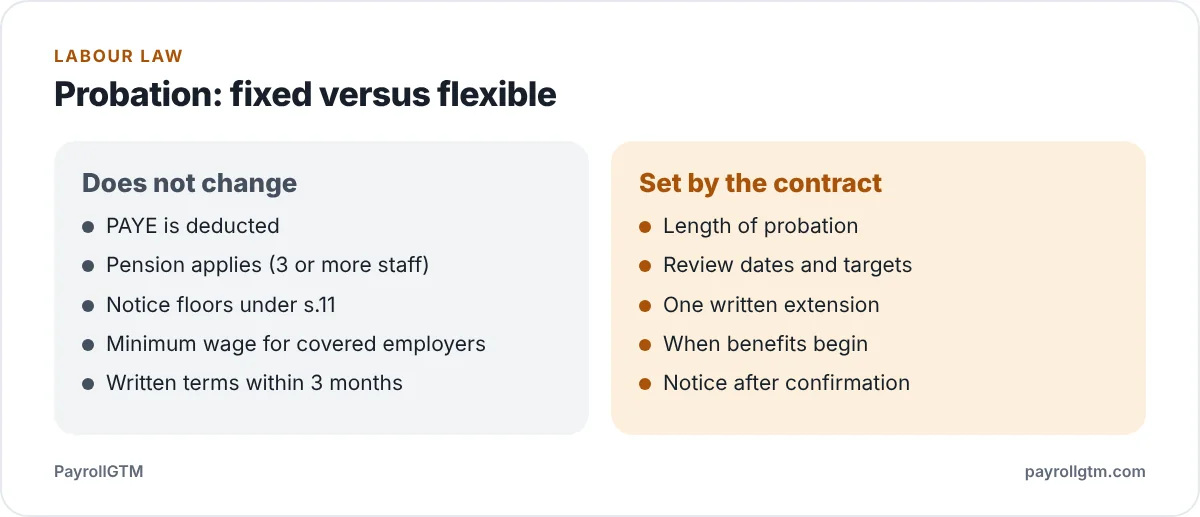
The Labour Act sets no minimum or maximum probation period, so its length is whatever the contract says. Three to six months is the usual range in Nigerian offer letters. A probationer is still an employee: notice floors, PAYE, pension and minimum pay rules apply from the first day, and the only thing probation changes is how easily and how quickly you can decide whether to keep them.
The questions below are the ones employers and new hires ask most. Where the answer depends on the contract or on a point the law leaves open, we say so.
How long can a probation period be?
There is no statutory cap. Nothing in the Labour Act says 3 months, 6 months or any other number, and sites that claim a legal maximum are quoting a company policy, not the law. The test in practice is reasonableness: a 3-month probation for a shop assistant is ordinary, 6 months for an accountant is common, and 18 months for a driver is likely to attract questions in a dispute.
Whatever you choose must be in writing before the person starts. Put the length, the review date and the effect of success or failure in the offer letter, using wording such as the sample in the job offer letter template. A probation period you never wrote down is hard to enforce.
What rights does an employee have on probation?
Most of the ones a permanent employee has. A probationer is entitled to a written statement of terms within 3 months of starting (Labour Act s.7), which is exactly the length of many probation periods. So the paperwork should be done by the end of probation at the latest, and ideally on day one.
The employer must also deduct PAYE and, where the business has 3 or more employees, pay pension contributions for them. We know of no rule that exempts probationers from either; if your pension fund administrator or state IRS tells you otherwise, ask for it in writing. Take Bola, who joins on a consolidated ₦210,000 with the whole amount pensionable. Her payslip in month one shows employee pension ₦16,800, PAYE ₦18,980 and net pay ₦174,220, and the employer adds ₦21,000 into her RSA. The numbers are the same as for a confirmed staff member on that salary.
The national minimum wage of ₦70,000 a month applies to employers with 25 or more employees, probationers included. There is no lower "trainee rate" in the Act.
Can you end probation early, and what notice applies?
You can end employment during probation, but the contract usually says how. Under s.11 the Labour Act's notice floors depend on length of service: 1 day for under 3 months, 1 week for 3 months to under 2 years. A probation clause that says "terminable without notice" is risky for any worker the Act covers, because it can undercut those floors. Pay in lieu of notice is allowed.
The Act's definition of worker excludes some administrative, executive, technical or professional staff in certain respects, and for those the contract and common law govern. If you are hiring such a person, read whether the Labour Act covers managers and professionals and take advice on the clause.
Process matters as well as notice. If your handbook promises a review meeting or a warning before dismissal, follow it for probationers too. A fair, documented exit is the best defence if the person goes to the National Industrial Court. The full notice table is in notice of termination and severance.
What should the probation targets look like?
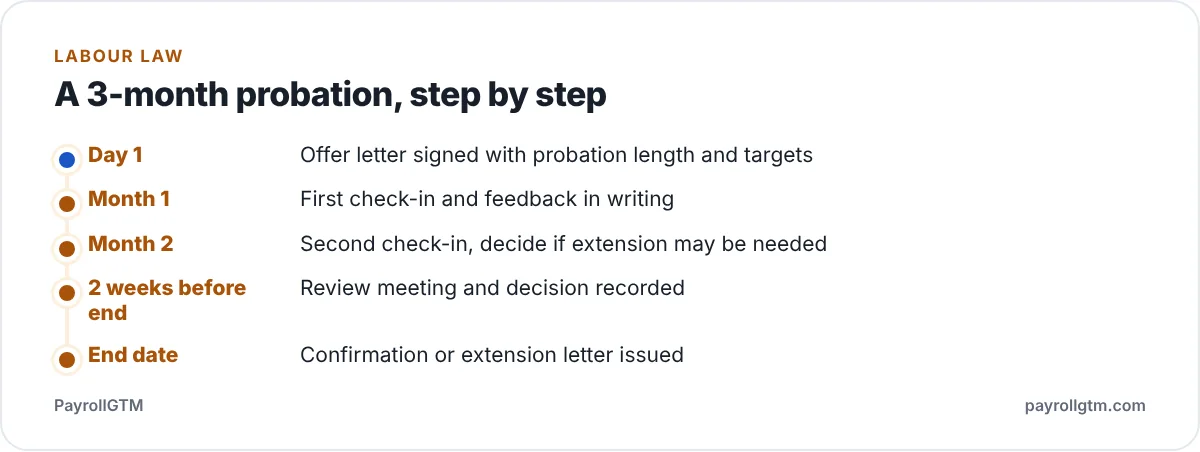
Vague goals such as "good attitude" are useless when you have to defend a decision. Write three to five targets that can be checked: reconcile the bank account within 5 working days of month end, handle at least 20 customer orders a day without errors, complete the stock count with no unexplained variance above an amount you name. Give a copy to the employee in the first week and keep a signed one on file.
Record each check-in in a line or two with the date. If a person is struggling in month one, say so in month one. A first complaint about performance in the last week of probation looks like an excuse, and an employee who was never told cannot be said to have failed to improve.
Can the employer extend probation?
Only if the contract allows it, or the employee agrees in writing. The safe pattern is to put one possible extension, with a maximum length, in the offer letter: "probation is 3 months and may be extended once for up to 3 months if performance targets are not yet met". Then write to the employee before the original end date, say why, and set new targets.
What goes wrong is an extension announced the week after the probation date, or a rolling "we are still reviewing you" that runs to nine months. By then the employee has been working under the same terms for so long that a court may treat them as confirmed, whatever the letter said.
What if nobody confirms the employee?
This is the risk most small businesses ignore. If the probation period ends, the employee keeps working and is paid, and no one writes anything, the practical position is that they are treated as a continuing employee on the terms in the contract. Whether a court would regard that as confirmation, or as an implied continuation of probation, depends on the contract wording and the facts; there is no statutory deemed-confirmation rule we can point to, so the position is uncertain and not something to rely on.
The employer's safest course is to decide before the end date: confirm, extend once in writing, or end the employment with the right notice or pay in lieu. Using the same checklist for every new starter, such as the one in the employee handbook guide, avoids the situation where one person gets a letter and another does not.
How do you confirm an employee properly?
Hold a short review meeting, record the outcome against the objectives you set, then send a confirmation letter. It should say the date of confirmation, that the other terms are unchanged, and any change in pay, leave or notice that follows confirmation. If notice or benefits improve after confirmation, state the new figures so there is no argument later. A sample paragraph you can adapt:
Dear Ngozi, Following your performance review on 14 March, we are pleased to confirm your appointment as Accounts Officer with effect from 1 April. All other terms in your letter of appointment dated 1 October remain unchanged, except that your notice period from confirmation is one month on either side. Please sign and return the copy of this letter.
Keep a copy in the personnel file with the review notes. If you are also tightening the contract, add clauses covered in non-compete and confidentiality clauses only where they are reasonable, and not as a surprise on confirmation day.
What if the person is on a fixed-term or casual contract?
Probation and contract type are separate. A fixed-term contract has an end date, and a casual engagement is paid by the day or by the task, so a probation clause rarely makes sense for either. Where the real relationship is permanent, calling it casual does not remove the rights above. See casual, fixed-term and permanent employees for how the status is decided.
For the full list of what the Act requires of employers, whether the worker is on probation or not, use the Labour Act employer overview. When a probationer resigns instead, the notice and final pay rules are in how to resign in Nigeria.