Pay wages on the date your contract states, into an account in the employee's name, with a payslip that shows how the figure was reached. Deduct only what the law requires (PAYE and the employee's 8% pension share) or what the employee has agreed to in writing. Everything else, from a till shortage to a damaged phone, needs a contract term and a fair process before a naira comes off pay.
This guide gives the rules in the order a small employer meets them. It is general information based on the Labour Act and practice, not legal advice, and state rules can differ.
How should wages be paid?
The Labour Act protects wages and generally expects them to be paid in money. Bank transfer to the employee's own account is now normal and is fine where the employee agrees. Put the pay date in the contract (for example, the last working day of the month) and keep to it. If you plan anything other than money, such as vouchers or goods, take legal advice first.
Do not pay through a supervisor who collects cash and hands it out. It invites theft, short-paying and disputes about who received what. Our guide to paying salaries by bank transfer covers bulk payments and approval controls. Give every employee a payslip each month; the payslip template guide lists what it should show.
Which deductions are lawful?
Wages are protected so that employers cannot reduce them at will. The working rule is simple: a deduction is safe if the law requires it, or if the employee has given clear written consent that fits the contract or a collective agreement.
| Deduction | Basis | What you need |
|---|---|---|
| PAYE | Required by law | Correct calculation, remittance to the state IRS by the 10th of the following month |
| Employee pension (8%) | Required by the Pension Reform Act for employers with 3 or more employees | Remit within 7 working days of paying salaries |
| NHF (2.5% of basic) | Voluntary for private-sector staff since the 2022 change; public-sector staff on minimum wage or more still contribute | For private staff, deduct only if the employee opts in, in writing |
| Loan or advance repayment | Employee's written consent | Signed agreement stating amount and monthly repayment |
| Cooperative or union dues | Employee's written authority or collective agreement | Signed authority on file |
| Loss, damage or shortage | Only if the contract allows it, after a fair process | Facts established, employee heard, agreed repayment plan |
The old advice that NHF is compulsory for all private-sector staff is out of date. See NHF for private-sector employees in 2026 before you put it on a payslip.
Can I deduct for a shortage, damage or lateness?
Treat this as high risk. Taking money because a till came up short, a vehicle was dented or a customer complained, without a clear contract term and a fair process, can land you in the National Industrial Court. Even where the contract permits recovery, find out what happened first, give the employee a chance to answer, and agree a repayment plan instead of taking the whole amount in one month. The process mirrors a fair disciplinary procedure.
Deducting for lateness is the same. If your contract or policy clearly allows it and the amount is proportionate, it may be defensible. A warning is usually the safer first step.
How do I run salary advances and staff loans?
- Write a one-page policy. Who is eligible, the maximum, the repayment period, and whether there is interest.
- Sign an agreement. It states the amount, the monthly repayment and the employee's consent to deduction from salary.
- Keep repayments affordable. Many employers cap total deductions at a share of net pay so the employee can still live on what is left.
- Show it on the payslip. Opening balance, repayment, closing balance.
- Decide what happens on exit. The agreement should say how the balance is set against final pay. See offboarding and final settlement.
- Check the tax angle. Large interest-free loans may be a taxable benefit. See benefits in kind.
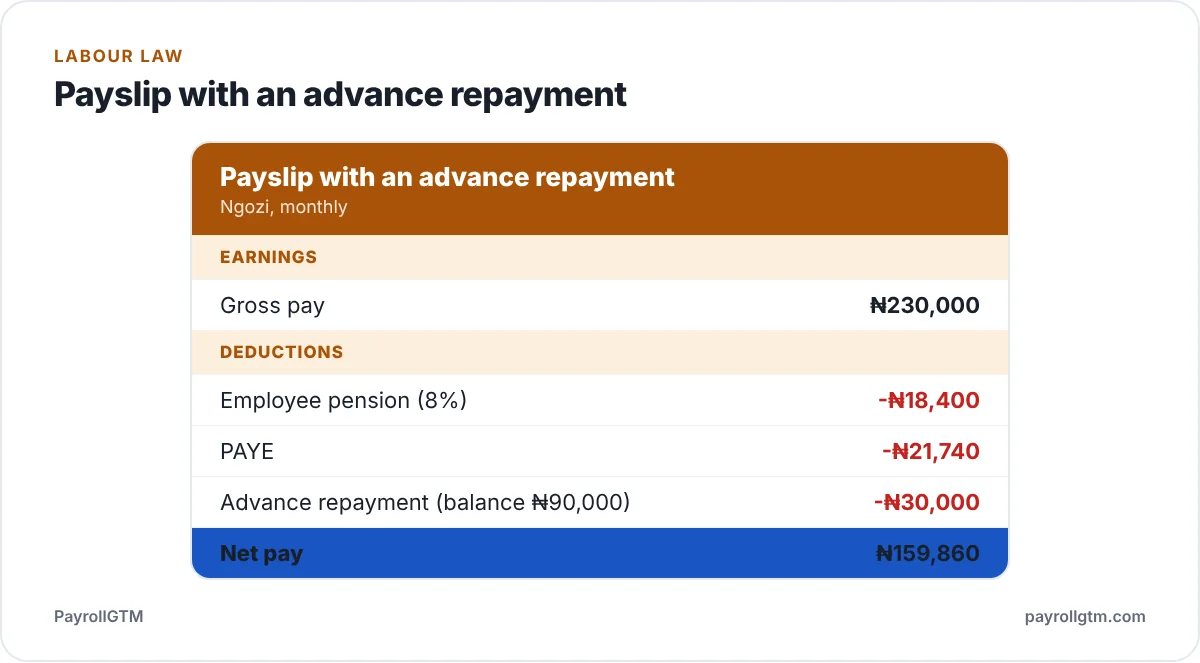
The loan repayment does not change PAYE, because it is not a tax deduction. Only the deductions the law allows reduce taxable pay.
What if I cannot pay salaries on time?
Tell staff before pay day, say why, and give a firm date you can keep. Pay the statutory items first where you can: PAYE and pension carry penalties, and a pension that is late attracts 2% of the unremitted amount for each month of delay. Chronic late pay invites complaints to labour officers and can support a claim that an employee was forced to resign. A cash reserve equal to one month of payroll is one of the best compliance investments a small business can make. When corrections are needed later, use the method in back pay, arrears and salary corrections.
What do I do about an overpayment?
Mistakes happen: a bonus paid twice, a leaver paid for a month he did not work, a rate keyed in wrongly. Tell the employee promptly in writing, show the calculation and propose repayment. Do not deduct without notice, and do not take the whole amount if it leaves the person with almost nothing.
For a leaver paid after exit, work out the correct figure with the method in how to prorate salary for part of a month.
Does the minimum wage limit deductions?
The national minimum wage is ₦70,000 a month and applies to employers with 25 or more employees. Smaller employers are outside the Act but may still pay it. Pay should not be pushed below the legal figure through deductions for covered workers, and anyone earning ₦70,000 or less is exempt from PAYE. Our minimum wage compliance guide explains the scope.
A pay-run routine that prevents most disputes
Most pay disputes come from small repeated slips, not drama. A simple routine fixes that.
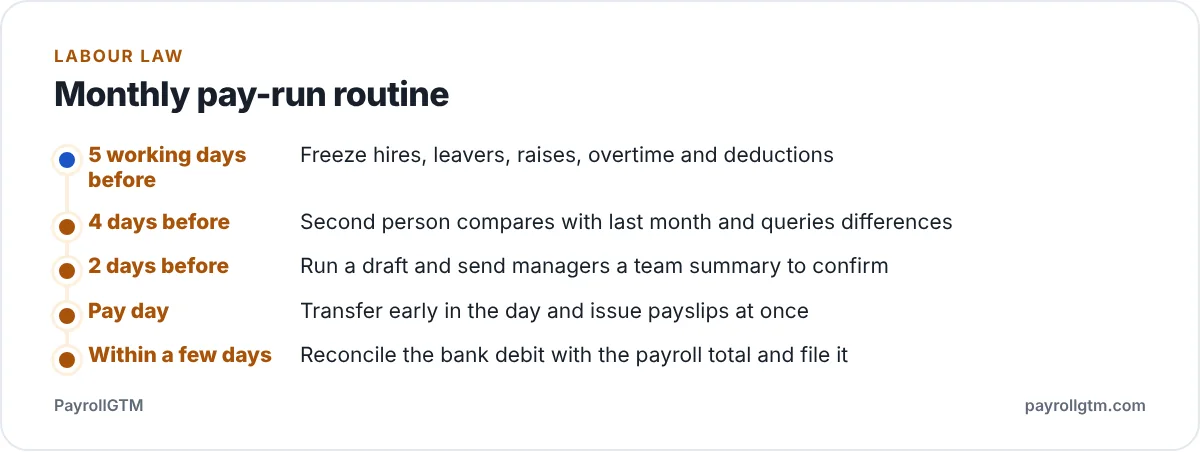
The second reader catches most errors before they reach an employee's account. Also give staff a named person to query pay with, and promise a reply within two working days.
Records to keep
- Signed contracts that state pay and pay dates
- Payslips for every period
- Written consent for each non-statutory deduction
- Loan and advance ledgers
- Evidence of bank transfers
- Notes on corrections and overpayments
How long to keep each is covered in payroll record keeping.
Common questions
Can I hold final pay until the employee returns company property?
That is risky. Agree a return process, and if a specific deduction is justified, document it with consent or a lawful basis. Withholding wages as pressure can create a separate claim.
Is cash payment acceptable?
It may be lawful, but transfers leave an automatic record and are safer for both sides.