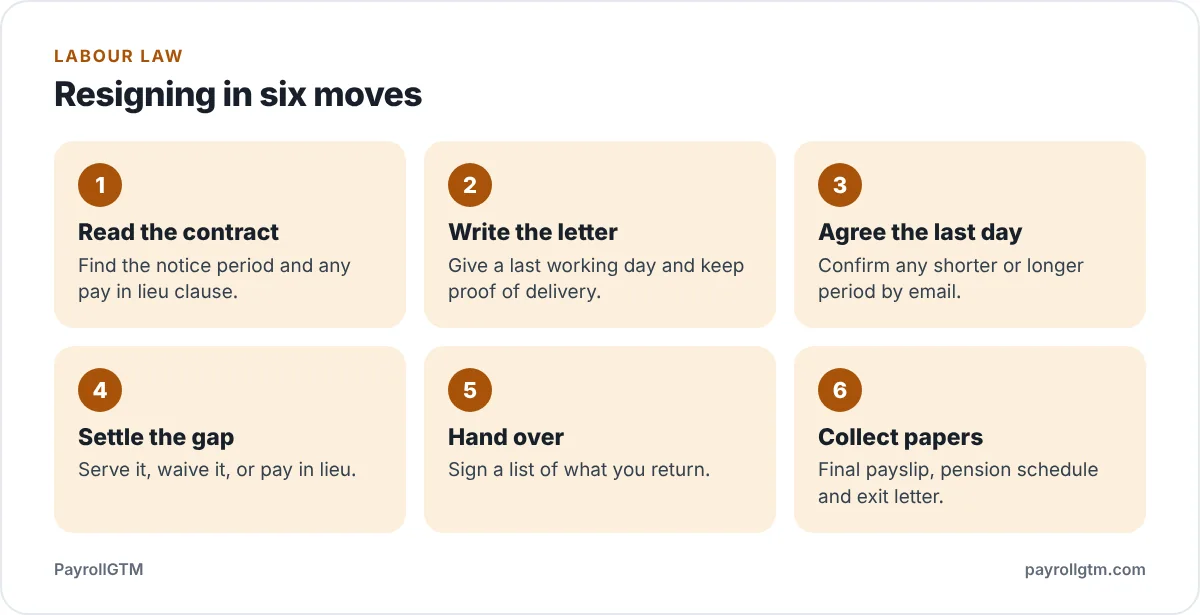
You resign by giving your employer written notice for the period in your contract, working that period (or agreeing a payment in place of it), handing over, and collecting your final pay. If your contract is silent, the Labour Act sets the minimum: 1 day if you have worked less than 3 months, 1 week for 3 months to under 2 years, 2 weeks for 2 to under 5 years, and 1 month from 5 years. A contract can ask for more than that, and when it does, the contract notice is the one you should plan around.
Step 1: find the notice period in your contract
Open your appointment letter or contract and the staff handbook. Look for the words "termination", "notice" or "resignation". Many Nigerian offer letters say one month, and senior or managerial roles often say two or three. Some say "one month's notice or one month's salary in lieu", which tells you the employer will accept payment instead of working time.
The statutory minimums are a floor. They are worth knowing because a short or unclear contract falls back on them:
| Length of service | Minimum notice (Labour Act s.11) |
|---|---|
| Less than 3 months | 1 day |
| 3 months to under 2 years | 1 week |
| 2 years to under 5 years | 2 weeks |
| 5 years or more | 1 month |
If you hold a managerial, professional or technical post, check whether the Act treats you as a "worker" at all. Courts look at the contract for such staff, so the contract wording matters even more. We cover that in who the Labour Act actually covers. If you are on a fixed-term deal, the end date and any early-exit clause are what count, see how casual, fixed-term and permanent roles differ.
Step 2: write the letter and keep proof you delivered it
Notice should be in writing. A WhatsApp message to your manager is not a safe way to start the clock. Address it to the person named in the contract (usually HR or the MD), state the last working day, and ask for acknowledgement. Send it by email and keep the sent copy, or deliver a hard copy and get a signed or stamped duplicate.
Count the days from the date the employer receives the letter, not the date you wrote it. If you want to leave on 30 November under a one-month clause, the letter needs to be in their hands by 31 October.
[Date]
The Human Resources Manager
[Company name]
[Address]Dear Sir/Madam,
Resignation from the position of [job title]
I write to resign from my position as [job title] with effect from [last working day], in line with the [one month] notice period in my contract of employment dated [date].
I will complete a full handover of my duties and will return all company property before my last day. Please confirm receipt of this letter and my last working day, and let me have details of my final payment and an employment confirmation letter.
Thank you for the opportunity to work with the company.
Yours faithfully,
[Name]
[Staff number]
Keep the tone neutral. Reasons are optional, and a letter full of complaints will only be quoted back to you later.
Step 3: agree the last day and work out any shortfall
Employers and employees often settle on a different last day from the contract. If both sides agree in writing, that is fine, and it is the easiest way to avoid a dispute. Get the agreed date confirmed by email.
When the new employer wants you in two weeks and your contract says one month, you have two lawful routes. Ask the employer to waive the balance, or offer to pay for it. Pay in lieu of notice is allowed in both directions, so an employee can pay instead of serving it out, and an employer can pay instead of keeping someone to work out the period.
Hauwa has worked at a Kano logistics firm for 3 years. Her contract says one month's notice, and her salary is ₦400,000 a month. A new employer wants her in 2 weeks. The statutory minimum for her service is 2 weeks, but her contract asks for one month, and the contract governs. She gives written notice and asks HR to release her after 2 weeks.
HR agrees on condition that she pays for the unserved half month. Half of ₦400,000 is ₦200,000. If her contract allows the company to deduct this from her final pay, HR can do so, and Hauwa should ask for the figure and the written agreement before the deduction is made. If the contract says nothing, a deduction needs her written consent. See the rules on lawful wage deductions.
Step 4: if the employer will not let you go
This happens, especially where a manager is trying to hold on to a person. In general an employer cannot keep you in the job against your will once you have given proper notice and served it. What they can do is claim for the loss of an unserved notice period, and they may delay paperwork. If you are caught in a standoff, do three things:
- Serve the full contractual notice if you can. It removes their strongest argument.
- Keep every email and the dated copy of your letter.
- If a payment or letter is withheld for weeks, write to HR once, politely, with a date. Disputes of this kind go to the National Industrial Court, which is slow and costly, so settle if the figure is small.
Do not just stop coming to work. Abandonment can be treated as misconduct and can sour the reference. Employers who want a clean exit, in turn, should follow a fair process and not invent a disciplinary case to avoid paying the final month.
Step 5: know what final pay should contain
Your last payslip normally covers salary up to your last day, any approved allowances or commission earned, and anything the contract says is paid on exit. Whether unused annual leave is paid out depends on your contract or handbook, so check the wording rather than assume. The Labour Act sets a leave floor, not a payout formula.
Also check these:
- PAYE is still deducted on the final salary, and pension still applies to it. The employer must remit that pension, so ask for your pension contribution schedule. Our piece on what happens to your pension when you leave a job explains what to do with the RSA.
- Staff loans or cooperative balances can be recovered according to the agreement you signed.
- A part month is normally prorated. Ask HR which method they use (calendar days or working days), see how part-month pay is calculated.
Employers commonly pay final salary after the clearance process. Ask for the expected date in writing when you submit your letter, so a vague "after clearance" does not become three months.
Step 6: return property, then collect your letters
Return the laptop, ID card, keys, SIM or company phone, and any documents or data. Get a signed handover note listing each item, because "you never returned it" is the usual way final pay gets held back. Delete your personal files from company devices before you hand them in, and do not copy client data to your own email. Many contracts have confidentiality and non-compete clauses that outlive your job, so read them: non-compete and confidentiality clauses explains what usually holds up.
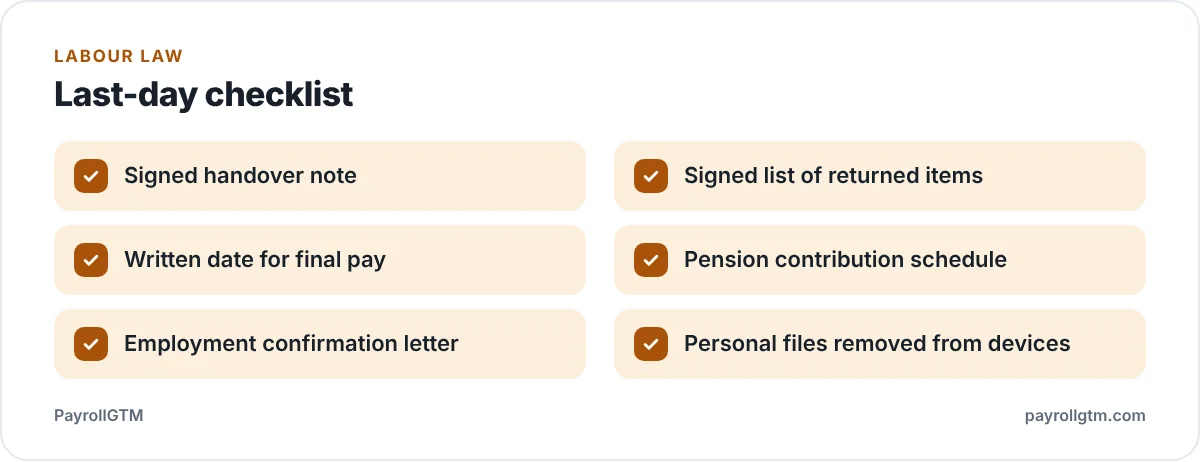
Ask for an employment confirmation or exit letter stating your job title, dates of service and, if you like, your final salary. Whether an employer must give a reference depends on your contract and handbook, so ask politely and early. Employers tidying their side of this can use the offboarding and final settlement guide.
Common questions at the exit door
Can I use my annual leave as my notice period? Only if the employer agrees. Leave is meant for rest and the employer approves it, so get that approval in writing.
Do I still get my 13th month or bonus? It depends on how the bonus is defined. If it is discretionary or conditional on being in employment on a date, the contract and handbook decide. Raise it before you submit the letter, not after.
Is a probation resignation different? The same notice rules apply, but many contracts shorten notice during probation. Read the clause.
Reading your contract carefully is the first step, so if yours is thin or missing, see what a Nigerian employment contract should contain and how notice and severance work on termination. This is general information, not legal advice. For a contested exit, speak to a lawyer who handles employment matters.