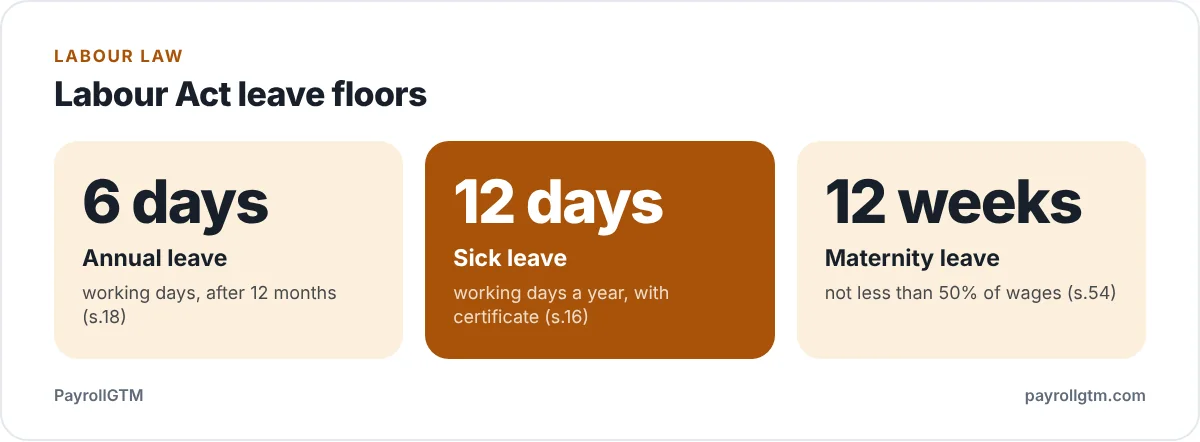
The Labour Act sets three floors. Annual leave: at least 6 working days of paid leave after 12 months of continuous service (s.18). Sick leave: up to 12 working days a year on a certificate from a registered medical practitioner (s.16). Maternity leave: 12 weeks, at not less than 50% of wages (s.54). Many employers give much more by contract. The figure of 24 working days that circulates online is not in the Act.
The statutory minimums at a glance
Use this table as the floor when you write or check a contract. Anything better in the contract, handbook or a collective agreement overrides it for that employee.
| Leave | Labour Act minimum | Section | What to know |
|---|---|---|---|
| Annual leave | 6 working days, paid | s.18 | After 12 months of continuous service. Young persons get more. |
| Sick leave | Up to 12 working days a year, paid | s.16 | Needs a certificate from a registered medical practitioner. |
| Maternity leave | 12 weeks, usually 6 before and 6 after birth | s.54 | Not less than 50% of wages under the Act. Contracts or state law may pay more. |
| Paternity leave | None under federal law for private staff | None | Only if your contract or policy grants it. |
| Public holidays | Federal holidays under the Public Holidays Act | Separate Act | See the holidays guide. |
Annual leave: where "24 days" comes from
Nowhere in the Act. Our own older content got this wrong, and so do many HR blogs. The statutory figure is 6 working days. What happens in practice is that employers write 15, 20 or 21 working days into the contract because 6 is too low to recruit anyone sensible, and the number becomes folklore. If a staff member says "the law gives me 24 days", the honest reply is: the law gives you at least 6, and your contract gives you whatever it says.
Three practical points follow:
- The 12-month wait is a statutory rule, not a rule you must copy. Many employers let leave accrue from the first month. That is a contract choice, and it should be in writing.
- Working days versus calendar days. Write which one you mean. "21 days" with no unit invites a fight when someone books a week off across a weekend.
- Carry-over. We found no statutory rule requiring carry-over or forbidding it. Your policy decides: use it or lose it, carry up to a number of days, or pay out. Pick one and write it down. The leave policy template has wording for each.
Leave allowance is not annual leave
People mix the two up constantly, and the mix-up shows on payslips.
A leave allowance is extra money paid when someone goes on leave, often a percentage of annual basic or total pay. It comes from the contract or custom, not from the Labour Act. For tax purposes it is part of employment income and is added to the year's PAYE base, which can push one month's deduction higher; see PAYE on bonuses, 13th month and leave allowance for the working.
Sick leave: what the certificate has to do
Section 16 allows paid sick leave of up to 12 working days in a year, supported by a certificate from a registered medical practitioner. Two situations cause trouble:
- The employee brings a note from a pharmacy, a traditional healer or a clinic that is not staffed by a registered practitioner. Whether that counts is a question for your HR policy and, if challenged, a lawyer. We would not refuse pay on that ground alone without reading the policy.
- The illness lasts longer than 12 days. The Act does not guarantee pay after that. Your contract may, and a long absence may also raise questions of medical capacity. Talk to a labour lawyer before any dismissal on health grounds, and read the employees' compensation guide if the sickness comes from the job.
Maternity leave and nursing mothers
Twelve weeks, normally split six before and six after delivery, at not less than 50% of wages as the Labour Act is written. A nursing mother is also entitled to reduced working time for nursing after she returns. Some employers and states pay full wages during leave; if yours promised full pay in the offer letter, that promise governs. The full discussion, with the employer's cost and the return-to-work steps, is in the maternity leave guide. There is no federal statutory paternity leave for private-sector employees.
Worked example: leave pay when someone resigns
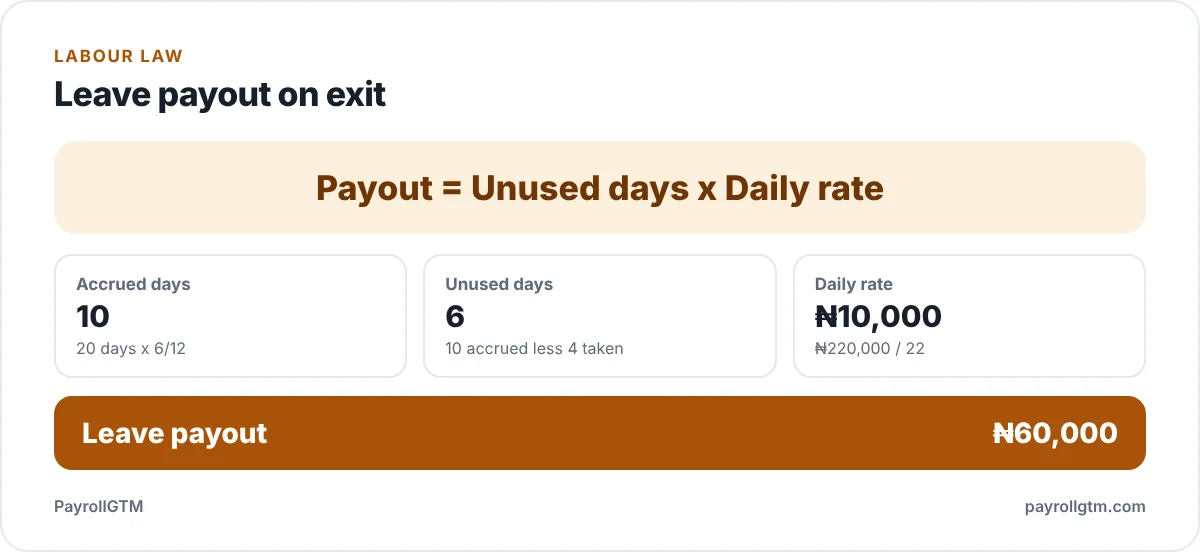
The Labour Act does not set a general rule for paying out unused leave on exit, so your contract and policy govern it. Here is a common design: leave accrues month by month, and untaken accrued days are paid on exit at a daily rate.
Tunde joined on 1 April under a contract giving 20 working days of leave a year. He resigns effective 30 September. His monthly gross is ₦220,000, and the contract says the daily rate is monthly gross divided by 22.
- Months served: 6 (April to September)
- Accrued leave: 20 x 6 / 12 = 10 working days
- Taken: 4 days, so 6 days unused
- Daily rate: ₦220,000 / 22 = ₦10,000
- Leave payout: 6 x ₦10,000 = ₦60,000
The ₦60,000 is paid with his final salary and is taxable like salary, so it goes through that month's payroll. Final-pay mechanics are in the offboarding guide.
The mistake to avoid is silence. If the contract says nothing, an employee who has accrued leave may argue it should be paid, and you will be settling that argument in the National Industrial Court of Nigeria rather than in a spreadsheet. Write the rule into the contract.
Five lines every contract should settle
Most leave disputes in small Nigerian firms come from things nobody wrote down. Put these in the contract or handbook:
- The number of leave days and whether they are working or calendar days.
- When leave starts accruing (from day one, or after a qualifying period).
- How leave is requested and who approves it, with a notice period, say 14 days.
- What happens to unused days at year end: lost, carried, or paid.
- What is paid on exit for accrued leave, and how the daily rate is worked out.
Consider Ngozi, who runs a Port Harcourt logistics office with eight staff. She promised "21 days" in WhatsApp messages, never wrote a carry-over rule, and one clerk now claims 63 days over three years. Without a document, she has to rely on goodwill and what was actually taken, and a written policy would have cost her an afternoon. If a clerk's claim is disputed, the matter ends up in the National Industrial Court of Nigeria, with both sides arguing from messages instead of a signed page. The statutory 6 days do not help her either; they set a floor for the employee and say nothing about her promise.
Who the leave rules reach
Casual workers, fixed-term staff and permanent employees do not all stand in the same place on leave, and the Labour Act's definition of a "worker" excludes some administrative, executive, technical or professional staff in certain respects. A senior manager's leave is then largely a matter of contract and the common law. Read whether the Labour Act covers managers and the types of employee before you apply a single policy to everyone, and ask a lawyer when a specific person is in doubt.
For the broader duties that sit alongside leave, such as written particulars within 3 months, see employer obligations under the Labour Act and what an employment contract should contain. Public holidays are a separate right; check holiday pay and work rights.