- What the Labour Act requires you to put in writing, and by when
- Twelve clauses a Nigerian employment contract should carry, with sample wording
- Statutory floors you cannot contract below: notice, leave and pay
- Mistakes that turn a misunderstanding into a claim
A Nigerian employment contract should be in writing, signed by both sides, and issued with the offer or on day one. The Labour Act (s.7) requires a written statement of terms within 3 months of the worker starting, and a business that has none is already out of line. Anything in your contract that gives less than the Act's minimums, such as notice, paid leave or wage rules, will not hold for covered workers.
What the Labour Act requires
The Act expects the employer to give the worker a written statement of the main terms of employment within 3 months. In practice that means the parties, the job, the start date, pay and how it is calculated, hours, leave and sickness terms, and the notice needed to end the contract. Any later change to those terms should also be put in writing.
One caveat matters. The Act's definition of "worker" excludes people doing administrative, executive, technical or professional work in some respects. Senior managers and professionals may therefore be governed mainly by their individual contract and common law rather than by the Act directly. Courts decide each case on its facts, so see whether the Labour Act covers managers and professionals and ask a lawyer where a senior role is unclear. Our own advice is simple: give everyone the same clarity.
Twelve clauses to include
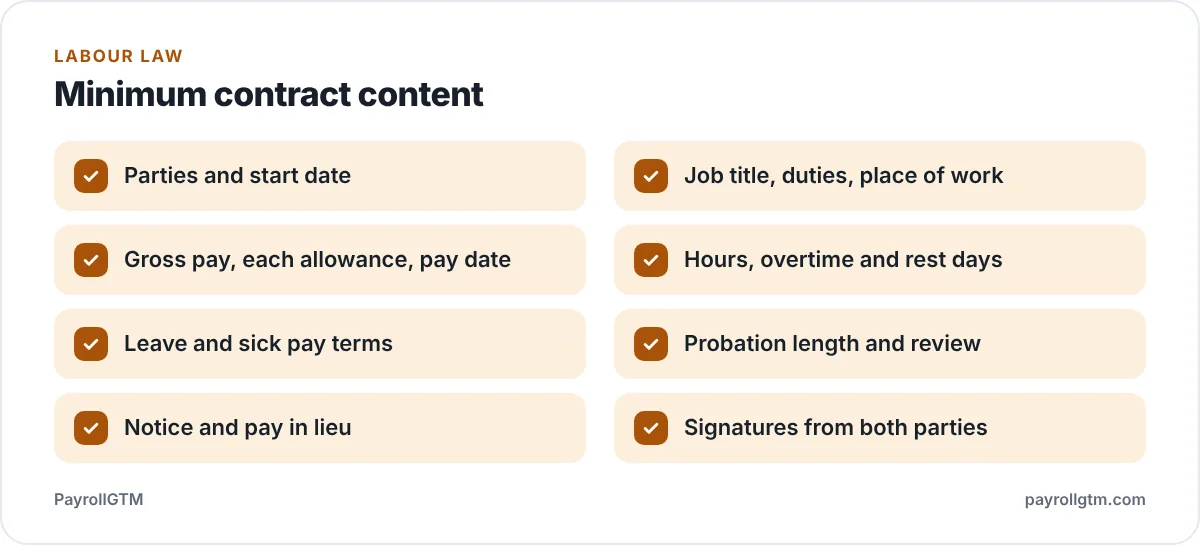
- Parties and start date. The employer's registered name, the employee's full name and address, and the first day of work.
- Job title, duties and reporting line. Describe the role fairly and add that reasonable related tasks are included.
- Place of work. The main location, and whether transfer or travel can be required.
- Employment type. Permanent, fixed-term or casual, since this affects pension, benefits and renewal. See casual, fixed-term and permanent employees.
- Probation. Whether there is one, its length, who reviews it and what confirmation looks like. We cover this in probation periods and confirmation.
- Pay. Each component (basic, housing, transport, others), whether the figure is gross, the pay date and the method.
- Statutory deductions and employer contributions. PAYE, 8% employee pension, and a note that the employer pays 10% and arranges group life insurance and NSITF. NHF applies to a private-sector employee only if they opt in.
- Hours and overtime. Normal hours, rest days, and how overtime is paid. There is no flat statutory overtime rate for most private staff, so your contract has to set one. See working hours, overtime and rest days.
- Leave. Annual leave, sick leave, maternity leave and public holidays (details below).
- Confidentiality and outside work. What must stay private and when the employee must disclose a second job. Restrictions after exit need care, as set out in non-compete and confidentiality clauses.
- Discipline and grievance. Point to your handbook or set out a short process. Our employee handbook guide shows where this belongs.
- Termination. Notice, pay in lieu, handover and return of company property.
Notice periods you cannot go below
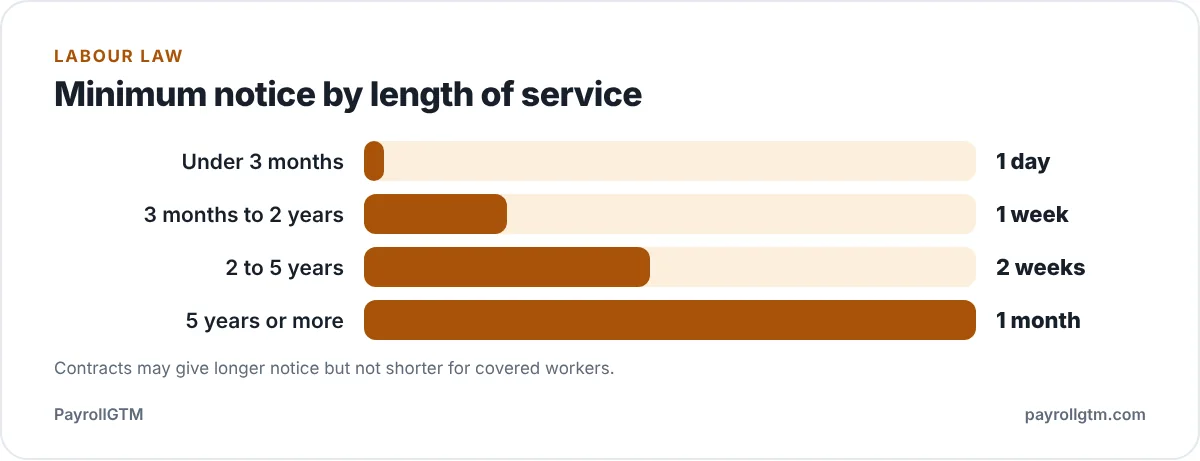
Section 11 sets minimum notice by length of service. Your contract may give longer notice, especially for senior roles, but not shorter for covered workers. Pay in lieu of notice is allowed.
| Length of service | Minimum notice |
|---|---|
| Less than 3 months | 1 day |
| 3 months to under 2 years | 1 week |
| 2 years to under 5 years | 2 weeks |
| 5 years or more | 1 month |
Make notice mutual. It is easier to defend a clause that binds both sides, and the employee's side is covered in how to resign and what final pay includes. Sample wording:
Either party may end this contract by giving the other [one month] written notice, or by paying [one month's] basic salary in lieu of notice. During probation the notice period is [one week].
Leave and sickness: write down the real numbers
The statutory floor for annual leave is 6 working days of paid leave after 12 months of continuous service. It is not 24 days, as some older sites say. Most employers give 15 to 21 days or more, and whatever you promise should appear in the contract. Paid sick leave is up to 12 working days a year on a certificate from a registered medical practitioner. Maternity leave is 12 weeks, normally 6 before and 6 after birth, at not less than 50% of wages under the Act. Your contract or state law may give better terms. There is no federal statutory paternity leave for private-sector staff, so any paternity leave you offer is a contractual benefit. The full rules are in annual, sick and maternity leave.
Pay clauses that prevent arguments
Most contract disputes are about money. State whether the figure is gross or net, list each allowance, say whether bonuses are discretionary or contractual, and say how pay is reviewed. If commission applies, attach the formula. A line such as "competitive salary" tells the employee nothing.
Allowance structure also changes pension, because the minimum pension base is basic plus housing plus transport. See how to design a salary structure before you fix the split.
Changing terms and fixed-term renewals
For a fixed-term contract, state the end date and whether renewal is possible. Renewing short terms again and again for work that is plainly permanent can look like an attempt to avoid obligations. To change a term mid-employment, discuss it, record it in writing and get a signature. Cutting pay or materially changing duties without agreement is a classic route to a constructive dismissal claim, which would go to the National Industrial Court.
Use short sentences and everyday words. Say "you" and "we" where it reads naturally. Define a term once. Put pay in a table near the front. Avoid repeating the same obligation in two places, because the wording will drift and the contradiction will be argued over later. Then ask someone who is not a lawyer to read it and tell you what it says. If they cannot, simplify.
Drafting tips and common mistakes
- No contract. The most common and the most expensive. Proving verbal terms is hard.
- A foreign template. Terms borrowed from other countries can clash with Nigerian rules on notice, leave and deductions.
- Vague pay. Unclear allowances create disputes about pension, overtime and final pay.
- Below-minimum terms. A clause that offers less than the Act is ineffective, and it makes the whole document look careless.
- No signature. Both parties should sign and each keep a copy.
- Never updating. Promotions and raises without a written update leave the file wrong.
Routine for a small business
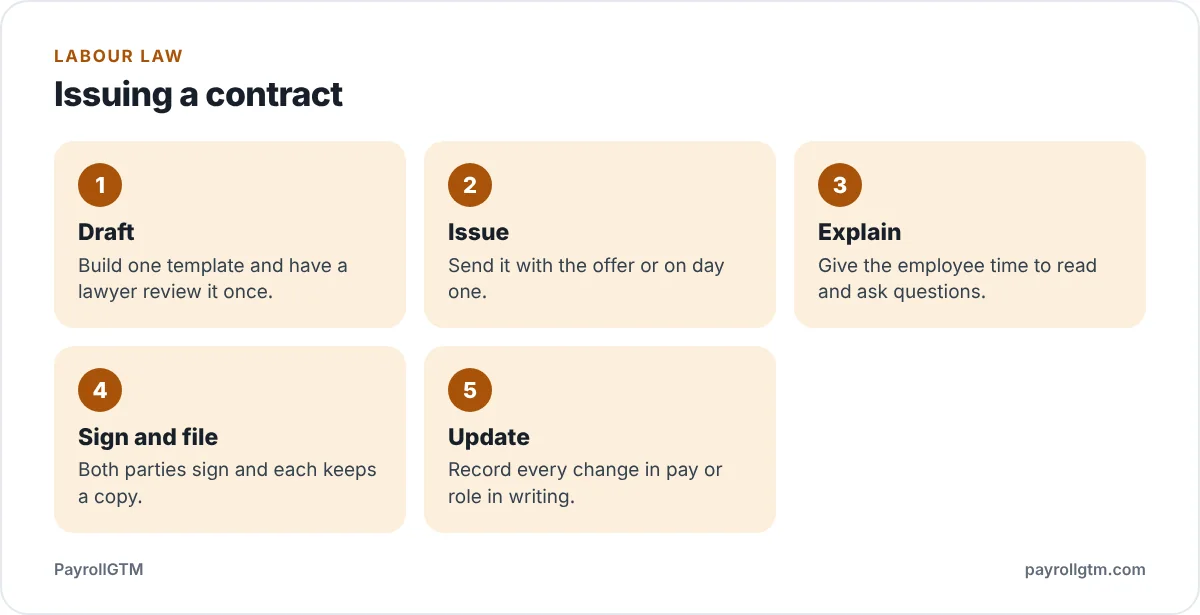
- Draft one template with the twelve clauses and have a lawyer review it once.
- Send the contract with the offer, or hand it over on the first day.
- Let the employee read it and ask questions before signing.
- File one signed copy in the personnel record and give the employee the other.
- Update it in writing whenever role or pay changes. Our guide to employer obligations under the Labour Act is a useful second check.
Common questions
Is a verbal agreement binding?
It can be, but it is hard to prove, which is why the Act requires a written statement.
Can an employee sign away statutory rights?
For workers covered by the Act, a term that gives less than the statutory minimum will not be effective.
Do I need a different contract for each person?
No. Use one template with a schedule for role, pay and start date.
Are electronic signatures acceptable?
They are widely used. Ask a lawyer about the right form for your business and keep a clear record of who signed and when.