To prorate a monthly salary, divide the monthly package by a fixed number of days and multiply by the days the person was employed. Nigerian law does not prescribe the divisor, so pick one method (calendar days, working days or 26 days), write it into your payroll policy and use it for every joiner and leaver. Switching method from one person to the next is what causes disputes.
The three methods side by side
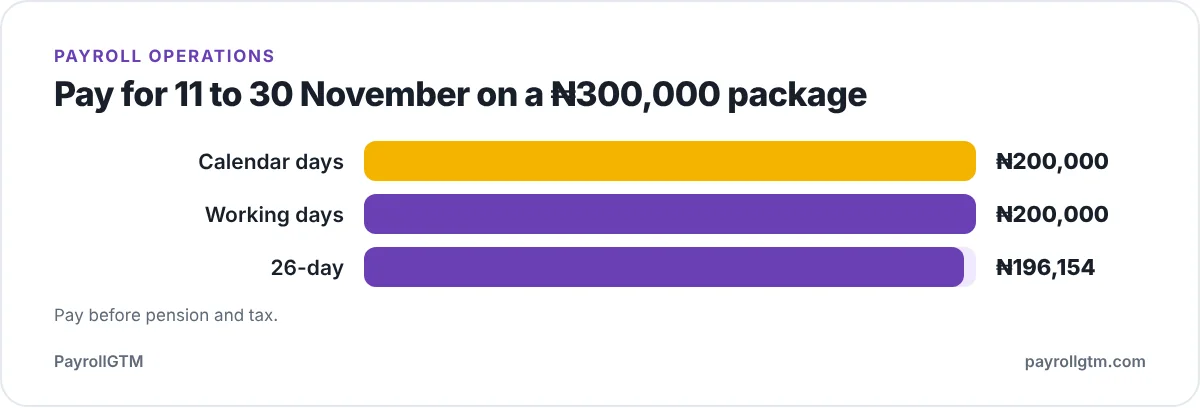
We use a ₦300,000 monthly package and November 2026, which has 30 calendar days and 21 weekdays (Monday to Friday). Two people are paid: Bola joins on Wednesday 11 November and Kelechi leaves after Thursday 19 November.
| Method | Daily rate | Bola (11 to 30 Nov) | Kelechi (1 to 19 Nov) |
|---|---|---|---|
| Calendar days: package ÷ days in month | ₦10,000 | 20 days = ₦200,000 | 19 days = ₦190,000 |
| Working days: package ÷ weekdays in month | ₦14,285.71 | 14 days = ₦200,000 | 14 days = ₦200,000 |
| 26-day: package ÷ 26, counting Mon to Sat worked | ₦11,538.46 | 17 days = ₦196,154 | 16 days = ₦184,615 |
The gap is not large for Bola, but for Kelechi it is ₦15,385 between the highest and lowest. That is why the choice belongs in policy, not in the head of whoever runs payroll this month.
The month you join in also changes the answer under the first two methods. The same ₦300,000 package and the same 20 days of work in a 31-day month gives ₦300,000 ÷ 31 x 20 = ₦193,548, while in a 28-day February with 20 days worked the result is ₦300,000 ÷ 28 x 20 = ₦214,286. Some employers dislike that swing and choose a fixed 30-day divisor for every month, which is also a valid policy as long as it is written down and applied to everyone.
Which method should you use?
Calendar days is the easiest to explain and to audit. Anyone can count the days from a payslip. Its weakness is that weekends are paid even when the person was not due to work them, which can look generous to a joiner whose first day is a Monday and harsh to someone whose last day is a Friday.
Working days matches the way most offices think, but the daily rate changes every month: a 20-weekday month and a 23-weekday month give different values for the same person. Public holidays also need a rule, since they sit inside the weekdays.
The 26-day method suits employers whose staff work Monday to Saturday (retail, schools, factories). It gives a stable daily rate, so the number does not move month to month. It is wrong for a Monday-to-Friday office, because it would value a day too low.
Our suggestion for most small employers on a five-day week: use calendar days. It is simple, it lets a part-month payslip be checked on a phone, and it never needs a calendar lookup. Whatever you choose, state the method in the offer letter and the handbook; the payroll run steps are the place to apply it.
Worked example: a joiner on the 11th
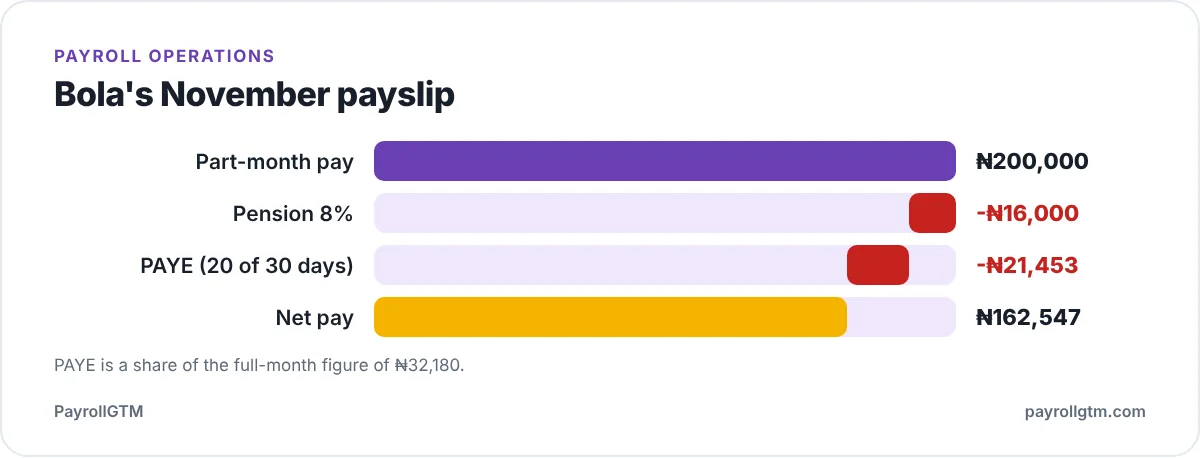
Employee pension at 8% of ₦200,000 = ₦16,000. The employer adds 10% = ₦20,000. Both are charged on what was actually paid, so a part-month means a part-month pension.
PAYE is where payroll teams disagree. The cleaner approach is to work out the tax on the full-month package (₦32,180 a month, from annual PAYE of ₦386,160) and take the same share: ₦32,180 x 20 ÷ 30 = ₦21,453. Net pay is ₦200,000 minus ₦16,000 minus ₦21,453 = ₦162,547.
A tempting shortcut is to run the ₦200,000 through the payroll as though it were a full month's salary. That gives PAYE of ₦17,600, about ₦3,853 less than the share above. It looks fine until you see that it treats the part-month as if she earned ₦2,400,000 a year, which she will not.
Worked example: a leaver on the 19th
Pension at 8% = ₦15,200 and the employer's 10% = ₦19,000. PAYE on the full package is ₦32,180 a month, so the share for 19 days is ₦32,180 x 19 ÷ 30 = ₦20,381. Net pay for the days worked is ₦190,000 minus ₦15,200 minus ₦20,381 = ₦154,419.
That is not his whole last payslip. Unused leave, notice pay and any loan balance may all belong in the final settlement, so treat the figure above as one line in it.
The rest of a leaver's final pay depends on his contract, the notice rules and any deductions he has agreed to; the offboarding and final settlement guide lists the lines. For the pension side of a departure, remember the 7-working-day remittance rule applies to the final contribution too.
Why annualised PAYE is the safer approach
PAYE under the Nigeria Tax Act is an annual tax on an annual income. The monthly figure is a convenience. The way a part-month is handled is a payroll-system setting rather than a rule the Act spells out in detail, so confirm with your state IRS if your approach is unusual. Two practical points:
- Working out tax on the full-month package and then prorating keeps each person's tax in line with the band their annual pay would reach. A person who joins in November and works the rest of the year will normally be taxed on the same basis as colleagues.
- Taxing the partial amount as if it recurred monthly can put a part-month in a lower band and under-deduct. When the full-month pay arrives in December, the payslip suddenly looks heavier, and the employee asks why.
Leavers can be over- or under-taxed by either method, because they stop working before the year ends. A leaver's year-end position may leave a small refund or balance; the person should keep their payslips and, if they think they overpaid, ask the state IRS how to settle it. Net-to-gross calculations become messy with part-months, so if a salary was agreed net, work back from the full-month figure first.
Policy wording and cut-off dates
A single sentence is enough. For example: "Where an employee joins or leaves part-way through a month, salary for that month is the monthly package divided by the number of calendar days in the month, multiplied by the number of days employed, counted from the first day of work to the last day of employment inclusive." Then say whether the day of joining counts, whether public holidays and weekends are included, and who approves manual changes.
Cut-off dates matter here. A joiner on the 28th or a leaver on the 3rd of next month crosses a payroll cut-off, so decide in advance whether their pay goes in this run or the next. See payroll cut-off dates and pay schedules for how to set one.
Checks that catch most errors
- Count the days twice, once from the contract start date and once from the payslip.
- Confirm the leaver or joiner is on the bank file only once. Ghost entries often begin as leavers who stay on the register; see preventing payroll fraud and ghost workers.
- Reconcile the part-month pay to the bank transfer in the monthly reconciliation.
- If you paid the wrong amount, correct it in the next run with a documented adjustment, as in back pay and salary corrections.
- Pay the part-month by the usual transfer date; the bulk payment schedule covers lining up the file.