- What every line on a Nigerian payslip means and where the figure comes from
- A full worked example for ₦500,000 gross a month, computed under the 2026 tax bands
- Six checks that catch most payslip errors
- What a payslip needs to carry to be accepted as proof of income
A payslip reads top to bottom as: who and when, what you earned (gross), what was taken off (pension, PAYE, any other deduction), and what you were paid (net). Every figure should trace back to your contract, the PAYE bands in force since 1 January 2026 and the pension rate of 8% from the employee. If one line cannot be explained, ask payroll to show the working.
The header: name, period and identifiers
The top of the slip names the employer, the employee, the pay month and the payment date. A useful one also shows staff number, job title, Tax ID, RSA PIN and bank account. These look like admin, but they decide whether money lands in the right place. A pension contribution sent against a misspelt name or a wrong RSA number can sit unallocated at the PFA for months.
Employees should check the header on the first payslip they receive. If your Tax ID or RSA PIN is missing or wrong, tell payroll in writing. Our guide to what a payslip template should include lists the fields an employer should carry.
Earnings: from basic salary to gross pay
The earnings block lists everything the employer owes you for the month before any deduction. Most Nigerian payslips show basic salary, housing allowance and transport allowance, and many add utility, meal, medical or leave allowances. Overtime, commission and bonus appear here in the month they are paid.
The total is gross pay. Multiply it by 12 and compare it with the annual package in your offer letter. A gap usually means an allowance was left out, or one was added that was never agreed.
Basic, housing and transport together are the minimum base for pension. How the package is split therefore changes both your deductions and the employer's cost, which we cover in how to design a salary structure.
Statutory deductions: pension, PAYE and NHF
Pension
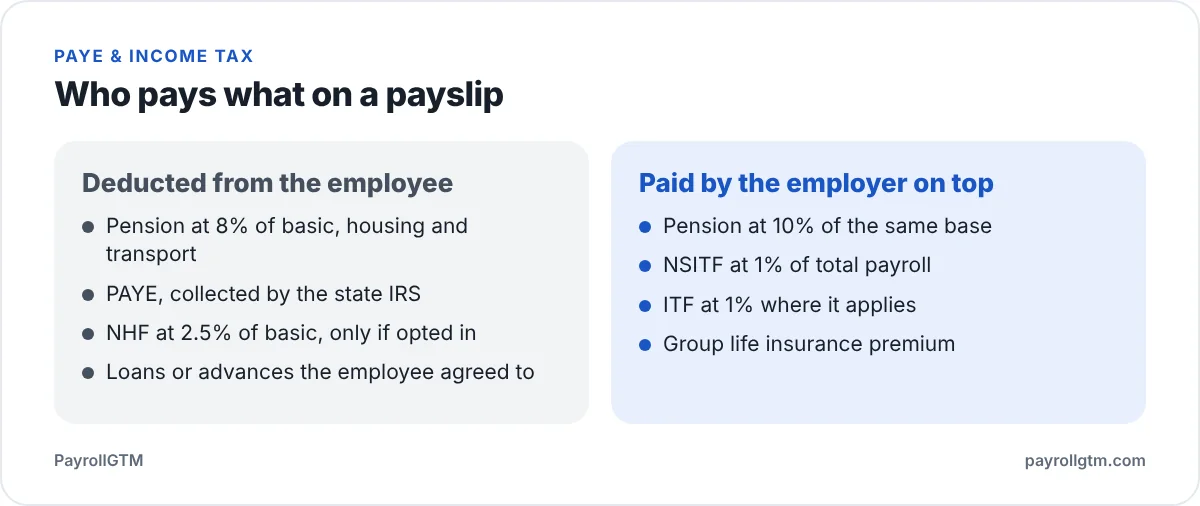
Under the Pension Reform Act 2014, which applies to employers with 3 or more employees, the minimum is 8% from the employee and 10% from the employer, calculated on at least basic, housing and transport. Only the 8% is deducted from you. The employer's 10% is paid on top and is not part of your net pay, though some payslips show it as an information line. If your employer pays the whole contribution, the employer minimum is 20% instead. The arithmetic is set out in how pension contributions are calculated.
PAYE
PAYE is income tax withheld by the employer and paid to your state Internal Revenue Service (for example LIRS in Lagos or FCT-IRS in Abuja). It is worked out on annual chargeable income and then divided by 12. The bands from 1 January 2026 are:
| Slice of annual chargeable income | Rate |
|---|---|
| First ₦800,000 | 0% |
| Next ₦2,200,000 (to ₦3 million) | 15% |
| Next ₦9,000,000 (to ₦12 million) | 18% |
| Next ₦13,000,000 (to ₦25 million) | 21% |
| Next ₦25,000,000 (to ₦50 million) | 23% |
| Above ₦50 million | 25% |
The old Consolidated Relief Allowance no longer exists. What reduces chargeable income now includes your 8% pension, rent relief of 20% of rent actually paid (capped at ₦500,000 a year, with evidence), and other properly claimed items. See the deductions that reduce PAYE and how to claim rent relief.
NHF, only if you opted in
National Housing Fund contributions are 2.5% of basic salary. Since the Business Facilitation Act 2022, private-sector staff are not compulsorily covered, so a deduction should appear only if you chose it. If you never opted in and see an NHF line, query it. Public-sector staff at or above the minimum wage are still covered. Details are in NHF for private-sector employees.
Worked example: ₦500,000 a month
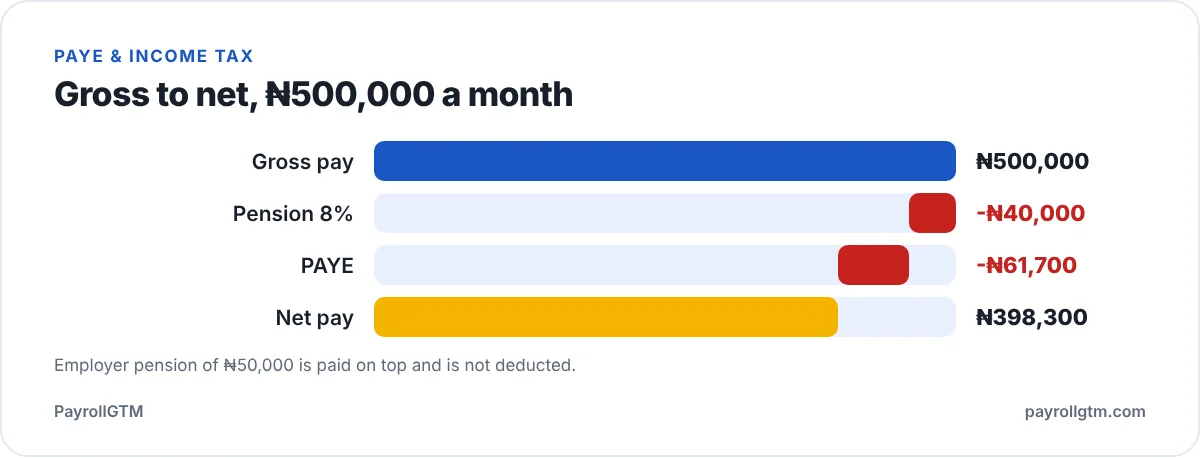
Take Ngozi, who earns ₦500,000 a month made up of ₦250,000 basic, ₦150,000 housing and ₦100,000 transport. She pays ₦1,200,000 a year in rent and has evidence. All three components are pensionable, and she has not opted into NHF. We computed this with our PAYE script.
| Line | Working | Amount |
|---|---|---|
| Gross pay | 250,000 + 150,000 + 100,000 | ₦500,000 a month, ₦6,000,000 a year |
| Employee pension | 8% of 500,000 | ₦40,000 a month, ₦480,000 a year |
| Rent relief | 20% of 1,200,000 | ₦240,000 a year |
| Chargeable income | 6,000,000 - 480,000 - 240,000 | ₦5,280,000 |
| Tax on first ₦800,000 | 0% | ₦0 |
| Tax on next ₦2,200,000 | 15% | ₦330,000 |
| Tax on remaining ₦2,280,000 | 18% | ₦410,400 |
| Annual PAYE | 330,000 + 410,400 | ₦740,400 |
| Monthly PAYE | 740,400 ÷ 12 | ₦61,700 |
| Net pay | 500,000 - 40,000 - 61,700 | ₦398,300 |
The employer also pays its own 10%, which is ₦50,000, so the monthly cost of Ngozi before other levies is ₦550,000. If she had opted into NHF, 2.5% of her ₦250,000 basic is ₦6,250. That lowers chargeable income, so PAYE falls to ₦60,575 and net pay becomes ₦393,175. You can test your own figures in the payroll calculator.
Other deductions you may see
Staff loans, salary advances, cooperative contributions, union dues and HMO top-ups also appear. Each one should trace to something you signed or to a law. A deduction nobody can point to a signed authority for is a red flag, and the limits on what an employer may take are covered in wage payment and lawful deductions.
If you pay extra into your RSA yourself, the payslip may show a voluntary pension line. It can reduce taxable income when properly claimed, as explained in voluntary pension contributions and their tax benefits.
Net pay and year-to-date totals
Net pay is gross pay less every deduction, and it should equal the amount that reaches your bank. The best payslips add a year-to-date block with cumulative gross, PAYE and pension. It lets you spot a month where pension was skipped, and it gives you something to compare against your own annual return and the employer's Form H1.
When a payslip corrects an earlier mistake, it should say so. Underpayments and overpayments fixed in a later month are treated in back pay and salary corrections.
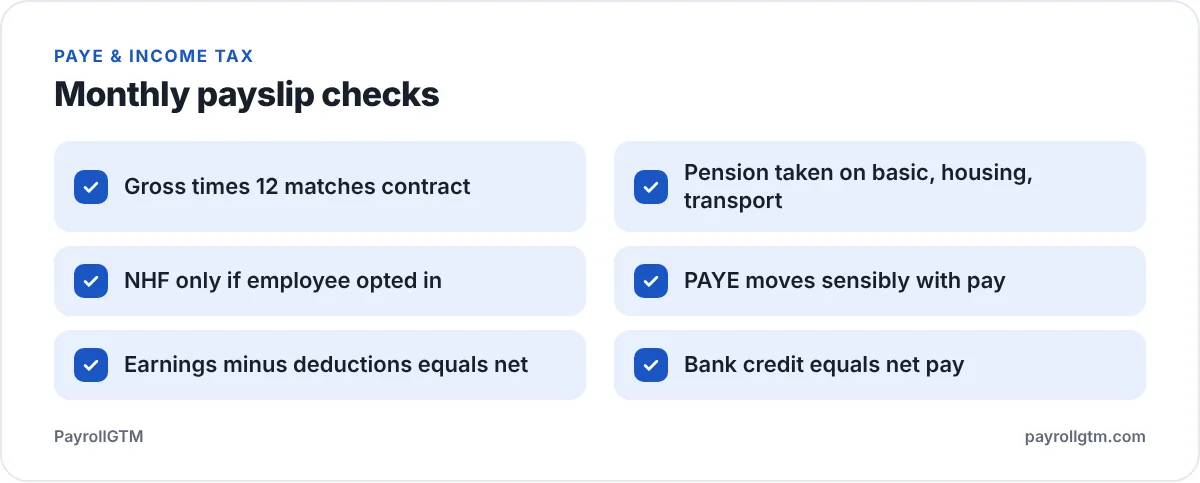
Six checks to run every month
- Gross times 12. Does it match the annual package in the contract?
- Pension base. Is 8% taken on basic plus housing plus transport, not on basic alone?
- NHF. If a line is there, did you opt in? It should be 2.5% of basic only.
- PAYE movement. Does it rise with a raise or bonus and stay level otherwise? Compare it with a fresh calculation from the bands above.
- Arithmetic. Do earnings minus deductions equal net pay to the naira?
- Bank match. Did the credit equal the net figure?
Using a payslip as proof of income
Banks, landlords and embassies want the employer's name, your name, the month, gross and net pay, and ideally a stamp or signature. A screenshot of a bank alert rarely satisfies them. If payslips come from software, make sure they export as PDF with a reference number.
Common questions
Can an employer refuse to give me a payslip?
We found no clause in our reference material that uses the word "payslip", and we will not invent one. Employers are expected to keep proper wage records, and refusing to explain a deduction invites a dispute. Ask in writing and keep the reply. A lawyer or the labour office can advise on enforcement.
Why did my PAYE change when my gross did not?
A bonus, new rent relief evidence, a pension change or a correction can all move it. Some employers also spread the annual figure differently. Ask payroll for the annual workings.
How long should I keep payslips?
Keep them for as long as you may need to prove income or tax paid. Keep them permanently if they support a pension or exit-benefit claim. Employers have their own record-keeping duties.