A compliant Nigerian payslip shows who was paid, for which period, what the gross pay was and how it was built, every deduction with its amount, the net pay, and the employer's pension contribution. The Nigerian law we rely on does not publish one official payslip format, so this guide gives you a layout that shows the numbers the state IRS and your PFA will ask about, and that your staff can read without calling HR.
Fields every payslip should carry
Group them in four blocks so the eye knows where to go.
- Header. Company name, employee name, staff ID, job title or department, pay period (for example "October 2026"), pay date and the last four digits of the bank account.
- Earnings. Basic, housing, transport, each other allowance on its own line, any bonus or overtime, and the gross total.
- Deductions. Employee pension (8%), PAYE, voluntary NHF if the employee opted in, loan repayments, salary advance recovery, any union dues, and the total.
- Summary. Net pay, and below it the employer's own contribution (pension at 10%) for information.
Optional but useful: year-to-date gross and PAYE, leave balance, and the PFA and RSA PIN of the employee. Keep the NIN and full account number off the sheet. A payslip is forwarded, printed and photographed, and the employee data protection rules are easier to meet if sensitive identifiers sit in the master file only.
A complete sample payslip
We have used Yetunde, paid ₦350,000 a month: basic ₦175,000, housing ₦87,500, transport ₦52,500 and ₦35,000 of other allowance that is not pensionable. The figures come from the PayrollGTM calculation for October 2026.
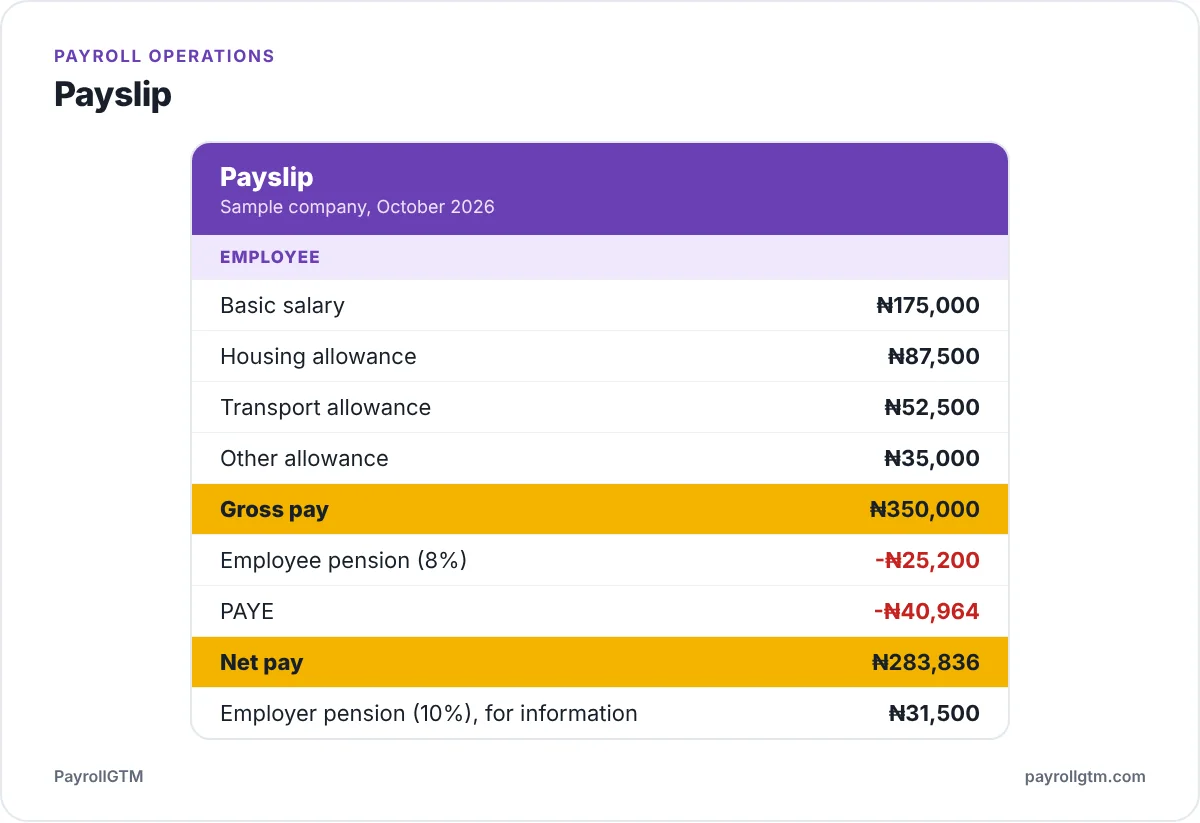
How the numbers fit together:
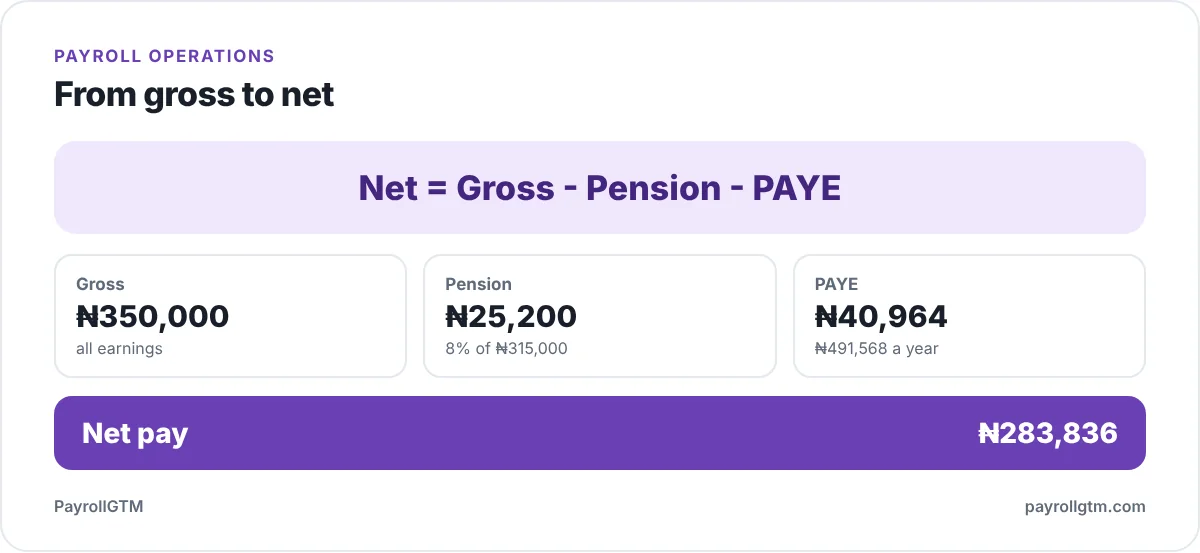
- Pensionable pay is basic + housing + transport = ₦175,000 + ₦87,500 + ₦52,500 = ₦315,000. The ₦35,000 other allowance is left out of it.
- Employee pension at 8% = ₦25,200. The employer adds 10% = ₦31,500.
- Annual chargeable income = (₦350,000 minus ₦25,200) x 12 = ₦3,897,600.
- Tax: 0% on the first ₦800,000, 15% on the next ₦2,200,000 (₦330,000), 18% on the remaining ₦897,600 (₦161,568). Annual PAYE is ₦491,568, so ₦40,964 a month.
- Net pay = ₦350,000 minus ₦25,200 minus ₦40,964 = ₦283,836.
If Yetunde had claimed rent relief, a line for it would appear in the tax workings, not in the deductions. Rent relief reduces chargeable income, and nothing is paid to anyone. Many payslips get this wrong by listing it as a deduction.
Copyable payslip layout
If you build payslips in a spreadsheet or document, this table layout works. Replace the sample numbers with your own formulas; the payroll spreadsheet template has them ready.
| Section | Line | Amount (₦) |
|---|---|---|
| Earnings | Basic salary | 175,000 |
| Earnings | Housing allowance | 87,500 |
| Earnings | Transport allowance | 52,500 |
| Earnings | Other allowance | 35,000 |
| Earnings | Gross pay | 350,000 |
| Deductions | Employee pension (8%) | 25,200 |
| Deductions | PAYE | 40,964 |
| Deductions | Total deductions | 66,164 |
| Net | Net pay | 283,836 |
| Employer cost | Employer pension (10%) | 31,500 |
Put a short note at the bottom, for example: "Pension is calculated on basic, housing and transport. Query this payslip within 5 working days to payroll@yourcompany.ng." Use your own address and your own window; the number of days is a company choice, not a legal one.
What changes when the employee opts in to NHF or claims rent relief
Two optional items change the sample. Suppose Yetunde chooses to contribute voluntarily to the National Housing Fund (2.5% of basic) and gives payroll evidence of ₦1,200,000 annual rent. NHF is ₦4,375 a month (2.5% of ₦175,000). Rent relief is 20% of the rent paid, ₦240,000 for the year, under the ₦500,000 cap. Chargeable income falls to ₦3,605,100 and PAYE to ₦36,576 a month. Net pay becomes ₦283,848, almost the same as before, because the NHF deduction takes back most of what the lower tax gives.
The payslip should show NHF as its own deduction line, and only for staff who opted in, since private-sector NHF is voluntary for employees now. The rent relief changes the tax workings and nothing else. A good habit is to keep a small "tax workings" block at the foot of the payslip with annual chargeable income and annual PAYE, so an employee can see where the monthly figure came from.
Payslip lines that cause arguments
- A deduction with no name. "Sundry" or "adjustment" invites a query. Name every deduction and say what it is for.
- Loan recovery. Show the original amount, the instalment and the balance left. Deductions from wages are tightly controlled, so confirm the employee has agreed in writing before you add one.
- A bonus month. Show the bonus separately and the extra PAYE it triggered. Staff who see a jump in tax with no explanation assume an error.
- Net-pay promises. If a salary was agreed as net, the gross is worked back from it, and say on the payslip that the gross is derived.
- Employer pension left off. The employee does not pay it, but showing it proves that it is being made, and many staff only discover a shortfall years later.
How to deliver payslips
Pick one channel and use it every month. A password-protected PDF sent to the employee's work email is simple and leaves a trail. A portal is better once you have 30 or more staff. Printed copies in a sealed envelope still suit shop floors and sites where staff have no email. What does not work: pinning a list of salaries on a notice board or sending one group file to everybody.
Send payslips on or before the day salaries land, and use the same payment calendar each month; the bank transfer bulk payment schedule shows how to line payslips up with the transfer file.
Corrections and keeping copies
If a payslip is wrong, do not overwrite it. Issue a corrected payslip with the same period, mark it "Corrected", and show the difference as an adjustment in the next run if money is owed either way. The method is in back pay, arrears and salary corrections. For staff who joined or left mid-month, see how to prorate salary so that the payslip shows the days paid.
Keep a copy of every payslip with the payroll register. How long is a question for your accountant and your state IRS; the payroll record-keeping guide covers the practical side. Employees should also keep their own, since they are what a bank asks for when someone applies for a loan or a visa.
Who should approve payslips before release
Payslips are produced by whoever runs payroll, so a second person should look at them before they leave the building. That person does not need to recheck every figure. Ask them to compare the totals to last month, look at the five biggest changes in net pay, and open three payslips at random to confirm that the arithmetic holds. In a small office the second pair of eyes can be the managing director or the accountant. A payslip that goes out wrong costs more to repair than to check, because the employee has often already planned the money.
Check before you press send
- Do the earnings lines add to the gross, and do gross minus deductions equal the net?
- Does the pension line equal 8% of basic, housing and transport?
- Does the bank file show the same net? Monthly payroll reconciliation catches the differences.
- Is any leaver, ghost name or duplicate still in the run? See how to prevent payroll fraud and ghost workers.
For employees who want to understand each line, how to read a Nigerian payslip explains them from the other side, and the steps for the whole run are in how to run payroll in Nigeria.