A benefit in kind is anything an employer provides that the employee would otherwise pay for personally, such as housing, school fees, a car used privately or an interest-free loan. Value received because of employment is generally treated as part of income, so it can attract PAYE even though no cash reaches the employee's bank account. The owner usually forgets to tell payroll, and a tax audit later counts the benefits as unreported pay.
Valuation rules for each benefit are technical, and we do not quote a fixed rate for any of them. This guide shows the principle, the scale of the tax effect and a process that keeps your records straight. Confirm the valuation of each item with your state IRS or a tax adviser.
What counts as a benefit in kind
The test is private advantage. If the employer provides something that the employee would otherwise buy from their own pocket, its value is likely to be taxable pay. If it is purely a tool for the job and gives no private gain, treat it differently. A laptop used only for work, protective boots and a desk are tools of the trade. A car that goes home on weekends, a flat for the family or a phone used heavily for personal calls have a real personal element.
The employer's duty is to include the value in the payroll computation, deduct PAYE on it and remit it, as with salary. If the employer agrees to pay the tax on the benefit as well, that arrangement may itself be an additional benefit.
How the common benefits are usually treated
| Benefit | Why it can be taxable | What to record |
|---|---|---|
| Company car | Private use (home, weekends, family) | Logbook of business and private mileage, running costs |
| Employer-paid housing | Employee would otherwise pay rent | Tenancy agreement, rent paid, reason if living on site is a job requirement |
| School fees paid directly | Personal expense of the employee | Invoices and receipts, period paid |
| Interest-free or cheap staff loan | Employee saves the interest a lender would charge | Signed agreement, repayment schedule |
| Phone, data and internet | Personal use mixed with business use | Policy separating allowance from private use |
| Cash allowances (medical, meal, utility) | Cash is simply part of gross pay | Show as an allowance on the payslip |
For cars, tax authorities lean towards a higher private-use estimate when no logbook exists. For housing, a common starting point is the rent the employer actually pays. For group life insurance, treatment follows the Pension Reform Act framework, and health insurance has its own rules, so ask your state IRS how each is treated before you assume either way. Our guide to employer health insurance explains the HMO side.
What a benefit does to the tax bill
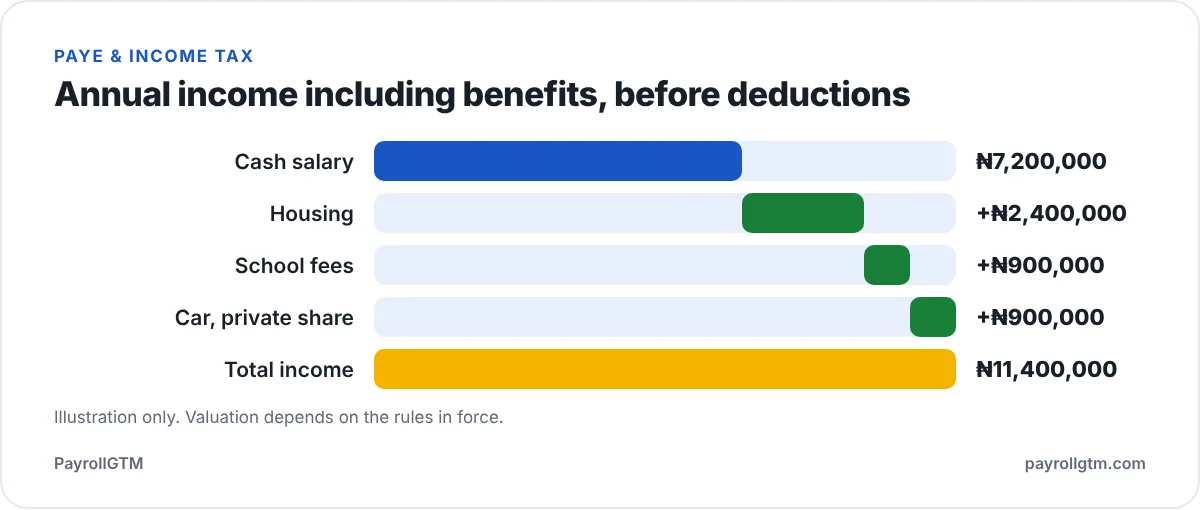
Emeka is a sales manager with a cash salary of ₦600,000 a month. The company also rents him a flat for ₦2,400,000 a year, pays ₦900,000 in school fees for two children, and gives him a car costing ₦3,000,000 a year to run, of which about 30% is private use, so ₦900,000. A cautious payroll treatment adds those three items to his annual income.
Cash only: pension 8% of ₦600,000 = ₦48,000 a month. Chargeable income (₦600,000 - ₦48,000) x 12 = ₦6,624,000. PAYE = ₦982,320 a year, or ₦81,860 a month.
With benefits: ₦4,200,000 a year of benefits adds ₦350,000 a month. Pension stays at ₦48,000 because the benefits are outside the pension base. Chargeable income (₦950,000 - ₦48,000) x 12 = ₦10,824,000. PAYE = ₦1,738,320 a year, or ₦144,860 a month.
The benefits add ₦756,000 a year (₦63,000 a month) to Emeka's PAYE. If nobody told payroll, that tax sits as an unreported liability.
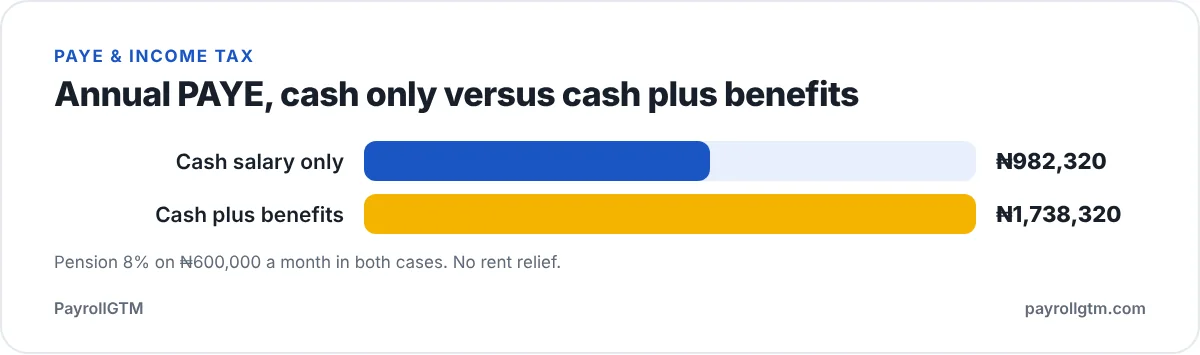
The values are only an illustration of scale. The actual treatment depends on the rules in force and the documents you hold. Two other effects are worth knowing. First, rent relief is for rent the individual actually pays and can evidence. Emeka cannot claim it on a flat the company rents. Second, because many benefits sit outside the pension base, they do not increase pension contributions, which is a trade-off we cover in designing a salary structure. The rent relief guide and the list of deductions that reduce PAYE show what is allowed against income.
A process that keeps benefits visible
- Keep a benefits register. One sheet: employee, benefit, start date, annual cost, valuation basis and who approved it.
- Write a policy. Say which grades get which benefits, what private use is allowed and who approves exceptions.
- Tell payroll first. No benefit starts until payroll has seen a short approval form.
- Value the same way each year and write the method down.
- Reconcile before filing. Compare the register with payroll before you file the annual Form H1 return, which is due 31 January for the previous year.
A common mistake
A trading company in Lagos pays a branch manager's school fees directly to the school every term. The owner treats it as a gift, the bookkeeper posts it to "staff welfare", and payroll never hears about it. Three years later an inspector reads the ledger, sees ₦900,000 a year going to a school, and asks why it is not in the manager's income. The company then faces three years of PAYE it never deducted, possible penalties and an awkward conversation with an employee who now owes tax on money he never saw. The fix costs nothing: a one-page approval form that routes every new benefit through payroll before it starts.
Cash or benefit: which is cheaper to run?
Compare the benefit with a cash alternative before you offer it. A transport allowance is easier to administer than a company car. A housing allowance is simpler than renting flats for staff. Both are taxable in principle, but cash needs no logbook, no valuation argument and no register. Employees usually value choice more than a benefit they cannot use freely. A cash allowance in the pensionable base also raises pension for both sides, while many benefits do not.
Records to keep
- Leases, invoices and receipts for housing and school fees
- Vehicle logbooks and fuel records
- Signed loan agreements with repayment schedules
- The written benefits policy and approvals
- The workings used to value each benefit each year
Retention periods are in our guide to payroll record keeping.
Common questions
Are all benefits taxable?
No. Items strictly necessary for the job, with no private advantage, are treated differently from items with a personal element. Check each one.
Do directors have to be included?
Directors who are employees are treated like other employees for payroll. A director who is not on payroll is a separate question for your accountant.
What if I have not been including benefits?
Start correctly now and ask a tax adviser or your state IRS how to deal with past periods. Do not backdate documents.