To pay salaries by bank transfer in Nigeria, build one payment schedule from the approved payroll, check every account name against the employee's own record, have a second person approve it before the file goes to the bank, upload it, then reconcile what was paid against what was approved. Doing those five things in that order stops the three most common failures: money sent to the wrong person, a ghost worker slipped into the list, and a short-paid employee who finds out on payday. We do not name any bank here, because upload formats and limits differ between banks and change; use your bank's current instructions for the file layout.
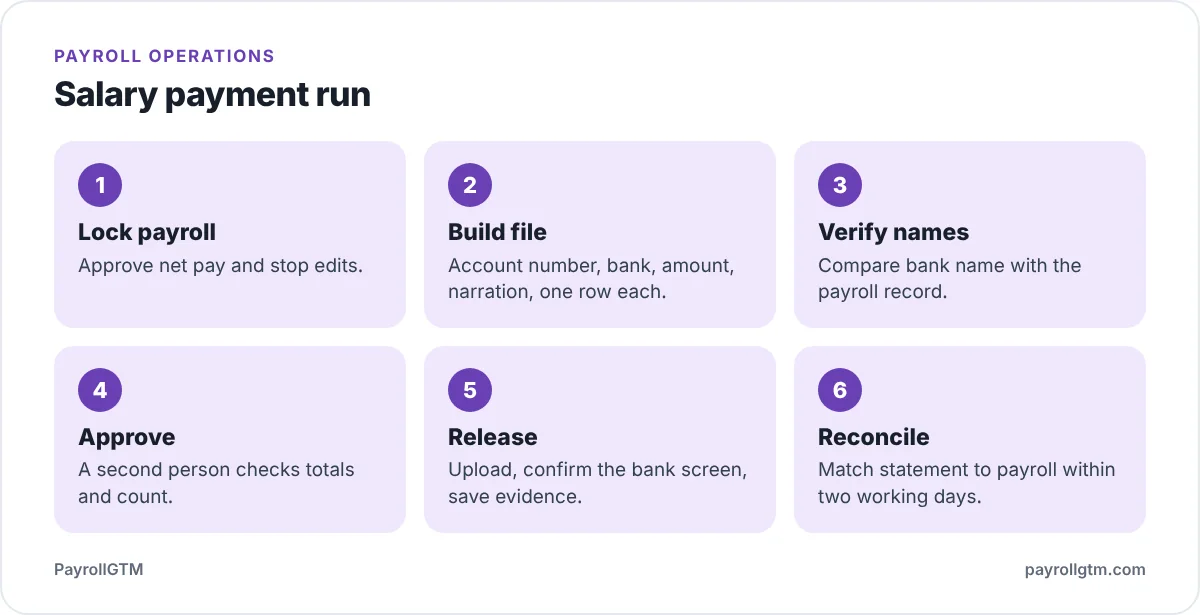
Step 1: lock the payroll before you build the file
The bulk file is only as good as the payroll behind it. Finish the run first: the full payroll run ends with approved net pay for each person after PAYE, pension and other deductions. Use a cut-off that everyone knows; payroll cut-off dates and pay schedules explains how to choose it. Once the numbers are approved, nobody edits the payroll without a logged reason.
Step 2: what the bulk payment file contains
Most banks accept a spreadsheet or CSV with one row per payee. The columns are usually the same in principle: beneficiary account number, bank (by name or code), amount, and a narration. Your bank will say whether it wants the 10-digit NUBAN account number, a bank code or sort code, the format of amounts (no commas, two decimal places) and any limit on rows per file.
| Account number | Bank | Account name (check column) | Net pay | Narration |
|---|---|---|---|---|
| 0123456789 | Bank A | OKAFOR CHINEDU E. | ₦186,400.00 | Salary Nov 2026 |
| 0234567891 | Bank B | BELLO AISHA M. | ₦142,250.00 | Salary Nov 2026 |
| 0345678912 | Bank A | ADEYEMI TUNDE O. | ₦98,700.00 | Salary Nov 2026 |
The names and account numbers above are made up. Keep a column for the account name returned by the bank's verification so you can compare it to your payroll record. Store account numbers as text, not numbers: spreadsheets drop leading zeros and turn long digits into scientific notation, and that has sent many payments to the wrong place.
Step 3: verify account names
Run each new or changed account through the bank's name-enquiry facility, if your banking platform offers one, and compare the result with the employee's name on their ID and payroll record. A mismatch is not always fraud; people use abbreviations and middle names. But a first name that does not appear at all is a stop sign. Resolve it with the employee in person or on a call to a number you already hold, never a number sent by email. Do this check on every changed bank detail, and for new joiners before their first payment; see how to prevent payroll fraud and ghost workers.
Be wary of last-minute change requests that arrive by WhatsApp or email "because my card was blocked". Make the rule: bank detail changes need a signed form and a call-back, and take effect only after the next verification cycle.
Step 4: maker and checker
Use two different people. The maker prepares the file and the payment instruction. The checker, who cannot be the maker, compares the file with the approved payroll summary: total amount, headcount and any line that changed from last month. Only then does an authorised signatory release it on the bank platform. If your business is tiny and you are the owner, you can still split the roles: your bookkeeper prepares, you approve, and you never share your token or password.
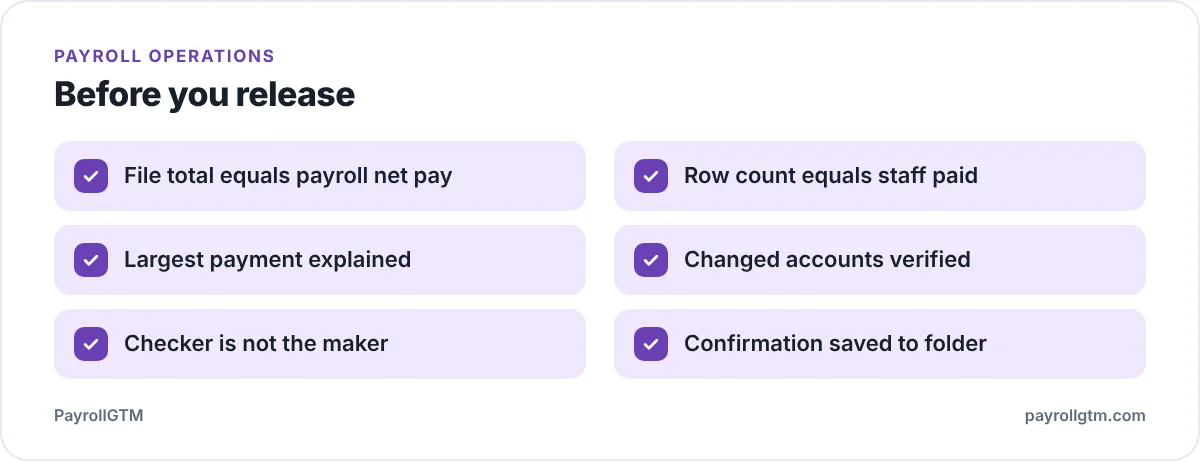
A good check takes ten minutes and uses three numbers. The file's total must equal the payroll's total net pay. The row count must equal the number of staff being paid. The largest single amount should be explainable.
Step 5: upload, release and keep the evidence
Upload the file, read the bank's confirmation screen (total, count, debit date), and release it. Save the bank's confirmation or the debit advice, the final bank file as sent, and the signed approval page in the payroll folder for the month. Auditors and tax officers ask for proof that wages were paid; see payroll record keeping for what to keep.
Step 6: handle failed and returned credits
Some transfers fail: a closed account, a wrong number or a bank limit. Your bank will report which rows failed, sometimes immediately and sometimes the next working day. Do not re-run the whole file, or the people who were paid will be paid twice. Make a new small file for the failed rows only after you have confirmed the right details with the employee, record it as a separate payment with its own approval, and tell the employee the real reason and date. If the money was returned to your account, keep the return advice.
Protect the bank access too. A perfect file is no use if the login is shared. Give each approver their own credentials and token, never write a password on a sticky note by the finance desk, and remove access the day someone leaves the finance role. Set the bank's daily transfer limit above your payroll total but not wildly above it. Keep the payroll spreadsheet in a protected folder and send each employee a payslip separately from the payment, so a question about pay can be answered from a record and not from memory. If an employee reports a missing credit, check the bank's report on that row before you accuse anyone of anything, and answer within the same day.
Timing around weekends and holidays
If payday falls on a Saturday, Sunday or public holiday, banks may not settle on that day, and some platforms treat the instruction as next working day. Decide the rule in your handbook: either pay on the last working day before, or state that salary is paid on the next working day. Telling staff once avoids twenty phone calls. Public holidays and pay is the place to check the wider rights. Confirm your bank's cut-off times for same-day settlement; we have not stated one.
Why you should not pay in cash
Cash payment is sometimes unavoidable for day workers, but it is the weakest control you can have. There is no bank record, so disputes become one person's word against another's. The cash must be drawn, carried and counted, which creates security risk and an opportunity to skim, and a worker who signs for a larger amount than received leaves little to prove. It also makes pension remittance and PAYE records harder, and a tax or pension officer may not accept an undocumented payment. If you must pay cash, use a signed payment sheet with two witnesses and move to a bank account as soon as possible.
Reconcile after payday
Within two working days, compare the bank statement with the approved payroll and the journal; the monthly reconciliation checklist gives the full list and payroll journal entries show how the payment is booked. Mid-month starters and leavers are paid by prorated salary, and a wrong payment is corrected by the rules in back pay and salary corrections.