The employer's annual return of employees' emoluments, known as Form H1, is due by 31 January for the year just ended (Nigeria Tax Administration Act 2025, s.14). For 2026 pay, that means 31 January 2027. Filing late costs ₦100,000 for the first month and ₦50,000 for each month after (s.96), and your employees still have to file their own returns separately.
- What the return must contain for every employee
- The December data list and a sample column layout
- Who should sign and what to check first
- The cost of filing late, worked through
What the return is for
Each month you send PAYE with a schedule. Form H1 is the yearly summary that lets the tax authority compare what you say you paid staff against what you deducted and remitted. If the twelve monthly schedules say ₦1,034,496 and the annual return says ₦900,000, someone from the state IRS will ask why. For the monthly side, see how monthly PAYE remittance works.
The return goes to the tax authority that collects PAYE for your staff, which for most private employees is the state IRS (LIRS in Lagos, FCT-IRS in Abuja). If you are unsure which office, read which tax authority gets PAYE. A state may also run its own form or portal for the annual return, so ask for its current template before you build yours.
Step 1: Gather the data in December
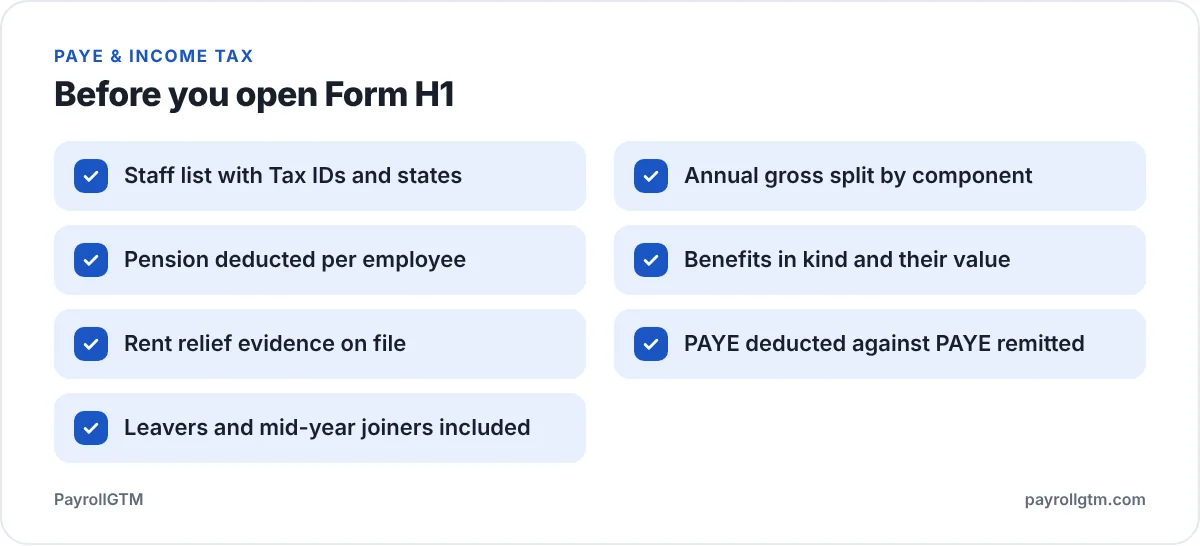
Waiting until 25 January is how returns go in wrong. Start in the first week of December so any gap in records can be fixed while staff are still at their desks. You need, for every person who was on payroll at any point in the year, including leavers:
- Full name, Tax ID (or the NIN or state tax number your state IRS accepts) and residential state.
- Date joined and date left, if applicable.
- Total gross pay for the year, split into basic, housing, transport, other allowances and bonuses.
- Benefits in kind and their value, such as a company car or school fees. How these are valued is in the benefits in kind guide.
- Employee pension deducted, and any NHF, NHIS or other deduction where the employee asked for it.
- Rent relief claimed and the evidence you hold for it.
- PAYE deducted and PAYE actually remitted, month by month.
Pull these from your payroll register, not from memory or from payslips alone. If you keep one payroll file per month, add them up in a single sheet and compare to your remittance receipts.
Step 2: Lay out the sheet
The columns below are a working layout, not the official form. Your state IRS template may use different headings or order, but every item here is normally asked for in some form. The three rows are real calculations for three staff on different pay structures.
| Employee | Annual gross | Pension (8%) | Chargeable income | PAYE for the year | PAYE remitted |
|---|---|---|---|---|---|
| Hauwa (₦260,000 a month, split basic/housing/transport) | ₦3,120,000 | ₦224,640 | ₦2,895,360 | ₦314,304 | ₦314,304 |
| Emeka (₦400,000 a month, ₦40,000 other allowances) | ₦4,800,000 | ₦345,600 | ₦4,454,400 | ₦591,792 | ₦591,792 |
| Kemi (₦150,000 a month, whole gross pensionable) | ₦1,800,000 | ₦144,000 | ₦1,656,000 | ₦128,400 | ₦128,400 |
| Totals | ₦9,720,000 | ₦714,240 | ₦9,005,760 | ₦1,034,496 | ₦1,034,496 |
In this example Hauwa's pension base is basic ₦130,000, housing ₦65,000 and transport ₦39,000, so 8% is ₦18,720 a month. Emeka's base is ₦360,000 of his ₦400,000, which is why his pension is not 8% of the full figure. Check which base your payroll used before copying a pension number across.
Step 3: Reconcile before you file
Three checks catch most errors. First, the PAYE column total should equal the sum of your twelve monthly remittances. Second, the number of staff on the return should match your headcount from payroll at each month. Third, anyone with a nil tax figure, such as a worker paid the minimum wage, still appears on the list.
When a figure does not tie, the usual causes are a salary increase back-dated into a later month, a bonus paid in December that was taxed in January, or a leaver whose final pay was processed after they were taken off the list. The back pay and corrections guide shows how to treat each one. Differences between what was deducted and what was remitted have to be cleared before filing, not explained afterwards.
Step 4: Sign and submit
A person with authority to bind the business should sign: a director, the proprietor or whoever your state IRS form names. A payroll officer can prepare the return, but the signature is a statement that the figures are correct, so the signatory should look at the totals and a sample of lines. Keep a copy of the return and the acknowledgement. If your state IRS has an online portal, save the submission confirmation as a PDF; if it takes paper, ask for a stamped copy.
What filing late costs
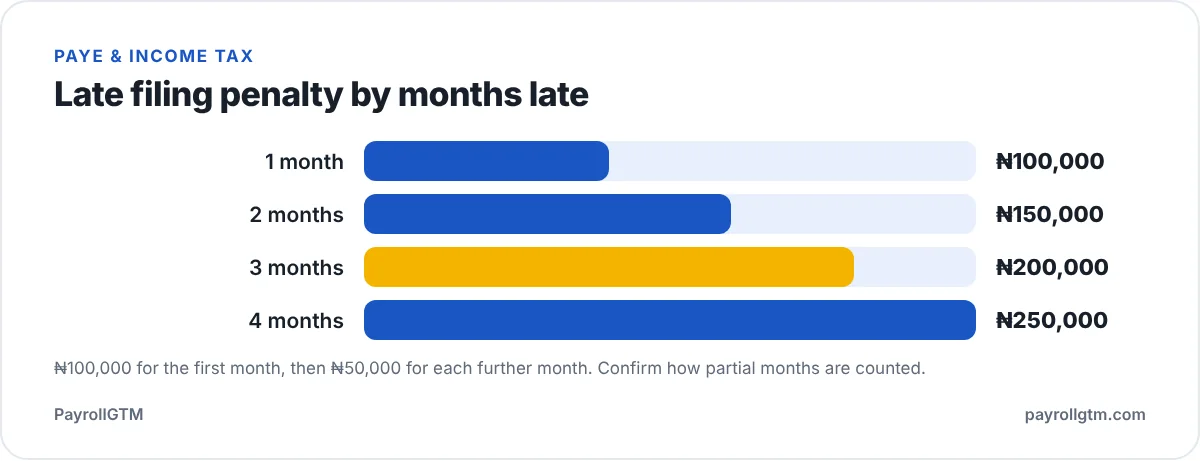
The penalty in s.96 is ₦100,000 for the first month and ₦50,000 for each month after. A return filed about three months after 31 January would, on the usual reading, attract ₦100,000 plus two more months at ₦50,000, which is ₦200,000. How a partial month is counted is a point to confirm with your state IRS.
Also remember the Act lets the tax authority assess from the records it has where you do not file (an administrative assessment under s.34). That tends to produce a higher figure than an honest return would, because it is built from what the authority can see rather than from your records.
Mistakes that make a return wrong
Reporting net pay. The return works from gross emoluments. A sheet built from bank transfer amounts understates income and makes the tax look too high for the pay shown.
Dropping leavers. Ibrahim worked from January to June and was paid in full. He still belongs on the return for that year, with his joining and leaving dates, even though he is not on your October staff list.
Mixing deducted and remitted. If ₦591,792 was deducted from Emeka but only ₦540,000 was paid over because two months were skipped, the return should show both figures honestly, and the shortfall should be paid with the filing, not left to be found. Showing deducted tax as remitted when it was not is a worse problem than the late payment itself.
Treating allowances as optional detail. Pension is based on basic, housing and transport, so the split matters. A single consolidated figure per person makes it impossible to prove the pension line was right.
Keep the paper trail
An auditor looking at the return will want the monthly schedules, the receipts, the payroll register and evidence for every relief. Hold these in order, by year. The checklist in preparing for a payroll tax audit covers what is asked for and the usual questions. Pension remittances are checked by PenCom separately, as explained in the pension remittance deadline and penalty. Finally, if you are not sure whether a relief you gave in the year qualifies, compare it against the deductions that reduce PAYE in 2026 before it goes onto the return.