Before you release salaries each month, reconcile the payroll in this order: headcount, gross pay against last month, net pay against the bank file, statutory totals against what you will remit, then people on the edge (joiners, leavers, zero or negative net, duplicate bank accounts). Any month-on-month movement in total gross above 5% should be explained line by line before anyone signs. The reason is simple. Errors found on Thursday cost a correction; errors found by staff on Friday cost trust, and errors found by a tax officer cost penalties.
Check 1: headcount
Start with the number of people. Take last month's headcount, add this month's joiners, subtract leavers, and compare with the number of people on the payroll run. If the figures differ, find the name. Then compare the payroll list with the HR list and the list of people who actually came to work. A person on payroll who nobody can place is a ghost-worker risk; see preventing payroll fraud.
- Every joiner has a signed contract, a start date and bank details.
- Every leaver has a last day, and nothing is paid after it except final settlement.
- Anyone on unpaid leave or suspension is flagged, not paid in full by accident.
Check 2: gross pay variance against last month
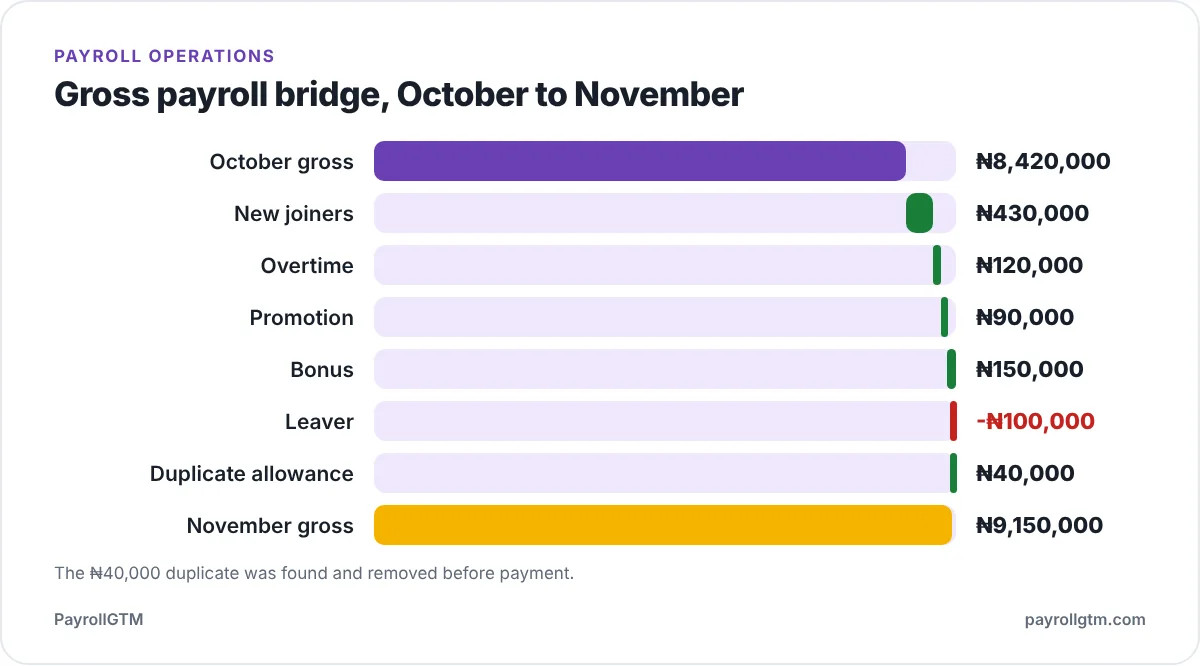
Total gross pay rarely stays still. Draw up a short bridge from last month's total to this month's and explain every item over a small threshold. Use 5% on the total as the trigger for a full review, and a lower limit (say ₦20,000) for an individual line.
Two new joiners (₦250,000 and ₦180,000): +₦430,000
Overtime in the warehouse: +₦120,000
One promotion approved in October: +₦90,000
A one-off bonus paid to the sales team: +₦150,000
One leaver (Emeka, left 31 October): -₦100,000
Explained movement: ₦690,000. Unexplained: ₦40,000.
The ₦40,000 is traced to a transport allowance entered twice for one employee. Removed before payment.
The bridge is what a manager signing off will read. It also shows where to look in next month's run: the bonus and overtime will not repeat, and the new joiners are full-month costs from now on.
Check 3: net pay against the bank file
Total net pay on the approved payroll must equal the total in the bank payment file, to the kobo, and the number of rows must equal the number of people being paid. If not, stop. Read the bank transfer payment guide for what to check in the file itself. Also review the extremes: the five highest and five lowest net pays, any zero or negative net pay (usually deductions exceeding earnings, such as a loan or a back-pay clawback), and anyone whose net changed by more than 10% with no explanation.
Check 4: statutory totals against what you will remit
Add the figures on the payroll for each statutory item and compare with the amount you are about to pay over. They must match.
| Item | Payroll figure to check | Compare with |
|---|---|---|
| PAYE | Sum of all employee PAYE deductions | Amount in your state IRS remittance (due by the 10th of the next month, state practice) |
| Employee pension (8%) | Sum of employee deductions | PFA schedule, with the employer's 10% |
| Employer pension (10%) | Employer cost on the pension base | Same PFA schedule; remit within 7 working days of paying salaries |
| NSITF (1%) | 1% of total monthly payroll | NSITF payment, employer cost only |
| NHF (2.5%, if staff opted in) | 2.5% of basic for opted-in staff only | Remittance to FMBN |
If the November total payroll is ₦9,150,000, NSITF at 1% is ₦91,500. Deadlines and penalties are in the pension remittance deadline guide and how to pay PAYE.
Check 5: is the PAYE reasonable?
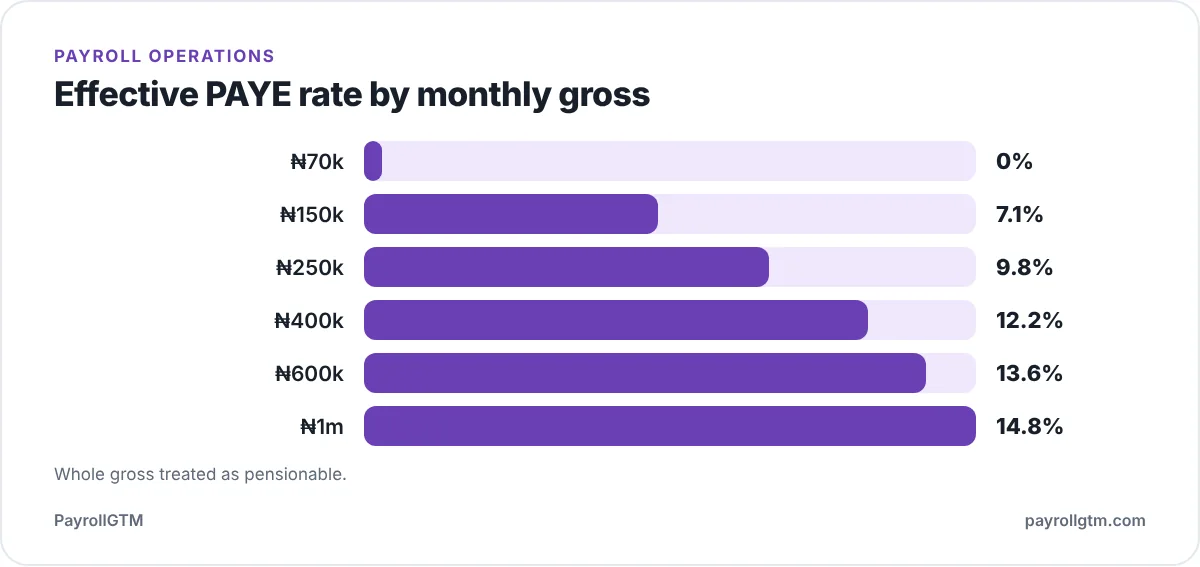
You do not have to recompute everyone to spot a wrong PAYE figure. Use the effective rate, which is PAYE divided by gross. The numbers below come from our PAYE calculator logic with the whole gross treated as pensionable, so a real payslip with a lower pension base will show a slightly higher rate.
| Gross a month | PAYE a month | Effective rate |
|---|---|---|
| ₦70,000 | ₦0 | 0% |
| ₦150,000 | ₦10,700 | 7.1% |
| ₦250,000 | ₦24,500 | 9.8% |
| ₦400,000 | ₦48,740 | 12.2% |
| ₦600,000 | ₦81,860 | 13.6% |
| ₦1,000,000 | ₦148,100 | 14.8% |
If a ₦250,000 employee shows PAYE of ₦45,000 (18%), something is wrong, probably an old-band rate or a missing pension deduction. If a ₦600,000 employee shows ₦20,000, a relief may have been applied without evidence. Rent relief claims should have documents on file; see how to claim rent relief, and compare any doubtful result with the payroll calculator.
A second quick test is to compare per-head cost. Divide total gross by headcount: ₦8,420,000 over 30 people last month is about ₦280,667, and ₦9,150,000 over 31 is about ₦295,161. A jump in per-head cost with no promotion or bonus to explain it usually means a rate or allowance was entered wrongly for a group of people, such as a housing allowance applied to the wrong grade.
Check 6: duplicates and one-offs
- Sort the bank file by account number. The same account twice is either a family arrangement you have documented or an error.
- Check duplicate names, phone numbers and addresses on the employee master.
- List every one-off payment, such as bonuses, arrears or reimbursements, with its approval. Arrears and corrections are handled in back pay and corrections.
- Check part-month pay for joiners and leavers against the proration method you use.
When an error shows up after payment
It will happen eventually. Decide the rule before it does. If an employee was underpaid, pay the difference in a separate, approved top-up as soon as it is confirmed, not "in next month's salary" unless the employee agrees and the shortfall is small. If someone was overpaid, tell them promptly in writing with the arithmetic, and agree how it is recovered; do not simply deduct it without a documented agreement, as the rules on lawful deductions are strict. Record the cause (a late leaver notice, a wrong rate, a duplicated line) and change the checklist so the same slip is caught next time. The most common causes in small payrolls are late notice of leavers and salary changes approved verbally after the cut-off date.
Statutory errors need more care. If PAYE or pension was under-remitted, correct it with the state IRS or the PFA straight away rather than waiting to be asked, and keep the correspondence.
Who does it, and how long it takes
For a business of up to about 50 people, the six checks take one to two hours once a template exists. The preparer should not be the person who approved the pay rises, and the reviewer should not be the person who prepared the file. In a one-person finance team, the owner or an outside accountant plays the reviewer role, and the reconciliation sheet is what they sign. Build the checks into a spreadsheet tab with formulas for headcount, totals and the 5% flag so that most of the work is reading, not calculating. If the tab keeps turning red for the same reason every month, fix the cause in the payroll setup, not at the sign-off.
Sign-off and records
Finish with a one-page reconciliation sheet: headcount bridge, gross bridge, net pay equals bank file, statutory totals, exceptions and who resolved them. The preparer signs and dates it, and a second person signs. File it with the payslips and bank confirmation. Payroll journals then follow, as in payroll journal entries, and the sheet is the first thing to hand over in an audit; see the annual payroll audit checklist.