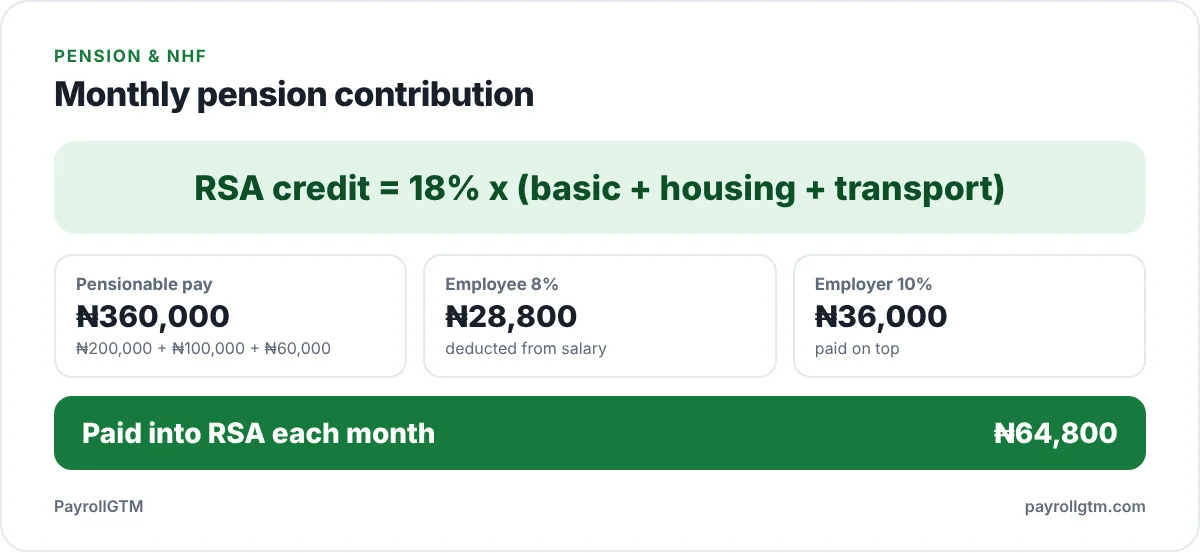
Pension for a Nigerian employee is 8% of monthly pensionable pay from the employee and 10% from the employer, 18% in all, where pensionable pay means at least basic salary plus housing allowance plus transport allowance. A staff member with ₦360,000 of basic, housing and transport therefore has ₦28,800 deducted and the employer adds ₦36,000, so ₦64,800 goes into the employee's RSA that month.
The formula is short. The mistakes come from the base: what exactly counts, and what happens to the other allowances. This page walks through three salary structures, then two awkward cases. If you only want a table of figures for round salaries, use pension contribution examples by salary instead.
The formula in four lines
- Add basic, housing and transport for the month. That is pensionable pay.
- Employee contribution = 8% of pensionable pay, deducted from salary.
- Employer contribution = 10% of pensionable pay, paid by the employer on top of salary.
- Remit both to the employee's pension fund administrator (PFA) for credit to their RSA within 7 working days of paying salaries.
The Pension Reform Act 2014 applies to an employer with 3 or more employees. Some older websites say 15, and that is wrong. The 18% is a minimum: an employer may agree a higher rate in the contract, and may count more of the pay as pensionable. An employer may not count less than basic, housing and transport.
Example 1: a consolidated salary
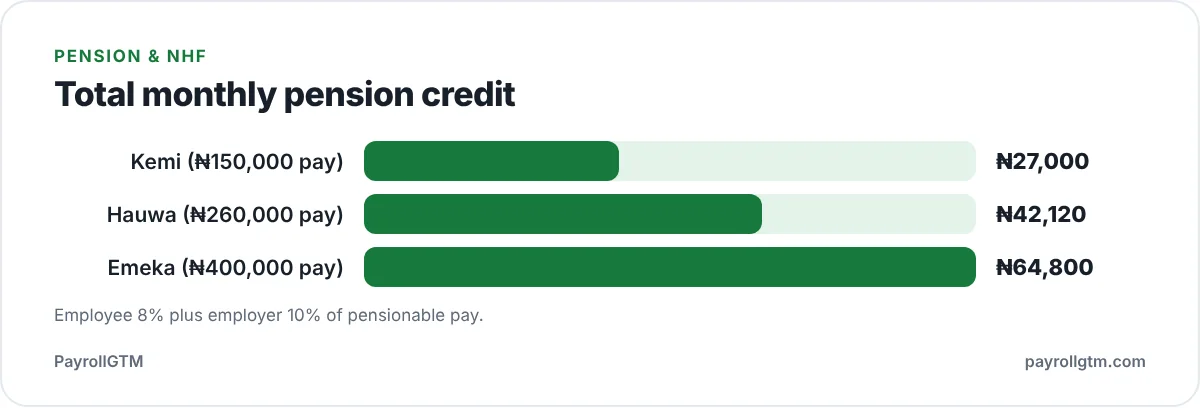
Kemi earns ₦150,000 a month as a single consolidated figure with no breakdown on her letter. Where the employer treats the whole amount as pensionable, which is the safest approach when no split exists, the sums are simple.
A consolidated figure causes trouble later. If a tax officer or PenCom asks what the basic, housing and transport were, you have nothing to show. A split on paper protects both sides. See how to structure basic, housing and transport.
Example 2: a salary with other allowances
Emeka earns ₦400,000 a month. His letter says basic ₦200,000, housing ₦100,000, transport ₦60,000 and ₦40,000 as a "responsibility allowance". The responsibility allowance is not one of the three named components, so the minimum base leaves it out.
If the employer had instead used the whole ₦400,000, the employee would pay ₦32,000 and the employer ₦40,000. That is allowed and some employers do it, but it should be written in the contract or handbook so it is applied to everyone the same way. Do not switch bases for one person.
Example 3: when the other allowances are large
Hauwa earns ₦260,000 with basic ₦130,000, housing ₦65,000 and transport ₦39,000, leaving ₦26,000 for other allowances. The base is ₦234,000.
| Item | Basis | Monthly amount |
|---|---|---|
| Pensionable pay | ₦130,000 + ₦65,000 + ₦39,000 | ₦234,000 |
| Employee 8% | 8% of ₦234,000 | ₦18,720 |
| Employer 10% | 10% of ₦234,000 | ₦23,400 |
| Total into RSA | 18% of ₦234,000 | ₦42,120 |
| PAYE after pension | Chargeable ₦2,895,360 a year | ₦26,192 |
| Net pay | ₦260,000 less ₦18,720 less ₦26,192 | ₦215,088 |
Notice the share of gross that is pensionable: 90%. When basic, housing and transport are a small fraction of the package, as is common in firms that load pay into "other allowances", the pension credit is lower and the employee's retirement balance grows more slowly. That is lawful at the minimum, but it is something a prospective employee should ask about when comparing offers.
If the employer pays the whole 20%
An employer may agree to carry the entire contribution so the employee has nothing deducted. The Act then sets the employer's minimum at 20% of pensionable pay. For Hauwa's ₦234,000, the employer pays ₦46,800 a month and the employee ₦0.
Two points catch people out. First, the employer pays 20%, not 10% plus the 8% it would have deducted, which would be 18%. Second, the employee loses the 8% deduction that lowers taxable pay, so the take-home pay does not simply rise by ₦18,720; part of it goes to PAYE. The rules and a full example are in when the employer pays the full 20%.
Where the numbers go wrong in payroll
- Pension taken on net pay. The base is before tax, never after.
- New allowance, old base. When a transport allowance is raised, the pension line must rise in the same month. A salary review that updates the payslip but not the pension schedule leaves a shortfall that grows monthly. Arrears are handled in back pay and salary corrections.
- Employer contribution left off the payslip. The employer's 10% is not deducted from pay, but showing it as a line helps the employee check it against the PFA statement.
- Rounding by hand. Calculate each person's figure separately, then total. Do not take 18% of a rounded total.
To build the formulas into a sheet, use a payroll spreadsheet with the formulas, and to see how pension sits inside a full monthly run read running payroll step by step.
Check your own contribution in five minutes
An employee can test the employer's figure without any software. Take the basic, housing and transport lines from your payslip or contract, add them, and multiply by 0.08. That should equal the pension deduction on the payslip. Multiply the same total by 0.10 for the employer's share, then add the two. Log in to your PFA's portal or open the statement and look for a credit of that size, dated within about a week of payday.
If the deduction on your payslip is right but the credit on your RSA is missing or short, the employer has deducted and not remitted. That is the employer's breach, not yours, and the first step is to ask payroll for the remittance date and the PFA receipt. How to open an account and read the statement is in the RSA and PFA explainer.
Part-month salaries follow the same rule: pension is worked on the pay actually due for the month, so a new starter's first contribution is smaller than a full month's. Voluntary top-ups sit outside the 18% and are covered in voluntary pension contributions and their tax benefit.
Paying it on time
Make the pension remittance a fixed item in the payroll checklist, with a named person and a date, so it is not left to whoever remembers.
Calculating correctly is half the job. The contribution must reach each RSA within 7 working days of payday, and each month of delay attracts a 2% charge on the unremitted amount. On Hauwa's ₦42,120 that is ₦842 for one late month (₦42,120 x 2%). The charge sounds small but is applied to the whole payroll and compounds with the employee's lost investment gains. Details are in the pension remittance deadline and penalty.
The employer must also hold group life insurance for staff, paid for by the employer and not deducted from anyone's salary; the cover rule is in the group life insurance guide. That premium is separate from the 18% and does not reduce it. For the pension rules and PenCom's role, start at the National Pension Commission, and confirm any specific case with your PFA.