Yes, in most cases. The Pension Reform Act 2014 covers employers with 3 or more employees, and it asks whether the person is an employee, not what the contract calls them. Probationers, fixed-term staff and part-timers who work under your direction are employees, so pension starts from their first salary. Only a genuine independent contractor is outside it. Casual and daily-paid workers are the hard case, and the answer depends on the facts.
Employee status, not job title
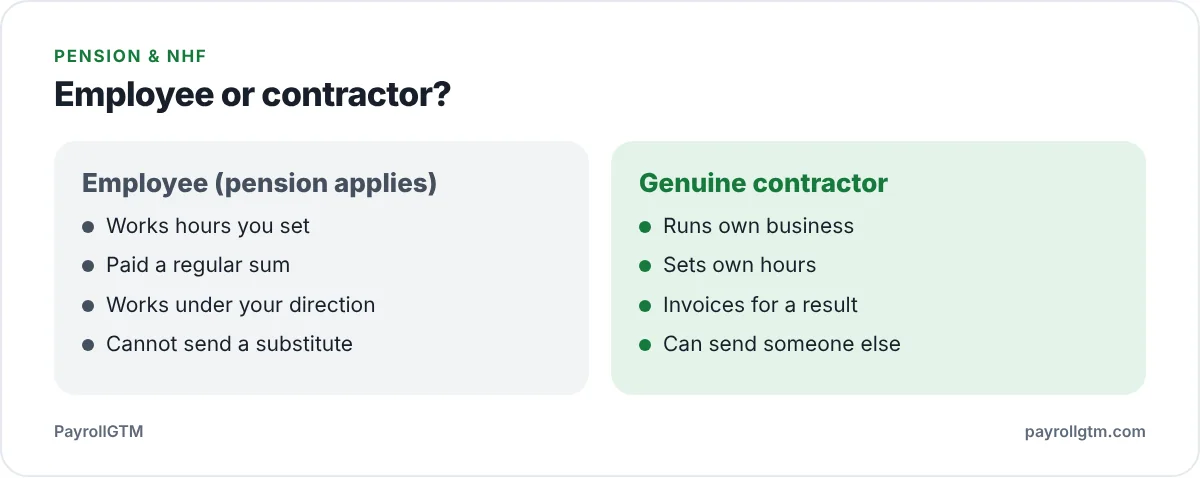
The Act has no exemption for probation, fixed terms or hourly pay. Someone on a one-year contract who works fixed hours, under supervision, for a monthly sum is in substance an employee, and the minimum 18% applies: 8% from the employee and 10% from the employer, on at least basic, housing and transport. A real contractor runs their own business, sets their own hours, can send someone else, and invoices you. Our guide to casual, fixed-term and permanent employees sets out the differences, and employee or contractor classification gives the practical tests.
How each type of worker is treated
Probationary staff
Enrol from the first month, not from confirmation. Waiting until confirmation leaves a gap, and the unremitted amount attracts a penalty of 2% for each month of delay (PRA s.11).
Fixed-term contract employees
If you employ the person directly for a set period, with a defined role and a salary, they are an employee for the whole term. Contributions are due for each month they are paid. The RSA stays theirs after the contract ends.
Part-time employees
Part-timers who work regular hours under your direction are employees. Contributions follow their actual pensionable pay. If an employee earns ₦60,000 a month and the whole amount is pensionable, the employee pays ₦4,800 (8%) and the employer adds ₦6,000 (10%), so ₦10,800 goes to the RSA. PAYE on ₦60,000 is nil, because the first ₦800,000 a year is taxed at 0%, and the employee takes home ₦55,200.
Casual and daily-paid workers
If the same person turns up every week for months, is paid by the day and is treated like part of the crew, treat them as an employee and enrol them. If the engagement is truly one-off and independent, write down why. When you are unsure, ask PenCom or a lawyer rather than guess, because the cost of getting it wrong grows every month.
Useful signs that a casual worker is really an employee: they work most weeks, you give them tasks and hours, they use your tools, they have worked for you for many months, and they would struggle to work for anyone else. Any two or three of these should make you stop and enrol them.
Agency workers
If a staffing agency is the legal employer, it carries the pension duty. Still, ask the agency for its monthly remittance schedules or its PenCom compliance certificate. Choosing the cheapest agency without checking can leave you in a dispute when workers complain.
Domestic workers, interns and trainees
The Act applies to employers with 3 or more employees, so a household with one driver and one cook sits outside it. Many households still enrol staff voluntarily. For interns and trainees, the question again is whether they are employees. A paid trainee doing a real role usually is. A short, unpaid supervised student placement may not be. Document the arrangement and take advice if the line is unclear.
What a missed enrolment costs
If an employee should have been enrolled and was not, you owe both shares, a penalty for each month of delay, and you risk a complaint to PenCom. The bill grows monthly.
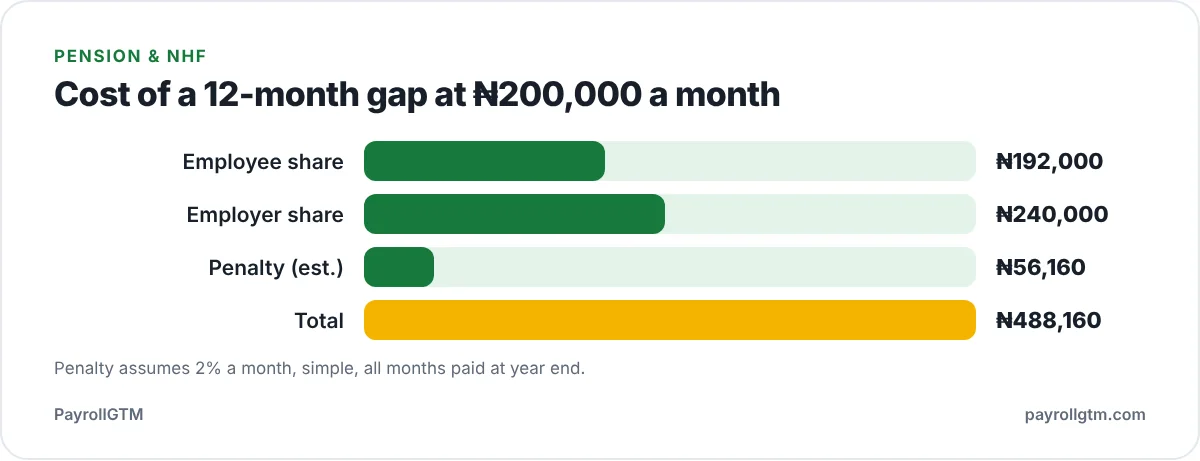
Segun earns ₦200,000 a month, all pensionable, and was left out for 12 months. Each month the missed contribution is ₦16,000 from him plus ₦20,000 from the employer, so ₦36,000, and ₦432,000 over the year (₦192,000 employee share and ₦240,000 employer share). If everything is paid at the end of the year, month 1's contribution is 12 months late and month 12's is 1 month late. That adds up to 78 contribution-months at 2%, or about ₦56,160 in penalty (₦36,000 x 2% x 78). The total is about ₦488,160, before admin time. PenCom may compute the penalty differently, so ask your PFA for the exact figure.
Our pension remittance deadline and penalty guide explains how the late-payment penalty works.
Enrolment routine for every new worker
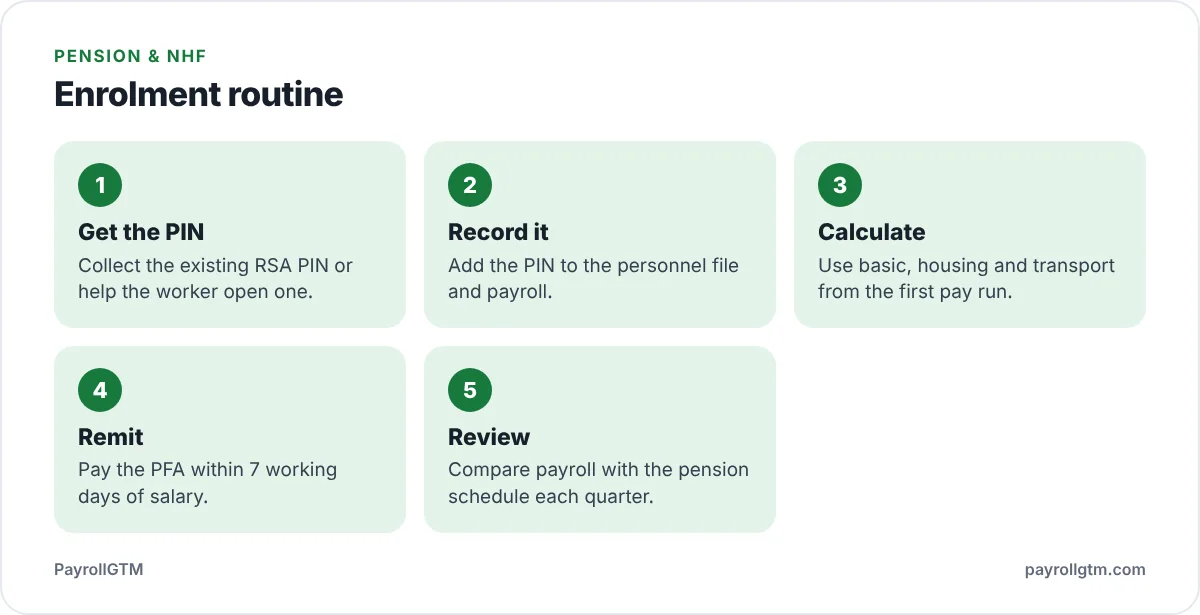
- Ask for the RSA PIN. A worker who already has an RSA keeps it for life, whichever employer.
- If there is none, help them open one. The employee chooses the PFA. See how to open an RSA and get a PIN.
- Record the PIN in the personnel file and in payroll.
- Calculate contributions from the first pay run using basic, housing and transport, as in calculating pension contributions.
- Remit within 7 working days after salary is paid, and keep the schedule and proof of payment.
- Review every quarter. Compare the payroll list with the pension schedule, name by name.
Fixing past omissions
If you find staff who were left out, do not hide it. Work out the missing months for each person, both shares, and speak to the PFAs about remitting the arrears. If the employee's share was never deducted, agree a repayment plan with the employee instead of taking a large lump sum from one salary, because uncontrolled deductions can breach wage protection rules. See wage payment and lawful deductions. Our pension compliance guide for SMEs covers the wider employer duties.
Policy tips for small employers
- Put pension enrolment in the onboarding checklist next to bank details and the contract.
- Describe the pension arrangement in the offer letter so the deduction is no surprise.
- Use a fixed-term contract template that confirms pension and group life cover.
- Re-check agency arrangements once a year.
- Keep a short note explaining why anyone is treated as a contractor.
Common questions
Does the employee have to agree to the deduction?
No. The statutory minimum is a legal obligation. Employees may add voluntary contributions on top.
Can the employer pay the whole 18%?
Yes, but then the employer's minimum is 20% of monthly emoluments. See when the employer pays the full 20%.
Does the contract need to mention pension?
It is good practice. Stating both shares avoids arguments later.