If you employ three or more people, the Pension Reform Act 2014 (section 4(5)) requires you to hold group life insurance for them, with cover of at least three times each employee's annual total emolument, and you pay the premium yourself. Nothing is deducted from staff pay for it. The cover is separate from the 10% employer pension contribution and from your NSITF contribution, and it is one of the first things a pension compliance review looks for.
Here is how it usually surfaces. Ngozi runs a six-person logistics office in Ikeja. She remits pension on time every month, so she assumes she is covered. Then a client asks for her PenCom compliance certificate before renewing a contract, and her accountant, Bola, asks one question: "Where is the group life policy?" There is none. The rest of this guide is what Ngozi does next, and what you should check before somebody asks you.
What the law requires, and what it leaves open
The requirements that are clear:
- Who must hold it. Employers covered by the Act, which means 3 or more employees. Some foreign websites say 15 or 10; that is wrong.
- How much. A sum assured of not less than three times the employee's annual total emolument, worked out per employee, not once for the whole company.
- Who pays. The employer. You cannot recover the premium from salaries.
- In whose favour. The employee, so the benefit goes to the family or named beneficiaries if the employee dies while covered.
What the Act does not spell out in plain terms for a small employer is how "total emolument" should be read. The pension minimum is built on basic, housing and transport, but for the life cover the safer reading is full annual pay, meaning every regular allowance too. Using the larger figure costs a little more premium and removes the argument. Confirm the reading with your insurer or PenCom before you sign.
Also check the current detail with PenCom, which publishes the rules on which insurers may write this cover and how the policy should be evidenced. The home page is pencom.gov.ng. We have not seen a published penalty figure for missing group life cover, so we will not quote one.
Working out the cover for each person
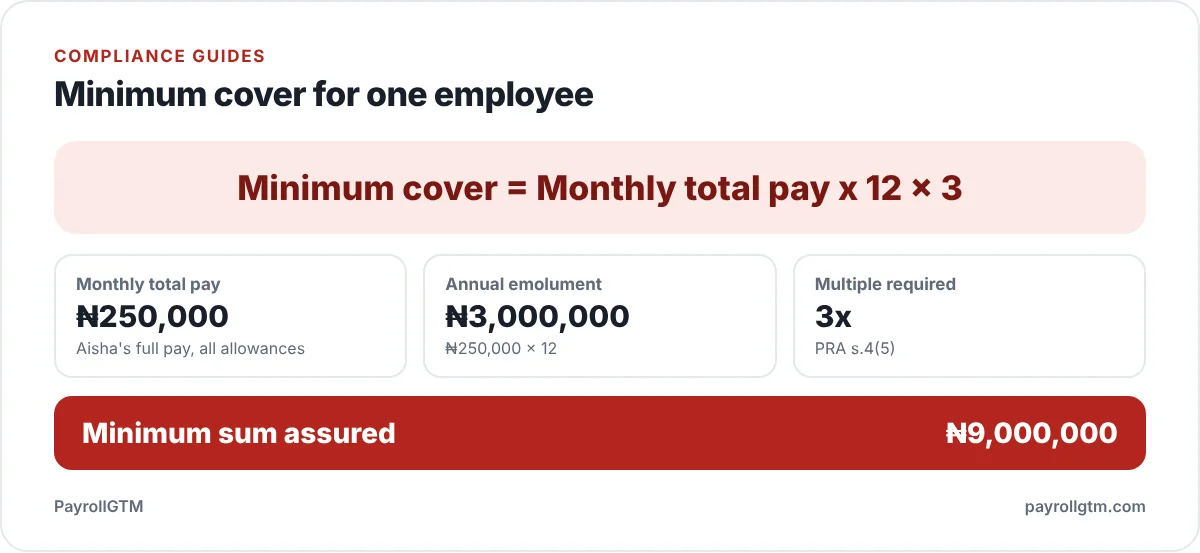
Ngozi has five staff on her payroll plus herself. She starts with the five whose monthly pay is in the books (her own cover is a separate decision). We multiply monthly total pay by 12 for annual emolument, then by 3 for the minimum sum assured.
| Employee | Monthly total pay | Annual emolument | Minimum cover (3x) |
|---|---|---|---|
| Hauwa | ₦150,000 | ₦1,800,000 | ₦5,400,000 |
| Chinedu | ₦180,000 | ₦2,160,000 | ₦6,480,000 |
| Aisha | ₦250,000 | ₦3,000,000 | ₦9,000,000 |
| Tunde | ₦320,000 | ₦3,840,000 | ₦11,520,000 |
| Segun | ₦500,000 | ₦6,000,000 | ₦18,000,000 |
| Total | ₦1,400,000 | ₦16,800,000 | ₦50,400,000 |
The total of ₦50,400,000 is the combined sum assured the insurer will quote against, not what Ngozi pays. The premium is a rate applied to that sum, and the rate depends on the insurer, the age and health profile of the group and the sector. We do not publish a typical rate because it moves, and any figure we gave would be a guess. Get at least three written quotes on the same sums assured so they can be compared.
How to buy the policy
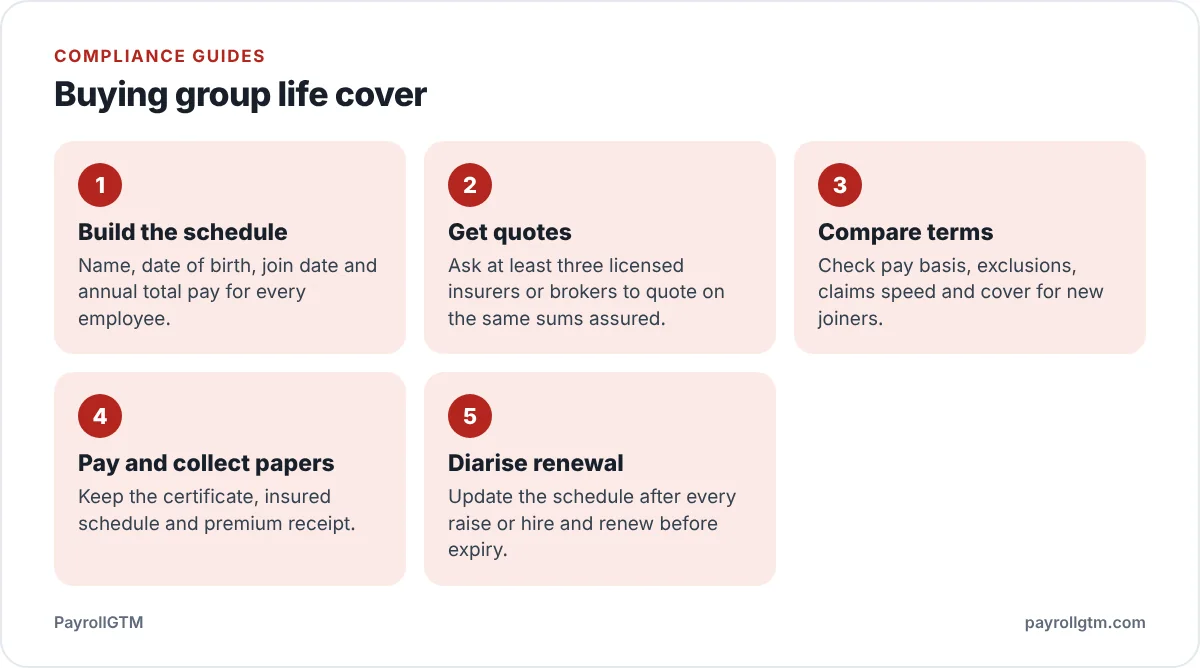
Ngozi does it in this order, and it takes her about two weeks, most of it waiting for quotes.
- Build the schedule. A sheet with each employee's name, date of birth, date of joining, job title and annual total pay. Your payroll spreadsheet already holds most of it.
- Ask a broker or insurers directly for quotes. Use an insurer or broker licensed in Nigeria and the NAICOM register to check that. Ask whether the insurer is one PenCom accepts for this purpose.
- Compare more than price. Look at the sum assured basis (3x full pay or 3x something narrower), exclusions, the claims turnaround the insurer commits to, whether new joiners are covered from their first day, and what happens to cover when someone resigns.
- Pay the premium and collect the documents. You want the policy certificate, the schedule of insured persons with their sums assured, and the premium receipt.
- Diarise the renewal. Cover is typically annual. A lapsed policy means you are in breach again, even though you complied last year.
What goes wrong in small offices
Most failures are not refusal to buy. They are drift.
- The policy covers the old headcount. You bought cover for six people, then hired four more. The four are uninsured until the schedule is updated.
- Cover is on basic salary only. The sum looks fine on paper but is below three times full pay.
- The renewal date passes. Nobody owns the diary entry.
- The beneficiary details are blank. A claim then stalls while the family proves entitlement.
How group life differs from your other covers
Owners often assume one of the other schemes already counts. They do not.
| Cover | Who pays | What it deals with |
|---|---|---|
| Group life (PRA) | Employer, premium to an insurer | Lump sum to the family if the employee dies while covered |
| NSITF (Employees' Compensation Act) | Employer, 1% of total monthly payroll | Compensation for workplace injury, disease or death arising from work; see the workplace injury claims guide |
| Health insurance (NHIA or HMO plan) | Depends on the plan | Medical treatment, see health insurance for employees |
| Pension (RSA) | 8% employee and 10% employer minimum | Retirement savings, which are separate from the life cover |
Group life is the only one that pays out on a death from any cause that the policy does not exclude, which is why NSITF does not replace it. Read the exclusions in your own policy, because they differ between insurers.
Records to keep, and what to ask if you are the employee
Keep the policy certificate, the current insured schedule, premium receipts and each renewal in one folder. When PenCom, a client or your own auditor asks, these are the papers that answer. They also support an application for the PenCom compliance certificate, and they form part of a wider pension compliance routine. If you are preparing for a tax or payroll review, add the folder to the pack described in how to prepare for a payroll tax audit.
Employees do not need to be insurance experts. Ask HR for four things:
- The name of the insurer and the policy number.
- The sum assured on your own record, so you can check it against three times your annual pay.
- Whether your beneficiaries are named, and a chance to update them.
- The date the policy renews.
If HR cannot show you any of these, raise it in writing. An employer that has no policy is in breach of the Pension Reform Act, and a PFA or PenCom can be told. Employers who want to see where this sits among all their yearly obligations can check the employer registration checklist and the list of common payroll mistakes.