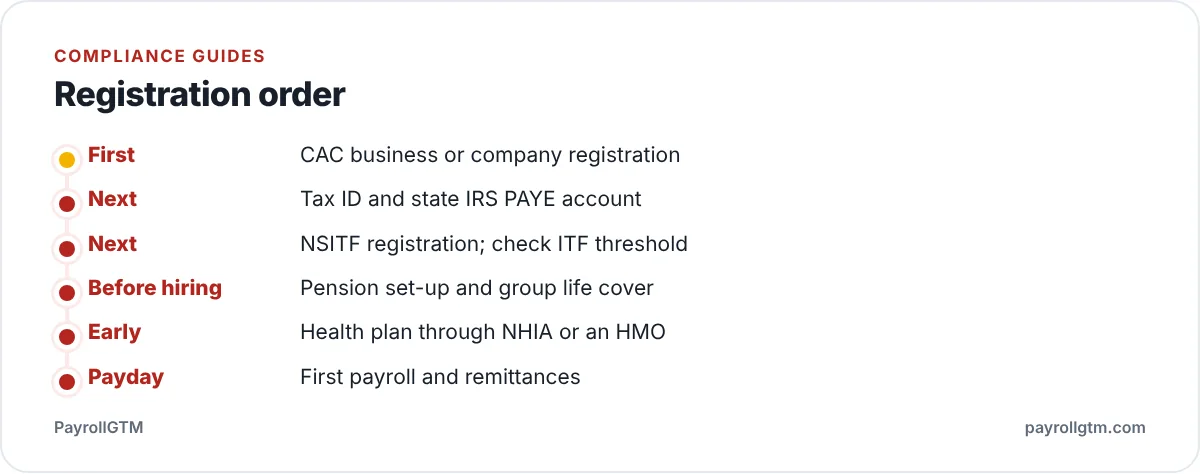
A new Nigerian employer should register with the Corporate Affairs Commission (CAC) first, then with the state Internal Revenue Service for PAYE, and then deal with PenCom, NSITF, ITF, a health plan and data protection before or soon after the first salary is paid. Not every body applies to every business, and some steps depend on headcount, so the table below gives the order, what you need and the recurring duty that follows each registration. We have deliberately not stated fees or portal addresses, because those change and an unofficial price is how people get scammed.
The checklist in one table
Use this as a working list. Tick each row, note the date and keep the proof in your compliance folder.
| Body | What to register | When | What you will usually need | Recurring duty |
|---|---|---|---|---|
| CAC | Business name or company | Before you hire | Name, directors or proprietor details, address | Annual returns |
| Tax authority (NRS and state IRS) | Tax ID and a PAYE account with your state IRS | Before the first payroll | CAC details, address, staff list | Monthly PAYE, annual returns |
| PenCom and PFAs | Pension set-up for each employee (3 or more employees) | When staff start | Each employee's RSA PIN or PFA choice, pay structure | Remit within 7 working days of paying salaries |
| Group life insurer | Group life policy | When pension applies | Payroll list, annual emoluments | Renew the cover each year |
| NSITF | Employer registration | Start of operations | CAC documents, staff count and payroll | 1% of total monthly payroll |
| ITF | Registration if 5 or more employees or ₦50 million turnover | When you reach the threshold | CAC documents, staff count, turnover | 1% of annual payroll |
| NHIA or an HMO | Health cover for staff | Early in the first year | Staff list, dependants, plan choice | Premiums and renewals |
| NDPC | Check whether your data processing needs registration | Before collecting staff data at scale | Description of data you hold | Keep a privacy notice and records |
Step 1: CAC comes before everything else
Banks, tax offices and insurers will all ask for your CAC documents. Register as a business name or a company, whichever fits, and keep the certificate. A company has annual return duties with CAC; see how CAC annual returns work so you are not struck off later. The wider picture is in running a registered business.
Step 2: tax registration and PAYE
Every taxable person needs a Tax ID. The Nigeria Revenue Service announced a unified Tax ID system in May 2026, and reportedly a business's CAC registration number becomes its Tax ID. Because the process is new, check the current NRS or Joint Revenue Board notice for how to register, and ask your state IRS for its PAYE employer registration form and what supporting documents it wants. The practical walk-through is in how employers register for PAYE. Normally you deal with the state IRS of the state where your staff live; some groups sit with the NRS.
After registration, you deduct PAYE monthly and remit by the 10th of the following month under state practice. Confirm the date with your state IRS.
Step 3: pension, group life and the PenCom certificate
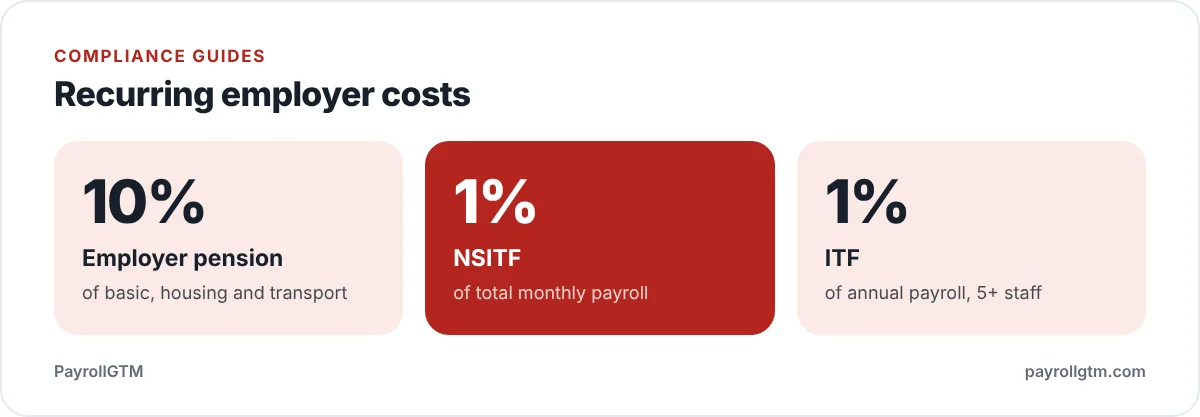
If you employ 3 or more people, the Pension Reform Act applies. That means at least 18% of monthly emoluments (8% from the employee, 10% from you) on basic salary, housing and transport, remitted within 7 working days of paying salaries, and group life cover of at least three times annual total emolument at your cost. Each new hire chooses a PFA or already has an RSA, and one who has none can open one through a PFA. Group life is covered in group life insurance for employers, and the document that proves compliance is explained in the PenCom compliance certificate guide. Late remittance carries a 2% monthly penalty on the unremitted amount.
Step 4: NSITF and ITF
NSITF is paid by the employer at 1% of total monthly payroll under the Employees' Compensation Act 2010, and nothing is deducted from the employee. ITF is 1% of annual payroll for employers with 5 or more employees or annual turnover of ₦50 million or more. The related guides are NSITF registration and ITF compliance. Check each agency's site for current forms: NSITF and ITF.
Step 5: health cover, NHF and data
Health insurance is intended to be mandatory for residents under the National Health Insurance Authority Act 2022, and many employers meet it through an HMO group plan; the NHIA and HMO guide explains the choices. The National Housing Fund is not a registration you must complete for private staff: since the Business Facilitation Act 2022 they may contribute voluntarily at 2.5% of basic, so deduct only if the employee opts in. Staff data is regulated by the Nigeria Data Protection Act 2023; whether your business must register with the NDPC depends on the volume and nature of the data you handle, which we cannot decide for you, so ask the NDPC.
Which rows depend on your size
Three rows turn on headcount or turnover. The pension rules apply once you have 3 or more employees, so a sole trader with two helpers is outside them for now, though hiring a third changes that overnight. ITF applies at 5 or more employees or ₦50 million turnover, so a shop with four staff and ₦60 million of sales is still caught on turnover. NSITF has no headcount line in our sources, so register as soon as you employ anyone and ask NSITF if you are unsure.
The small-company tax exemptions (turnover ₦100 million or less and fixed assets not above ₦250 million) cover company income tax and the development levy. They do not remove PAYE, pension or NSITF duties. Treating them as if they do is one of the more expensive misunderstandings.
A sequence for a brand-new employer
- Register the business at CAC and open the business bank account.
- Get your Tax ID and register for PAYE with your state IRS.
- Register with NSITF and check whether ITF applies yet.
- Agree the pay structure for each job, then give every hire a signed offer.
- Collect each hire's RSA PIN, NIN or Tax ID, bank details and next of kin.
- Take out group life and agree a health plan.
- Run the first payroll with every line correct, then remit on time.
Example: Bola opens a dental clinic in Ibadan with three staff. She registers the business, gets her PAYE account, signs up with NSITF, and sets up pensions for all three because she has reached the 3-employee mark. ITF does not yet apply because she has fewer than 5 staff and turnover is below ₦50 million, so she diaries it for the month she hires her fifth person. She asks an HMO for a group quote before the first payday, not after a nurse falls ill. None of these steps is hard; the damage comes from doing them in the wrong order or not at all.
The mistakes that most often undo this are late PenCom remittance and missing PAYE registration; common payroll mistakes lists the rest, and audit preparation shows what an inspector asks for.
What to keep in the compliance folder
Create one folder, paper or digital, from day one. It should hold your CAC certificate, Tax ID confirmation, PAYE registration acknowledgement, NSITF registration and payment receipts, the group life policy schedule, PFA remittance schedules, and each employee's signed offer and RSA details. When an inspector or a bank asks for proof, you should be able to hand it over in an hour, not a week.