Tunde has just won his first contract and wants to hire a designer, at ₦350,000 a month. Employee number one is easy: sign a contract, register for PAYE, pay on time. Employee number three is where the pension law starts to apply, and it is the one founders miss, because the Pension Reform Act 2014 covers employers with three or more employees. The rest of this guide is the first twelve months of his payroll compliance, with the costs worked out, so that the surprises come from the business and not from a regulator.
Before the first salary: the setup month
Do these in this order, and do them before pay day, not after.
- Business identity. CAC registration (company or business name) and a Tax ID for the business. See running a registered business in Nigeria for the basics.
- PAYE registration with the state IRS where your staff live. The steps are in how an employer registers for PAYE.
- A written contract and offer letter for every hire, including the pay breakdown (basic, housing, transport and other allowances), because pension is computed on the first three.
- A business bank account that you use for salaries and remittances, not your personal one.
- Staff paperwork: NIN or Tax ID, bank details, and an RSA PIN if they have one.
Employee one and two: what you owe even before pension bites
With fewer than three employees the Pension Reform Act does not apply to you as an employer, but PAYE does from the first salary, and the Employees' Compensation Act expects you to register with NSITF. Tunde's designer is paid ₦350,000 gross. With no pension scheme the whole amount is taxable: PAYE is ₦45,500 a month and net pay ₦304,500. If Tunde chose to run pension from day one, 8% (₦28,000) comes off first, PAYE drops to ₦40,460 and net pay is ₦281,540, while Tunde adds a further ₦35,000 as the employer's 10%. The employee is ₦22,960 a month poorer in cash but has ₦63,000 going into an RSA each month, and the employee share also lowers the tax. Offering pension voluntarily from the start is a sound choice and keeps you ahead of the threshold, but say in the offer letter which basis you are on, so that nobody is surprised when the third hire arrives.
Two other things start before the third hire. Keep every payslip and bank transfer from the first month, because the monthly record is what you will use for the annual return, and treat any "freelancers" who work set hours only for you with care, since they may be employees in law (control, set hours and exclusivity are the usual signs).
The third hire: the pension threshold
When the third person starts, the minimum 18% pension (8% employee, 10% employer, on at least basic, housing and transport) applies to everyone on payroll, and you need group life insurance of at least three times annual total emolument. Staff need RSAs; tell new joiners to bring their PIN, and see the pension compliance guide for small employers for the monthly routine. Remit within 7 working days of paying salaries. Late remittance costs 2% of the unremitted amount for each month of delay.
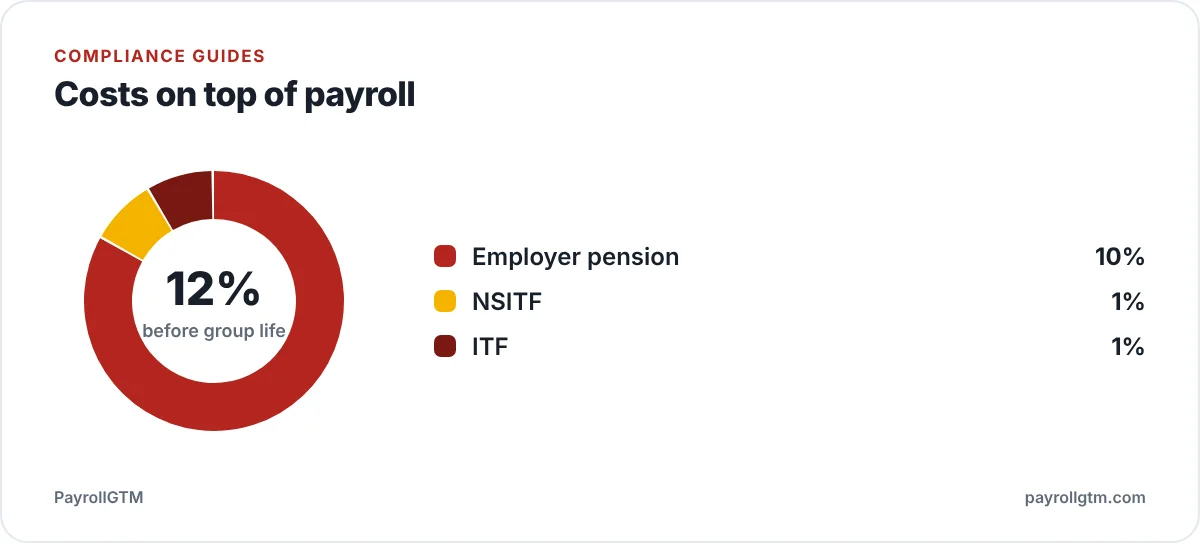
What the first year costs, as a percentage of payroll
Take a monthly payroll of ₦1,200,000 across five people: ₦400,000, ₦300,000, ₦250,000, ₦150,000 and ₦100,000. We treat the whole gross as pensionable to keep it simple; in real life the employer 10% is on basic, housing and transport only, so your figure may be lower.
| Employee | Gross | Pension (8%) | PAYE | Net pay |
|---|---|---|---|---|
| Employee A | ₦400,000 | ₦32,000 | ₦48,740 | ₦319,260 |
| Employee B | ₦300,000 | ₦24,000 | ₦32,180 | ₦243,820 |
| Employee C | ₦250,000 | ₦20,000 | ₦24,500 | ₦205,500 |
| Employee D | ₦150,000 | ₦12,000 | ₦10,700 | ₦127,300 |
| Employee E | ₦100,000 | ₦8,000 | ₦3,800 | ₦88,200 |
| Total | ₦1,200,000 | ₦96,000 | ₦119,920 | ₦984,080 |
The deductions above come out of the employees' pay. The costs below are on top of it, paid by the business.
| Employer cost | Rate | Monthly | Notes |
|---|---|---|---|
| Employer pension | 10% | ₦120,000 | Remitted with the employees' 8%, so ₦216,000 to the PFAs |
| NSITF | 1% of payroll | ₦12,000 | Not deducted from staff |
| ITF | 1% of annual payroll | ₦12,000 accrued | Applies from 5 employees or ₦50 million turnover |
| Group life premium | Varies | Quote needed | Cover of at least 3x annual emolument, premium paid by the employer |
| Total, before group life | 12% | ₦144,000 | ₦1,728,000 over 12 months |
So the true monthly cost of this payroll is ₦1,344,000 before the insurance premium, not ₦1,200,000. Budget about 12% on top of gross, plus whatever your insurer quotes. For your own numbers use the employer cost calculator. Details on the levies are in NSITF registration and contributions and ITF compliance, which also explains how to check whether you qualify.
A month-by-month plan for the first year
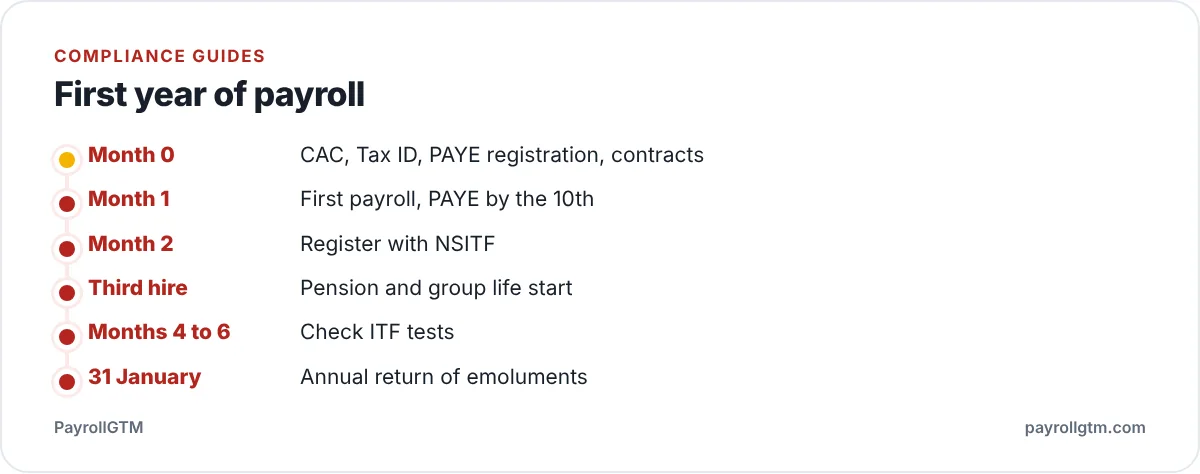
| When | Do this |
|---|---|
| Month 0 | CAC, Tax ID, state IRS PAYE registration, contracts, bank account |
| Month 1 | First payroll. Deduct PAYE, pay by the 10th of the next month. Issue payslips |
| Month 2 | Register with NSITF if not done. Start monthly reconciliation of payroll to payments |
| Month 3 or whenever the third hire starts | Pension for all staff, RSA PINs, group life policy placed |
| Month 4 to 6 | Check ITF headcount and turnover tests. Review any contractors you treat as non-employees |
| Month 9 | Check the company's CAC annual return timing (CAC annual returns) |
| Month 11 to 12 | Collect rent and other relief evidence; prepare the annual return of employees' emoluments, due 31 January |
The calendar of recurring dates is in the payroll compliance calendar, and anything that changed at the start of 2026 is in the January 2026 employer checklist.
Smaller items that still catch first-year employers
- Minimum wage. The ₦70,000 national minimum applies to employers with 25 or more employees, so a five-person startup is outside the Act, but paying below it will make hiring hard in practice.
- NHF. Private-sector employees are not compulsorily covered. Deduct the 2.5% only for staff who opt in, in writing.
- Health insurance. The NHIA Act 2022 intends cover for residents, and many employers use an HMO group plan. Ask a broker for quotes; this article does not give a percentage because we have no confirmed one.
- Leave and notice. The Labour Act sets floors (6 working days of annual leave after 12 months, and notice from one day to one month by length of service), and your contract should match or beat them.
What to automate and what to outsource
With five staff the arithmetic is not the hard part. What breaks is consistency: a month when the founder is travelling and nobody remits. Automate the repeatable parts, such as payslips, schedules, and standing orders for pension, and set calendar reminders for the 10th and the pension deadline. Hand over to a provider the pieces that need current knowledge or time you do not have, like filings and reconciliations, once headcount or complexity rises. When payroll outsourcing makes sense sets out how to judge it, and the liability stays with you either way.
If this is your first payroll, work through common payroll mistakes in Nigerian small businesses next, and keep the figures above to hand when you set your prices.