A yearly payroll audit is a set of 40 checks you run on your own records, ideally in December or January before the Form H1 deadline of 31 January. It takes two to four days for a business of 10 to 30 staff. Run it by someone who does not process payroll day to day, such as a director, an outside bookkeeper or an accountant, because people rarely spot their own errors.
It is not a statutory audit and it does not replace professional advice. It finds the usual problems: a leaver paid for two more months, a wrong pension base, a Tax ID missing, a remittance receipt that does not match the schedule.
How to prepare
- Fix the period. Usually the last full calendar or financial year.
- Collect documents. Payroll registers, payslips, contracts, remittance receipts, bank statements, headcount lists and the payroll accounts in the ledger.
- Choose a sample. In a small firm, test every employee for two months and 3 to 5 employees for all 12. Include one new hire, one leaver, one person on overtime or commission and one with a loan or advance.
- Open a findings log. One table: issue, evidence, amount, action, owner.
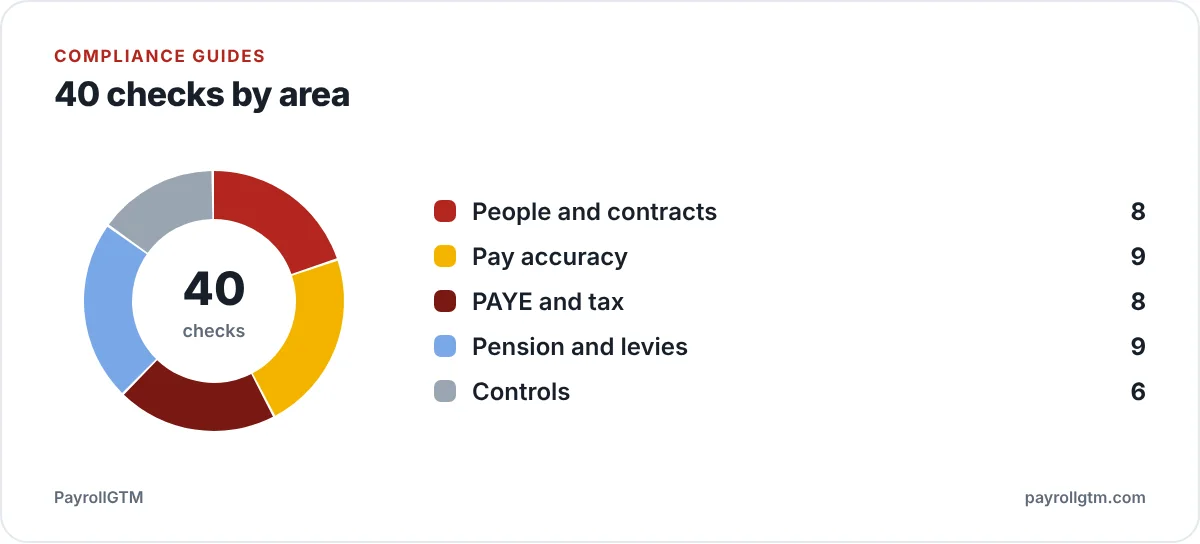
Area 1: People and contracts (8 checks)
- Everyone on payroll is a current employee, and every current employee is on payroll.
- No ghost workers: each person traces to a real contract, identity document and bank account.
- Each employee has a signed contract, and the pay in it matches the register.
- Pay changes during the year have written approval.
- Leavers came off payroll in the right month.
- Employees and contractors are classified correctly (see employee or contractor).
- Probation and confirmation dates are recorded and followed.
- Personnel files hold the records described in our record keeping guide.
Area 2: Pay accuracy (9 checks)
- Gross pay equals the contract components for each sampled employee.
- Overtime, commission and bonus payments have approvals and correct arithmetic.
- Advances and loans have signed agreements, and balances reconcile.
- Deductions other than statutory ones have written consent.
- Net pay equals gross less deductions, to the naira.
- Bank transfers equal net pay for every sampled person.
- Nobody was paid twice or after leaving.
- Payment dates matched the contract.
- The ₦70,000 national minimum wage was respected where it applies (employers with 25 or more employees).
Area 3: PAYE and tax (8 checks)
- The 2026 bands were applied from January, and the old CRA method, which no longer exists, was not used.
- Pension, NHF and other deductions were applied only where evidenced or claimed.
- Rent relief (20% of rent paid, capped at ₦500,000) has a tenancy agreement and receipts behind it. See how rent relief is claimed.
- Benefits in kind were included in taxable pay.
- PAYE went to the correct state IRS each month, by the date that office applies (normally the 10th).
- Payments equal the amounts computed, with receipts on file.
- The annual employer return (Form H1) was filed by 31 January and matches the monthly records. See the Form H1 guide.
- Every employee's Tax ID is on file.
Area 4: Pension, insurance and levies (9 checks)
- Every employee has an RSA and PIN on file (the Pension Reform Act applies to employers with 3 or more employees).
- Contributions use at least basic, housing and transport as the base.
- Rates meet the minimum of 8% employee and 10% employer, or 20% employer where the employer bears the whole cost.
- Remittances were made within 7 working days of paying salaries. A delay carries 2% of the unremitted amount for each month.
- PFA acknowledgements match your schedules.
- Group life cover is in force for at least 3 times annual total emolument for current staff. See the group life rule.
- NSITF (1% of total monthly payroll, paid by the employer) was paid every month.
- ITF (1% of annual payroll) was paid if you have 5 or more employees or turnover of ₦50 million or more.
- NHF was deducted only for staff who opted in, or where it is compulsory (public sector).
Area 5: Controls and housekeeping (6 checks)
- Payroll preparation and approval are done by different people (more in how to prevent payroll fraud).
- Access to payroll files and bank approvals is limited and logged.
- Payroll totals reconcile to the ledger every month (see the monthly reconciliation checklist).
- A compliance calendar exists and is used.
- Employee data is handled as the NDPA requires. See our NDPA guide.
- Backups of payroll data exist and have been restored at least once as a test.
A worked re-performance
Re-performing one employee's pay is the quickest way to find a formula error. Take Obinna, paid ₦450,000 gross a month: basic ₦225,000, housing ₦112,500, transport ₦56,250 and other allowances ₦56,250.
Pensionable pay = ₦225,000 + ₦112,500 + ₦56,250 = ₦393,750. Employee pension 8% = ₦31,500.
Chargeable income = (₦450,000 - ₦31,500) x 12 = ₦5,022,000. PAYE = ₦330,000 (15% on ₦2.2m) + ₦363,960 (18% on ₦2,022,000) = ₦693,960 a year, or ₦57,830 a month.
Net pay = ₦450,000 - ₦31,500 - ₦57,830 = ₦360,670.
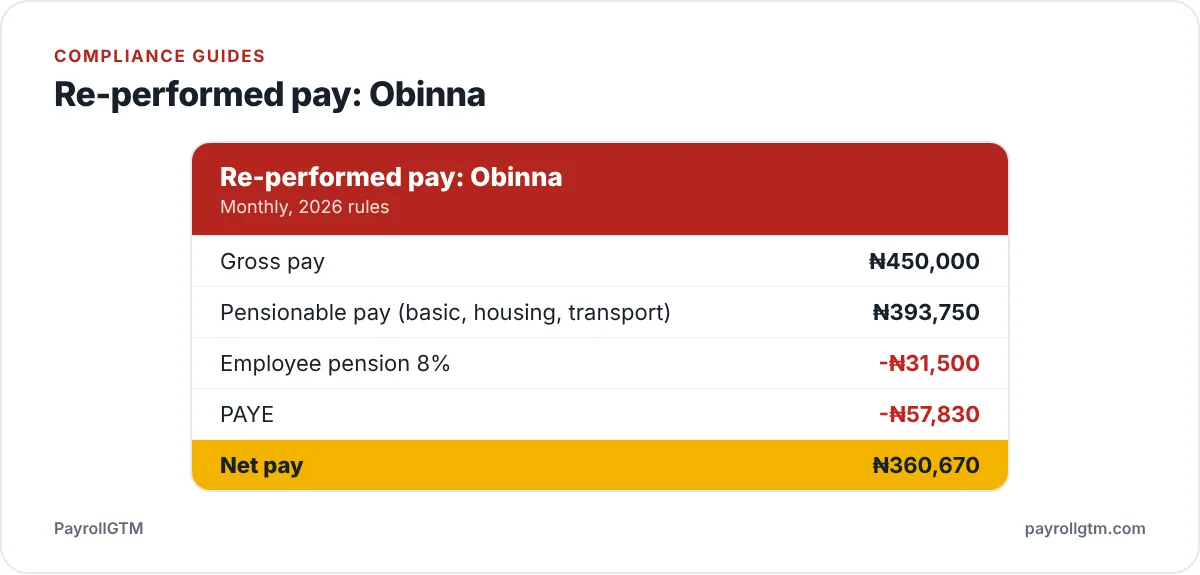
If the register shows pension of ₦36,000 (8% of the whole ₦450,000) and net pay of ₦356,170, the formula is using gross instead of the contract base. It is a ₦4,500 monthly difference for one person. If three sampled staff show the same pattern, check everyone, because the cause is a rule and not a one-off slip.
Rate and record what you find
For each issue, write down who and which months are affected, the amount and the cause. Rate it. High means money owed to employees or authorities, such as underpaid pension. Medium means a control gap likely to cause errors, such as one person preparing and approving. Low is housekeeping, such as file names. Fix underpayments first and pay the difference to the employee with a short explanation. For short statutory payments, work out the shortfall and ask the state IRS or PenCom how to regularise it. Document each correction with date, amount and approver. Records from this exercise also prepare you for an outside review: see how to prepare for a state IRS payroll audit.
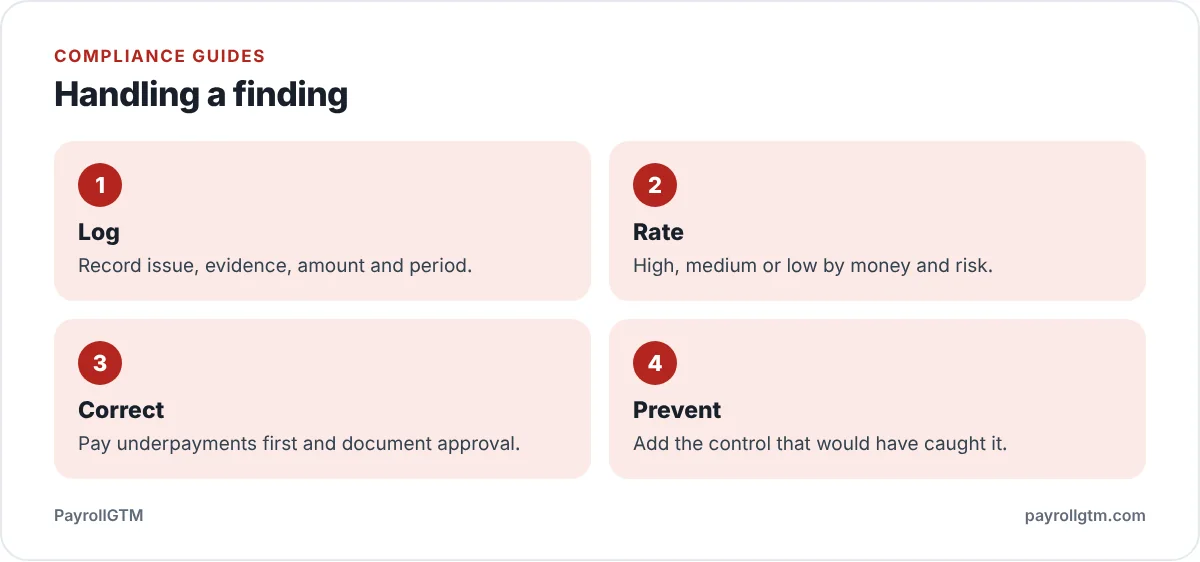
Ask for each finding what would have prevented it. A second reviewer on every pay run, a standard onboarding checklist and a monthly ledger reconciliation remove a large share of typical findings. As a last human test, ask three employees to explain their payslips. If they cannot, the problem may be communication and not arithmetic.