Outsource payroll when the cost of doing it badly, in late remittances, wrong deductions and the owner's time, is higher than the provider's fee, and when you are able to check what the provider does. You do not outsource the legal responsibility. The employer is still the party the state IRS, PenCom and NSITF come after, so a provider is a pair of hands that you must supervise, not a way of making the problem someone else's. This guide is about deciding, then about what to ask and what to put in the contract. We name no providers and quote no prices, because both vary and a price in an article goes out of date.
What a provider does and what stays with you
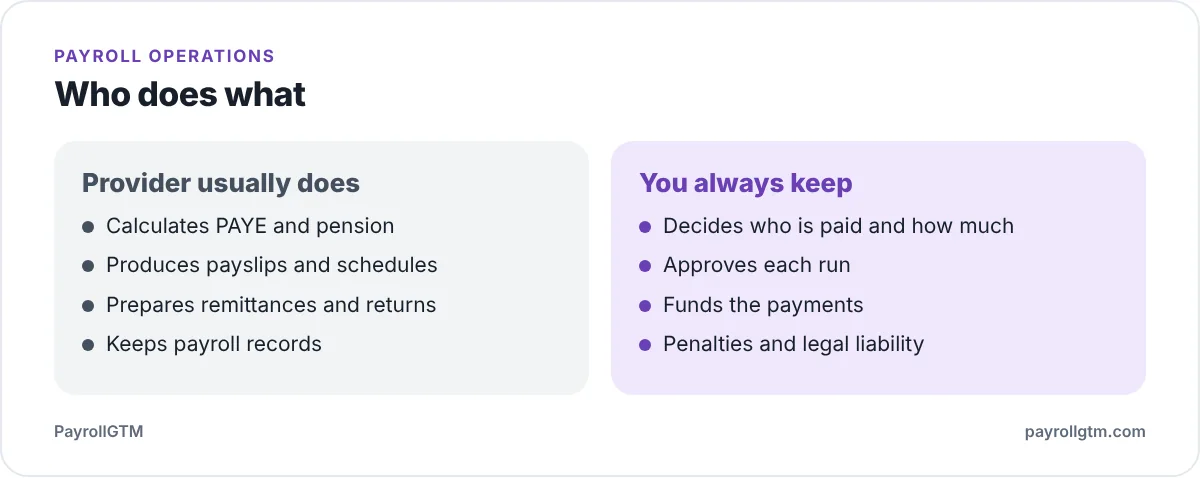
| Typically done by the provider | Always stays with you |
|---|---|
| Calculating gross to net, PAYE and pension | Deciding pay, allowances and who is an employee |
| Producing payslips and payment schedules | Approving each month's payroll before it is paid |
| Preparing remittance schedules, sometimes making the payments | Providing the money on time and checking proof of payment |
| Preparing the annual return (Form H1) and pension schedules | Penalties, interest and any assessment if something is late or wrong |
| Keeping payroll records | Your duty to keep records and to answer the state IRS |
The second column is the point. If a provider collects a month's PAYE from you and never pays it to the state IRS, the state looks for the tax from the employer. The reported penalty is 10% of the unremitted tax plus interest, so here at least ₦11,992 on one month's tax, plus the tax itself that you must now pay twice. Confirm current rates with your state IRS. It is the owner's name on the registration.
Break-even: when is it worth it?
There is no headcount at which outsourcing becomes obviously right. Work through these four tests instead.
- Time. Add up the hours a month spent on payroll by whoever does it: collecting changes, calculating, approving, paying, remitting, filing. Cost those hours at what that person's time is worth. Many founders find it takes more than they thought once pension, PAYE and NSITF are included.
- Errors. Look at the last six months. Late remittances, corrected payslips, staff queries and penalty letters are all cost. Two or three a year is normal for an overstretched owner. Persistent ones mean a process problem you may or may not solve by hiring someone.
- Complexity. Staff in several states, mixed currencies, many allowances, shift workers, frequent joiners and leavers all make the work harder. A fixed team of six on straight salaries is a different job from forty on variable pay.
- Knowledge. The tax law changed from 1 January 2026, and one person leaving can take all the knowledge with them. A provider offers continuity, if they actually keep up with the changes.
Obinna owns a distribution company in Onitsha with 14 staff. His accountant, Kemi, spends about two days a month on payroll, which is roughly 24 days a year. Suppose a day of her time is worth ₦60,000, which is our illustration and not a market figure. The internal cost is about ₦1,440,000 a year, before the cost of any mistakes. If a provider quotes less than that for the same scope, including evidence of remittance, and Kemi is freed for work that earns revenue, it is worth a serious look. If the quote is higher, the saving has to come from avoided penalties and risk, which is harder to prove. Run your own numbers the same way, and ask each provider for the same scope in writing so the comparison is fair.
When to keep it in-house
- Fewer than about five staff, one pay date, simple pay, and someone who is careful. A spreadsheet with a reviewer costs very little (payroll spreadsheet template).
- You are not ready to hand over messy records. Clean up first, or you will pay the provider to inherit the mess.
- The owner wants to understand payroll cost closely, for example in the first year (payroll compliance in the first year).
Moving to software rather than a service is a middle path, covered in payroll software versus spreadsheets.
Questions to ask a provider
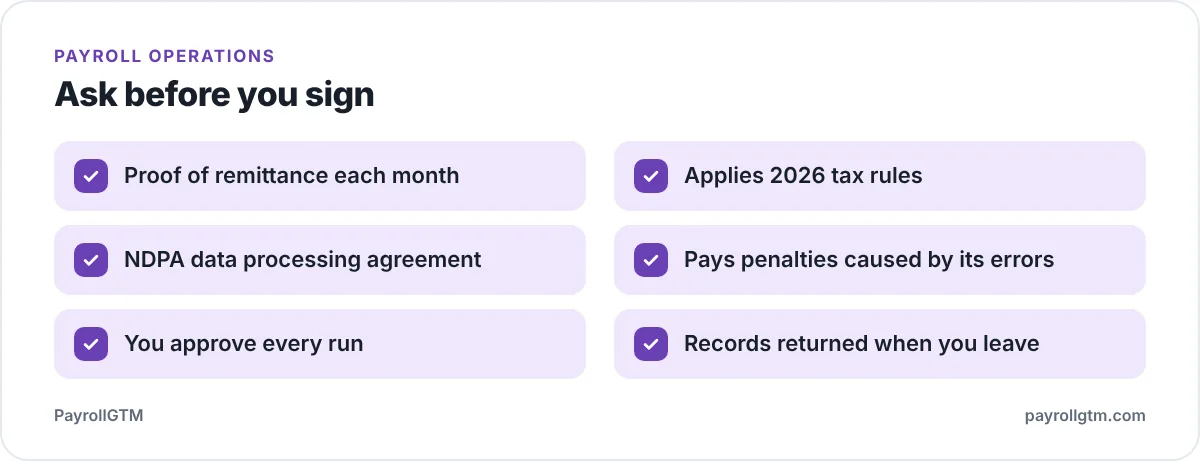
- Who actually pays the state IRS, PenCom and NSITF, and do you show proof every month? Ask for the receipt or payment confirmation, not a statement that it was done.
- Which tax rules do you apply, and when were they last updated? The Nigeria Tax Act 2025 bands took effect in 2026, and the old CRA no longer exists. A provider still deducting on the old basis is a warning. See the January 2026 changes.
- How do you protect employee data? Payroll data includes names, bank accounts, NINs and salaries, so the Nigeria Data Protection Act 2023 applies and the provider is usually a data processor acting for you. Ask where the data is stored, who can see it and whether there is a written data processing agreement.
- What happens when you make a mistake? Ask who pays penalties caused by the provider's error and whether they carry professional indemnity insurance.
- How do you handle corrections? They should be able to explain back pay and adjustments clearly (see back pay and salary corrections).
- What are your cut-off dates and who approves the payroll? You should approve every run before money moves.
- If we leave, what do we get and when? Payroll history, PAYE and pension records and employee data returned in a usable format, and old data deleted when you say so.
Points for the contract
- Scope in writing: which filings, which payments, which reports, and what is extra.
- Money flow: whether the provider ever holds your cash. If it does, insist on separate client accounts, and prefer the model where you pay the authorities directly from your own bank account.
- Deadlines tied to statutory dates: PAYE by the 10th of the next month, pension within 7 working days of paying salaries, Form H1 by 31 January.
- Liability and insurance clauses that cover provider errors.
- Data protection terms and a right to audit.
- Notice period, exit support and return of records.
The first three months after you hand over
Most outsourcing goes wrong in the handover, not in the steady state. A sensible start looks like this.
- Run one month in parallel. Keep your own calculation for the first cycle and compare it with the provider's line by line, for every employee. Differences in PAYE usually trace back to a wrongly entered rent relief, a pension base that leaves out housing or transport, or a staff member who joined mid-month.
- Hand over a clean staff file. Names as on the bank account, RSA PIN and PFA, Tax ID or NIN, the state each person lives in, start dates and the allowances in each contract. A provider can only be as accurate as the data you give it.
- Agree who sends what, and by when. Leave dates, new joiners, loans and overtime must reach the provider before the cut-off. Late changes are the commonest reason a provider's payroll is wrong, and the provider will rightly say the error was yours.
- Keep the authorities' records in your name. The state IRS employer registration, the NSITF and PenCom records and your bank mandate should stay with you. If the provider is the only one with the logins, you have lost control of your own compliance.
- Review at month three. Count late payments, corrections and unanswered queries. If the provider is not clearly better than your own record from the last six months, say so while the notice period is still short.
None of this is a legal requirement. It is what a careful employer does, and it also gives you evidence of reasonable care if a state IRS ever asks why a payment was missed.
Red flags
- They will not show remittance receipts, or say the money is "in process" for weeks.
- They ask you to pay them the PAYE and pension in one lump and promise to sort the rest out.
- They deny any liability for their own errors.
- No written contract, or fees that change monthly without explanation.
- They will not tell you where employee data is kept.