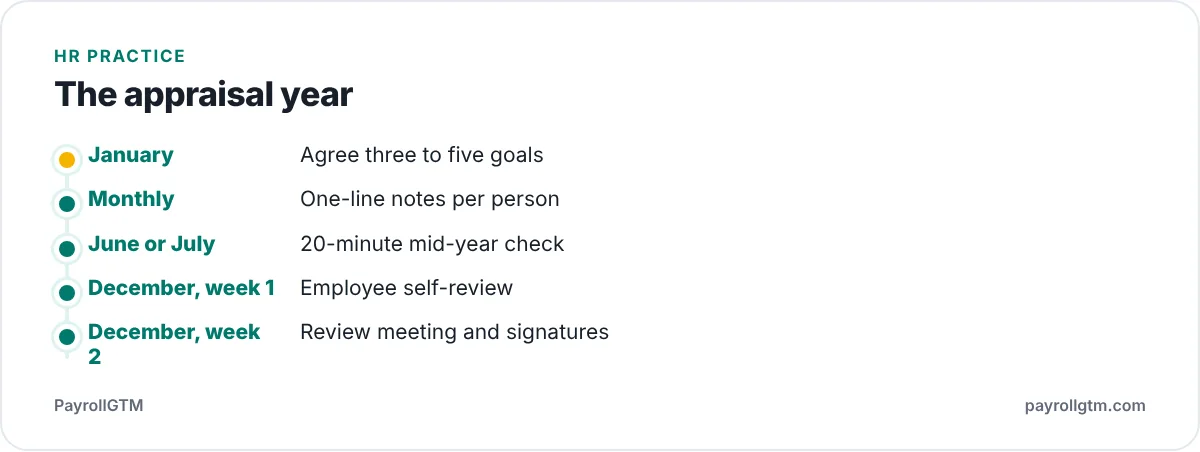
A small business can run a fair appraisal with one page per person, three conversations a year and a 1-to-5 scale that everyone has read in advance. You do not need software or a consultant. You need clear goals set at the start, written notes along the way, and a rule that the rating is never a surprise. This guide sets out the system step by step.
Step 1: Set three to five goals in January
Appraisals fail when the first time a person hears what "good" means is in the review. At the start of the year (or on joining, for a new hire after probation), write three to five goals with the employee. Each goal should be something you could check: "Close 30 new customer accounts", "Reduce delivery complaints to fewer than 5 a month", "Reconcile the bank statement by the 5th working day". Avoid "improve attitude" or "be proactive". Those cannot be measured and they invite arguments about personality.
Add one or two behaviours that matter in your business, such as punctuality, handling customers, or following safety rules. If you have a handbook, point to it; the workplace code of conduct and your attendance policy already define several of these. Both of you sign the page and keep a copy.
Step 2: Choose a simple 1-to-5 scale
Five points are enough. Write what each number means so that two managers would give the same person the same score.
| Score | Label | Meaning in plain words |
|---|---|---|
| 5 | Outstanding | Clearly beat the goal, and others learn from how they did it |
| 4 | Strong | Met the goal and sometimes exceeded it |
| 3 | Solid | Met the goal, with normal supervision |
| 2 | Needs improvement | Met some of the goal, with gaps that need a plan |
| 1 | Unsatisfactory | Did not meet the goal after clear instruction |
Most staff should be a 3 or a 4. If your list shows everyone at 5, the scale has stopped meaning anything, and the person who really is outstanding cannot be told apart.
Step 3: Keep notes through the year
The biggest source of unfair ratings is memory. Managers remember the last six weeks, and they remember the dramatic things. Keep a running note for each person, one line per event with a date: a client compliment in March, a late report in May, a stock count done unprompted in August. Five minutes a month is enough. Use these notes in the review, and keep them to what happened, not what you assumed.
Treat the notes as personal data. Under the Nigeria Data Protection Act 2023, keep them in a place only the manager and HR can open, and do not share one person's file with another employee.
Step 4: Hold a short mid-year check
In June or July, spend 20 minutes per person. Look at each goal: on track, behind or changed? Adjust goals if the business has changed, for example when a product line was dropped. Write two lines of notes and give a copy. If someone is heading for a 2, this is when they should hear it, not in December. A mid-year check also gives you evidence that you raised it early.
Step 5: Do the year-end review
- Ask the employee to fill in a self-review a week ahead: what went well, what did not and what they want next year.
- The manager scores each goal with an example from the notes, then gives an overall score.
- Meet for 45 minutes. Start with the employee's view, then yours. Agree the score or note the disagreement in writing.
- Agree two or three goals and one development item (a course, a task, a mentor) for next year.
- Both sign. Give the employee a copy and file one.
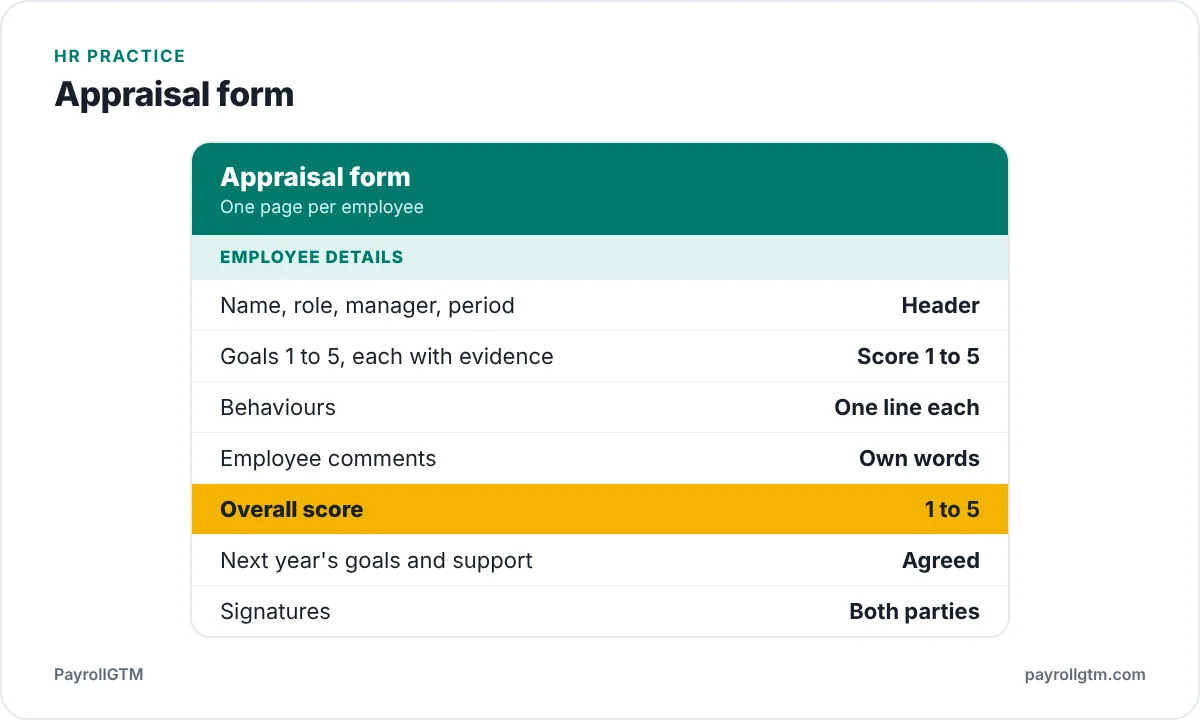
A one-page form can use this layout:
| Section | What goes in it |
|---|---|
| Header | Name, role, manager, review period |
| Goals and scores | Each goal, evidence, score 1 to 5 |
| Behaviours | Punctuality, teamwork, customer handling, one line each |
| Employee comments | Their view in their own words |
| Overall score | One number and one sentence of reason |
| Next year | Goals, training, support promised |
| Signatures and date | Employee, manager, HR or owner |
What the scoring looks like in practice
Take Ibrahim, a stores officer in a Kano distribution business. One goal was "reconcile stock counts to the system by the 5th working day, with fewer than 3 unexplained variances a month". His manager's notes show he hit the deadline in 9 of 12 months and had more than 3 variances only in March and April, when a new supplier delivered unlabelled cartons. That goal scores a 3: met, with normal supervision, and the notes explain the dip. Had he missed the deadline in 6 months and given no reason, it would be a 2.
His behaviour line shows two late arrivals in August during a transport strike, which the attendance policy already excuses. It is left out of the score. The point is that every number on the form can be traced to a dated note, so when he asks "why not a 4?", the manager has an answer that is not an opinion.
Linking appraisal to pay without making promises
Many owners tie the review to the salary round, and many staff expect it. Say in writing what the link is: "A rating of 3 or above makes an employee eligible for consideration in the annual pay review. Pay changes depend on company performance and are not guaranteed." Do not promise a percentage in the review meeting. If the business has a bad year, a promised raise becomes a broken promise and a morale problem. If a raise is agreed, confirm it in a letter that updates the pay structure; changes to basic, housing and transport also change the pension and PAYE figures, which the payroll run must pick up.
Also keep appraisal separate from discipline. A review is for development. A formal query or warning follows its own steps; see the disciplinary procedure and fair hearing and the query and warning letter templates.
What to do about a poor rating
A 1 or 2 should never be a first warning. If you have followed Steps 1 to 4, the employee already knows. Write a short improvement plan for 60 or 90 days: the specific problem, what good looks like, what support you will give, how often you will check, and the date of the next review. Keep each check-in note. If performance improves, say so in writing. If it does not, you have a record that you gave clear targets and time, which matters if the matter later goes to the National Industrial Court. Dismissal for poor performance has its own legal risks, and a lawyer should look at the contract and handbook first. The notice rules sit in termination notice and severance.
Bias traps to watch for
- Recency. The last month outweighs the first eleven. Use the notes.
- Likeness. People who share your background, church, school or football team are rated higher. Compare the evidence, not the chemistry.
- Visibility. The person who talks in meetings looks better than the one who quietly closes the books. Score the output.
- Leniency. Everyone gets a 4 to avoid conflict. Then nobody can use the rating.
- Absence. Do not lower a score because of approved maternity leave, sick leave or other protected absence. The employee did not choose it, and the Labour Act gives rights to it.
If you employ staff in more than one place or work remotely, see how a remote and hybrid work policy sets expectations you can then appraise. The review process belongs in your employee handbook, so everybody sees the rules before they are used.