Kemi runs a three-chair hair salon in Surulere and has been doing the books, the ordering and the Saturday rush herself for four years. On a Sunday night she decides to hire a receptionist and bookkeeper at ₦150,000 a month. She has a WhatsApp group of friends who "know someone". She has no job description, no interview plan and no idea what the hire will cost beyond the salary. This is where most first hires go wrong: not on the day they start, but in the two weeks before, when the owner is tired and in a hurry. What follows is the process that would have saved Kemi from a bad hire and a legal headache.
Write the role before the advert
Put on one page the five or six things this person must do, the hours, where they work, who they report to, and what a good first three months looks like. If you cannot write that page, you are not ready to advertise. Then decide pay: the gross monthly figure and how it breaks into basic, housing and transport, because pension is calculated on at least those three. How to structure basic, housing and transport pay shows why the split matters.
Writing an honest advert
Put a salary range or a fixed figure in the advert. Candidates who see no figure assume it is low, and you waste a week interviewing people who needed double. Say what the job is, the location (Surulere is a different commute from Ikeja), the hours, and whether you pay overtime. State the minimum experience you really need, not a wish list; a receptionist role does not require "five years' experience in a multinational".
Do not write adverts that exclude people for reasons unrelated to the work: age brackets, "must be single", a required state of origin, religion, or looks. Nigerian law gives you wide room to hire the person you want, but advertising that way invites complaints and rules out good candidates. Describe what the job needs: lifting, standing for long periods, a driving licence, a language. If you are considering a corps member, see employing NYSC corps members first, because the process differs.
Shortlist with one page, not a feeling
Score each CV against the requirements you wrote. Pick the top five or six, and send each a short message with the interview date, address, expected duration, and what to bring (ID, certificates). Ask for a phone call to confirm. Do not collect more personal data than you need at this stage. Whatever you do collect must be handled carefully under the Nigeria Data Protection Act 2023, which is covered in reference and background checks.
A structured interview: five questions to ask, three to avoid
Ask every candidate the same questions in the same order, and score each answer from 1 to 5. It feels stiff, but it is the best defence against choosing the person you simply like.
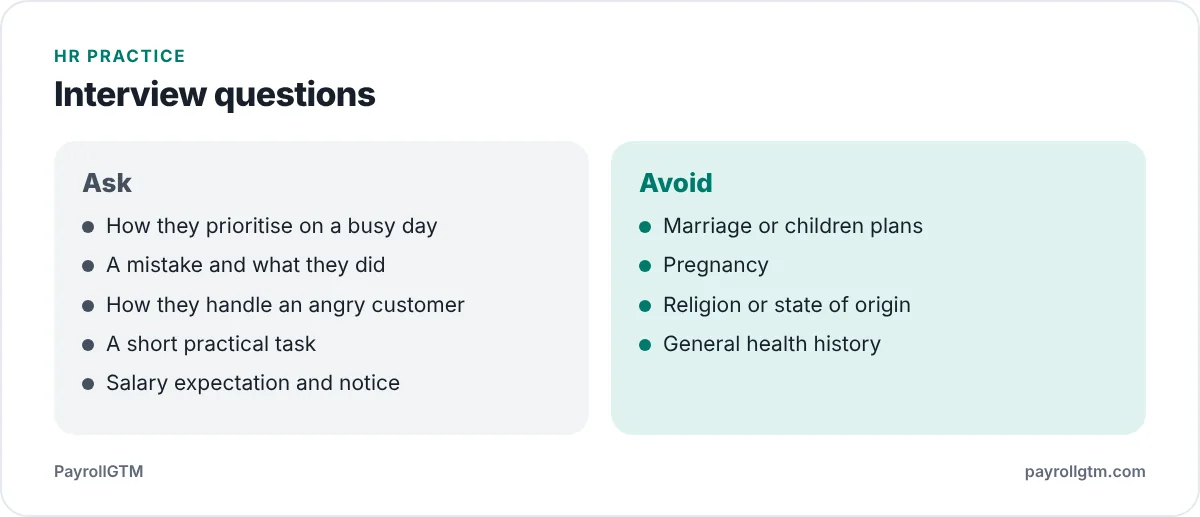
Ask:
- "Tell me about a busy day in your last job and how you decided what to do first."
- "Describe a mistake you made at work and what you did about it."
- "A customer is angry about a bill. Walk me through what you would say."
- "Which tools have you used for records: Excel, a point-of-sale system, a notebook? Show me how you would record this day's sales." (A five-minute practical test beats an hour of talk.)
- "What salary are you expecting, and what notice do you owe your current employer?"
Avoid:
- Marital status, plans for marriage or children, or pregnancy. These answers say nothing about performance and are the commonest source of unfair treatment of women.
- Religion, ethnic group or state of origin, unless a genuine, lawful requirement of the role exists and you have taken advice.
- Questions about health history in general. Ask instead whether the person can perform the duties of the job, with or without adjustment.
Where to find candidates. Referrals from people you trust work, but test the person, not the introducer. A post on your own social pages and a note at a nearby training school or polytechnic often draws better applicants than a paid listing. Whichever route, send every applicant the same application steps and keep a simple log of who applied, when, and what you decided, so a rejected candidate's query can be answered fairly.
Check references before you offer
Call two referees, ideally a former manager, and ask the same short questions: dates of employment, the role, strengths, and whether they would rehire. Get the candidate's consent first. If the role involves cash or stock, consider a guarantor form, but check what you can lawfully ask for and keep guarantor details secure. The legal side of references and background checks is in the guide linked above; use it, not a copied form.
What the hire will actually cost
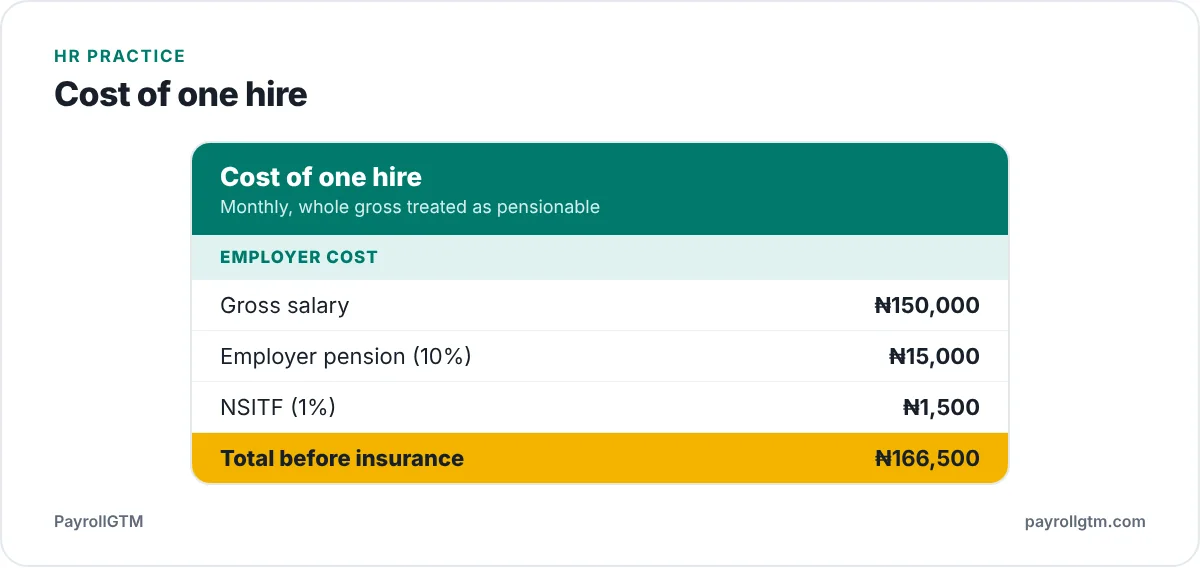
The ₦150,000 is not the whole bill. Treating the whole figure as made up of basic, housing and transport, here is what Kemi pays in the first month using the site's PAYE logic.
Employee pension at 8%: ₦12,000. PAYE: ₦10,700. Net pay to the employee: ₦127,300.
Employer pension at 10%: ₦15,000. NSITF at 1% of payroll: ₦1,500.
Cost to the business before insurance: ₦150,000 + ₦15,000 + ₦1,500 = ₦166,500 a month.
Add the group life premium (at least three times annual total emolument in cover, premium paid by the employer) and any health plan; ask an insurer or HMO for a quote because we cannot state one. ITF does not apply yet at one employee, since it starts at 5 employees or ₦50 million turnover.
Run your own figures in the employer cost calculator. The compulsory pension rules apply once you have 3 or more employees, so with one hire you are not yet bound, but we cost it in because a first hire often becomes the first of three, and offering a pension from day one avoids a messy change later. Registrations you will need before the first payday are in the employer registration checklist and how employers register for PAYE.
Decide on probation before you sign
A probation period lets both sides test the fit, but it is a term of the contract and not an automatic right, so it must be written down with its length, what is assessed and how it ends. The notice floor under the Labour Act for someone employed less than three months is one day, but do not treat probation as permission to dismiss unfairly or to skip pension and PAYE; both apply from the first salary. The rules and a sample confirmation process are in probation periods in Nigeria. Give feedback at the halfway point, in writing, so the final decision is no surprise to the employee.
Make the offer and start properly
Send a written offer stating the job title, start date, pay and its components, hours, probation, notice and leave. A template is in the job offer letter template. Give the new hire written terms within three months of starting as the Labour Act requires (s.7); doing it before day one is better. Ask for the RSA PIN or help the person open one; how to open an RSA and get a PIN explains the steps. If the person starts mid-month, pay for the part month using the proration method. Then follow the onboarding checklist for the first week.
Back to Kemi
She wrote the one-page role, put "₦150,000 gross, Monday to Saturday 8 to 5" in her advert, and interviewed five people with the same five questions. The third candidate, Yetunde, scored highest and did the practical test cleanly. Her referee confirmed the dates. Kemi's all-in monthly cost came to ₦166,500 before insurance, which she had budgeted. Six months later she was glad she had not hired her cousin's friend on a handshake.