A Nigerian employer can ask an employee not to work for a competitor or share business secrets after leaving, but only a reasonable restriction is likely to hold. Courts treat a clause that stops someone earning a living with suspicion, so a non-compete must protect a real business interest and be limited in time, area and scope. A confidentiality clause is much easier to defend. We do not cite cases here, and the law on restraint of trade is judge-made and fact-heavy, so have a lawyer review any clause you intend to rely on. What follows is how to choose between the clauses and draft them so they have a chance.
Three clauses, three different jobs
Employers lump these together as "the restrictive covenants" and then wonder why the clause fails. They protect different things, and the risk of enforcement differs.
| Clause | What it protects | How defensible |
|---|---|---|
| Confidentiality | Trade secrets, pricing, client lists, source code, internal figures | Strongest, because it limits use of information, not the person's work |
| Non-solicitation of clients or staff | Your relationships with named clients and your team | Moderate, if tied to clients the person actually dealt with and to a short period |
| Non-compete | The risk of a former employee setting up against you | Weakest, and hardest where the clause is wide or the employee is junior |
Start from the least restrictive clause that solves your problem. If you fear a leaver taking your client list, a non-solicit plus a confidentiality clause may do the work of a non-compete without its risk.
When a non-compete is worth including
Ask three questions about the specific role, not the company.
- What can this person take that hurts us? A sales director who holds every key client relationship, or an engineer who has seen the whole product, is a real case. A cashier or a driver is not.
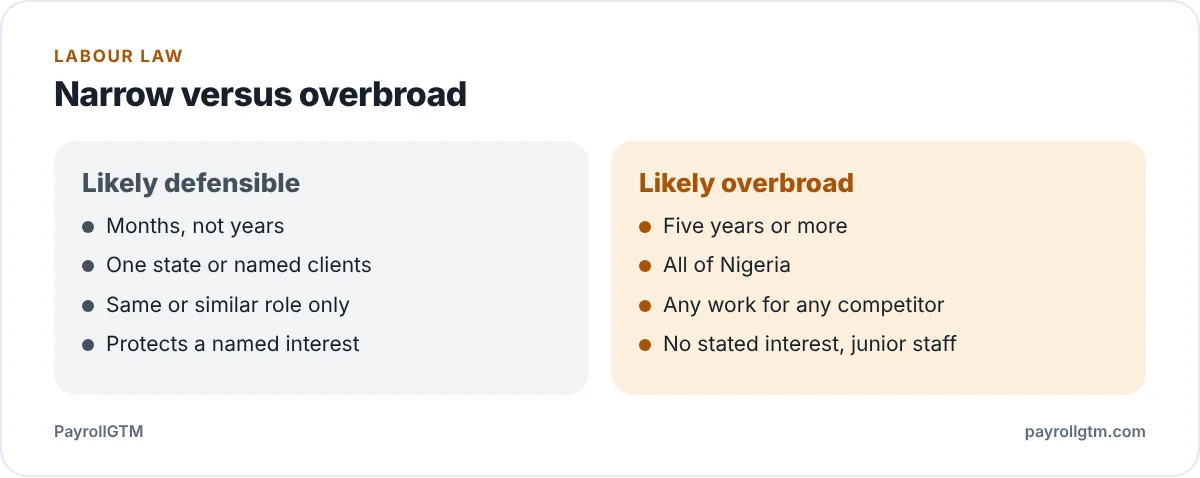
- Is the restriction no wider than that interest? Time, geography and activity should each be as narrow as the business can tolerate. "Anywhere in Nigeria for five years from any competing business" protects too much and a court is unlikely to enforce it.
- Is the employee paid or otherwise rewarded for the restriction? A senior hire with a good package is easier to bind than a junior on near-minimum pay, and the contract should say what the clause is part of.
If the answer to the first question is "nothing much", leave the non-compete out. A clause you cannot enforce still scares nobody who has taken advice, and it makes the rest of the contract look careless.
Sample wording you can adapt
These are starting points to take to your lawyer, not clauses guaranteed to hold. The periods in square brackets are illustrations, not legal standards.
Confidentiality
The Employee shall not, during employment or at any time after it ends, use or disclose any Confidential Information except as needed to do the job or as required by law. "Confidential Information" means non-public information about the Company's clients, pricing, finances, systems, methods and plans, and any information marked or reasonably understood to be confidential. It does not include information that is public other than through the Employee's breach. On leaving, the Employee shall return all documents, devices and data belonging to the Company and delete any copies held on personal devices or accounts.
Non-solicitation
For [six] months after employment ends, the Employee shall not, directly or indirectly, solicit or accept business from any client with whom the Employee dealt in the [twelve] months before leaving, in a way that competes with the Company, and shall not encourage any employee to leave the Company.
Narrow non-compete
For [six] months after employment ends, the Employee shall not take up a role in [Lagos State] with a business that sells [describe the specific product or service] in competition with the Company, where the role is the same as or similar to the Employee's role with the Company. The Company considers this restriction reasonable and necessary to protect its client relationships and confidential information.
Notice how the third clause names a product, a place, a time and a type of role. Specific is defensible. "Any business similar to the Company's" is not.
Notice periods and garden leave
A longer notice period is sometimes a better answer than a long post-employment restraint. The Labour Act sets only minimum notice (1 month for staff with 5 or more years' service), and a contract can require longer from the employee, which is how senior hires often end up on two or three months. The detail is in how to resign in Nigeria. A garden leave clause lets the employer keep the person on payroll during notice while telling them to stay away from work, clients and systems. That protects you while the information ages. It must be in the contract, the person must still be paid in full, and you should not use it to push someone out.
During any notice period the Company may require the Employee not to attend work, not to contact clients or colleagues about Company business, and to remain available to answer queries. Salary and benefits continue throughout.
Kemi manages key accounts at a Lagos printing firm. Her contract has a three-month notice period, a confidentiality clause and a six-month non-solicit limited to clients she handled. She resigns to join a rival. The owner puts her on garden leave for the notice period, pays her in full, collects her laptop and phone and reminds her in writing of the clauses. Nothing in that plan stops her from working in print. It protects the client list while her relationships go quiet, and it is the kind of limited, documented restriction a lawyer can defend.
Data protection overlaps
Client lists and staff records are personal data, and the Nigeria Data Protection Act 2023 regulates how an employee uses and keeps them. A leaver who emails the client database to a private account has potentially breached your confidentiality clause and your data protection duties, and you may have to assess whether the incident needs to be reported to the Nigeria Data Protection Commission. Check the current notification rules with the NDPC. Employee data protection under the NDPA covers what employers must secure, and a short access policy (who can see which files, and for how long after leaving) is as useful as the clause.
Who the clause can realistically bind
Whether the Labour Act covers a given manager or professional affects how the contract is read, as explained in managers, professionals and the Labour Act, and the same facts shape how a court thinks about a restraint. Fixed-term and casual staff can be bound by confidentiality, but a non-compete for a casual worker is hard to justify (see casual, fixed-term and permanent employees).
Practical rules for putting the clauses in place:
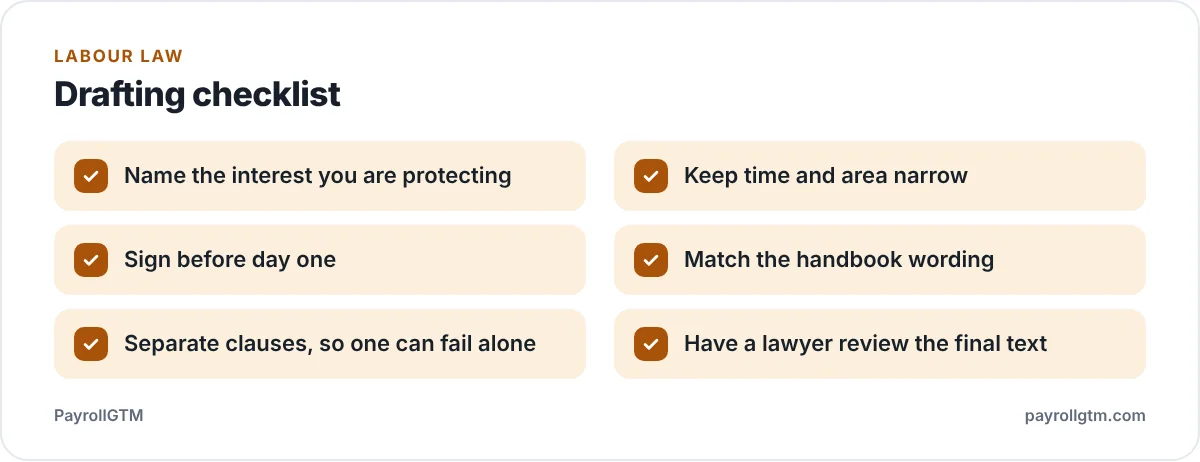
- Put the clause in the contract the employee signs before day one. Adding it later, with no new benefit for the employee, invites the argument that it was never agreed.
- Do not hide it. Point to it during hiring, and cross-refer it from the employee handbook so that what they signed and what they were told match.
- Draft each clause so that if a court strikes one part, the others remain. Your lawyer will know how to word it.
- Check what an employment contract should contain alongside these clauses, because they sit beside notice, pay and termination terms.
An overbroad non-compete cannot achieve what you want, and the damage is that you will have an empty threat and a worse relationship with the person leaving. Keep it narrow, explain it to the person, and rely on confidentiality for the bulk of your protection.