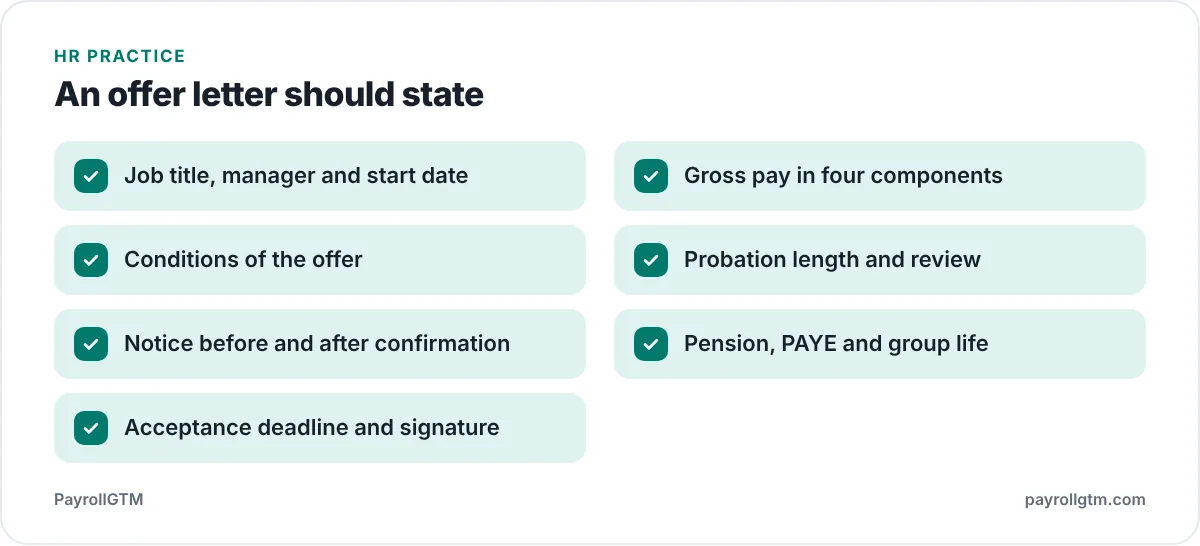
A good offer letter in Nigeria does five jobs: it names the role and start date, states pay as a gross figure broken into basic, housing, transport and other allowances, sets the conditions the offer depends on, tells the candidate about probation, notice, pension and tax, and gives them a place to accept. A sample you can copy is below, followed by the reasons behind each clause and the mistakes that cause disputes.
It is not a full employment contract. It is the document that tells a candidate what they are saying yes to, and for many small employers it ends up being the only document, so it needs to be accurate.
Offer letter or contract?
An offer letter makes the proposal, and a contract records the terms in full. If your business is small, the offer letter can be extended to serve as the contract, provided it carries every term the candidate needs and both sides sign it. The Labour Act (s.7) expects the employer to give a written statement of terms within 3 months of the person starting, so a signed offer that covers the particulars handles that requirement on day one. If you use a separate contract, the offer should say that it will follow and that the offer terms stand until then. The full list of contract clauses is in what an employment contract should contain.
The sample letter
Copy this into a letterhead and replace everything in square brackets. Delete clauses that do not apply to you rather than leaving them blank.
[Company name]
[Address]
[Date]Dear [Candidate name],
Offer of employment: [Job title]
We are pleased to offer you the position of [Job title] in the [Department] at [Company name], reporting to [Manager's title]. Your employment will start on [Start date] and your place of work will be [Location].
1. Pay. Your gross monthly pay will be ₦[Gross], made up of: basic salary ₦[Basic]; housing allowance ₦[Housing]; transport allowance ₦[Transport]; and [other allowance name] ₦[Other]. These figures are before pension and PAYE. Salary is paid by bank transfer on or before the [28th] of each month.
2. Statutory deductions and contributions. We will deduct PAYE and pass it to your state Internal Revenue Service. Under the Pension Reform Act 2014 we will pay a pension contribution of 10% of your basic, housing and transport allowances, and deduct 8% from your pay, into the Retirement Savings Account of the pension fund administrator you choose. Please send your RSA PIN, or tell us if you need to open an account, before your first payday. [We also provide group life insurance as required by law.]
3. Probation. The first [3] months are a probationary period. We will review your performance in writing before the end of that period and tell you in writing if you are confirmed, extended or not confirmed. During probation either of us may end the employment by giving [1 week's] written notice.
4. Notice after confirmation. After confirmation, either of us may end the employment by giving [one month's] written notice or payment of salary in lieu of notice, in line with your contract and the minimum notice set by the Labour Act.
5. Hours and leave. Your normal working hours are [hours and days]. You are entitled to [number] working days of paid annual leave after 12 months of continuous service, and sick leave as set out in the staff handbook.
6. Conditions of this offer. This offer depends on: (a) satisfactory references from [number] referees; (b) [verification of your certificates]; (c) proof of your right to work in Nigeria and a valid ID; and (d) [a medical examination by a doctor we nominate, where the role needs it]. We will handle all your personal information in line with the Nigeria Data Protection Act 2023.
7. Other terms. You agree to keep our confidential information confidential. A full contract of employment and our staff handbook will be given to you [on your first day].
Please sign and return a copy of this letter by [Date] to confirm that you accept. This offer lapses if we do not hear from you by that date.
Yours sincerely,
[Name], [Title], for [Company name]Acceptance: I, [Candidate name], accept this offer on the terms above and will start on [Start date].
Signature: ____________ Date: ____________
Why each clause is there
- Gross, not net. A candidate who hears "₦300,000" may think that is the money that lands in their account. State that all figures are gross, as in the sample, and say what the usual deductions are. If a candidate negotiates on a net figure, convert it first with the net-to-gross method.
- The breakdown. Basic, housing and transport set the pension base. Putting them in the letter avoids the later argument about what 10% was calculated on. How to split a salary into basic, housing and transport explains the effect.
- Conditions. Anything you may later rely on to withdraw the offer, such as references or certificate checks, must be written in it. See reference and background checks and the NDPA. Health information is sensitive personal data, so ask for a medical check only where the job truly requires it.
- Probation and notice. The Labour Act sets minimum notice: 1 day if the person has worked under 3 months, 1 week for 3 months to under 2 years, 2 weeks for 2 to under 5 years and 1 month for 5 years or more. Your letter may give longer notice but not less. Our guide to probation periods and confirmation covers how to run the review.
- Pension and group life. The Pension Reform Act applies to employers with 3 or more employees, and the employer must hold group life insurance of at least 3 times annual total emolument. Mentioning both removes surprises.
A worked pay breakdown to adapt
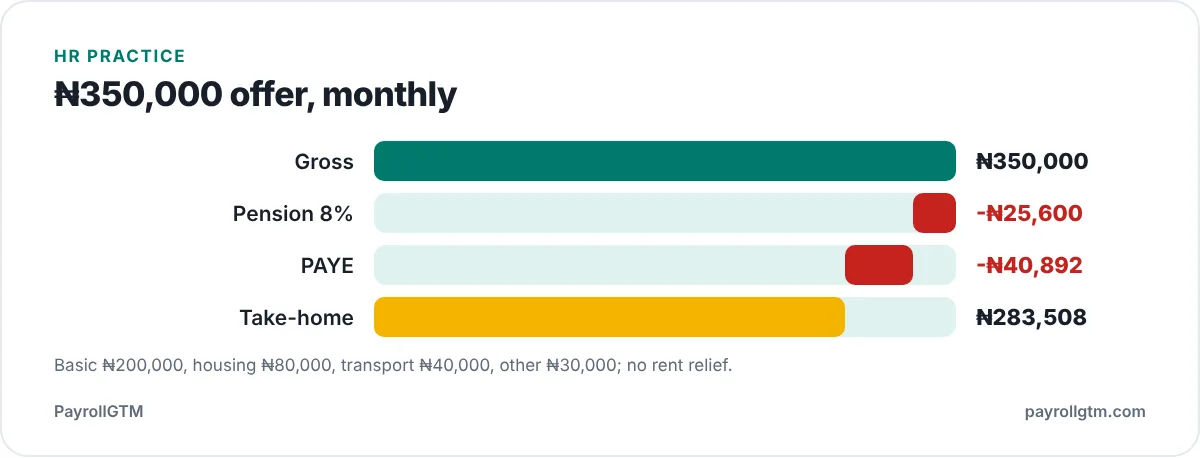
Suppose you offer Bola a gross of ₦350,000 a month, split ₦200,000 basic, ₦80,000 housing, ₦40,000 transport and ₦30,000 for other allowances. Pensionable pay is ₦320,000, so her deduction is 8% = ₦25,600 and the employer adds 10% = ₦32,000. PAYE at the 2026 bands is ₦40,892 a month and her take-home is ₦283,508 before any rent relief. If she has ₦1,200,000 in annual rent with evidence, PAYE falls to ₦37,292 and take-home rises to ₦287,108.
You can give the first figure as an illustration, with the words "this will vary with your personal circumstances", but do not promise the net. Our payroll calculator reproduces the numbers, and the figures come from the same method as in the PAYE guide.
Mistakes that cost employers money
- Quoting a net figure without conversion. If you offer "₦250,000 take-home" and the gross needed is higher, the business pays the difference every month.
- Leaving out the start date or the acceptance deadline. A letter that never lapses can be accepted a year later.
- Promising a probation outcome. Say the employment will be confirmed "subject to satisfactory performance" and nothing more.
- Making the offer before approval. Get the budget signed off first. Withdrawing an accepted offer can cost you the candidate's notice period at their current job and a damaged reputation.
- Skipping the checks that follow. The letter should be paired with a start-of-job process, such as the one in hiring your first employees.
If the candidate is a graduate on national service, a different arrangement applies and the employer rules are in the NYSC corps member guide. For leave days to state in section 5, see the leave policy template.
Have a Nigerian employment lawyer read your version once. After that, the template is reusable for every hire.